
Breakfast stopped being just a meal for me about three years ago. I was grabbing bagels, skipping meals entirely, doing whatever was fastest.
Then I started paying attention to what high-performers were actually eating in the morning, and more importantly, why they were eating it.
These people had turned breakfast into a strategic tool. They were using it to set their energy levels, sharpen their focus, and improve their metabolism for the entire day ahead.
The research backed up what they were doing intuitively, and when I started applying these principles myself, the results were impossible to ignore.
🥑 Build Your Biohacker Breakfast
Design your optimal morning meal for energy, focus, and longevity
Select your primary protein foundation
Choose healthy fats for satiety and brain function
Supercharge with mineral-rich additions
When and how you eat matters
Your Personalized Breakfast Blueprint
Optimized for your biohacking goals
The Foundation: Why Breakfast Became a Biohacking Priority
Your body operates on predictable biological rhythms. Breakfast allows you to work with those rhythms instead of fighting against them.
The science starts with circadian biology. Your insulin sensitivity peaks in the morning, which means your body processes nutrients more efficiently early in the day.
Your cortisol naturally rises around waking time, preparing your body to receive energy.
Your brain’s neurotransmitter production depends heavily on the amino acids you consume in those first few hours after waking.
Conventional breakfast advice tells you to eat something, anything, don’t skip it. That advice leaves massive performance gains on the table.
The macronutrient composition matters tremendously.
The timing matters. The consistency matters.
And perhaps most surprisingly, the quality of your sleep the night before determines how effectively your body can even use whatever you eat for breakfast.
I’ve tracked this extensively in my own data. On nights when my resting heart rate remains elevated, indicating poor sleep quality, even my perfectly optimized breakfast fails to deliver the same cognitive clarity.
The food stays identical, but the metabolic context changes completely.
This is why serious biohackers obsess over sleep metrics before they worry about advanced breakfast supplements.
The practical applications follow straightforward principles once you understand the underlying mechanisms. You’re aiming to stabilize blood sugar, preventing the mid-morning crash.
You’re providing sustained energy through fat oxidation as opposed to glucose spikes.
You’re delivering complete amino acid profiles for neurotransmitter synthesis. You’re reinforcing your circadian rhythm through consistent meal timing.
The challenge most people face is that this approach needs preparation. You can’t improve breakfast if you’re making decisions at 6:30 AM when you’re already running late.
The biohackers who succeed with this approach do their planning and prep the night before.
They know exactly what they’re eating and when, which removes decision fatigue from the equation entirely.
Protein: The Non-Negotiable Foundation
If your breakfast doesn’t contain at least 25-30 grams of high-quality protein, you’re fundamentally not optimizing. I spent months trying to make lower-protein breakfasts work because I preferred them, and I kept running into the same wall: inconsistent energy and declining afternoon focus.
The science here is solid. Protein triggers satiety hormones more effectively than carbohydrates or fats.
It provides the amino acid building blocks for dopamine and serotonin production.
It stabilizes blood glucose by slowing carbohydrate absorption. It preserves lean muscle mass, which becomes increasingly critical as you age.
Different biohackers source their protein differently. The animal-based camp swears by pasture-raised eggs, which deliver protein, choline for brain health, and complete amino acid profiles.
I’ve watched people make three-egg omelets with vegetables as a daily ritual, and their energy consistency throughout the morning is noticeably different from people eating carb-heavy breakfasts.
Then there’s the Greek yogurt approach. Plain, full-fat Greek yogurt delivers around 20 grams of protein per cup, plus probiotics that support gut health.
The gut-brain connection is something biohackers take seriously, and starting the day with probiotic-rich foods has become a common strategy.
I personally rotate between eggs and Greek yogurt depending on my schedule, and I’ve found that the yogurt approach is faster when I’m pressed for time.
The plant-based biohackers have had to get more creative. Tofu scrambles with turmeric and black pepper, which enhances curcumin absorption, have become surprisingly popular.
Smoothies built around hemp seeds, chia seeds, and plant-based protein powders can easily hit 30 grams of protein if you’re strategic about portions.
The key challenge with plant proteins is ensuring you’re getting complete amino acid profiles, which usually means combining many sources.
One pattern I’ve noticed across all successful biohacker breakfasts is the collagen addition. Professional protocols like Bryan Johnson’s include 20-30 grams of collagen daily, often split between morning drinks and breakfast.
Collagen provides glycine and proline, which support gut lining integrity, joint health, and skin elasticity.
While collagen lacks tryptophan and doesn’t qualify as a complete protein, it complements other protein sources really effectively.
The implementation mistake I see most often is people underestimating how much protein they’re actually consuming. Two eggs are only about 12 grams.
A single tablespoon of nut butter is maybe 4 grams.
You have to be deliberate about hitting those 25-30 gram targets, which usually means tracking your intake for at least a few weeks until you develop intuition for portion sizes.
Strategic Fat Integration: Beyond Bulletproof Coffee
The bulletproof coffee phenomenon introduced a lot of people to the concept of adding fats to breakfast, but most implementations miss the deeper strategy. Blending grass-fed butter or ghee into your coffee creates a creamy texture and slows caffeine absorption.
But the real benefit is how it shifts your metabolism toward fat oxidation for sustained energy.
I’ve learned from experimenting with different fat sources that MCT oil, medium-chain triglycerides derived from coconut oil, bypasses normal fat digestion and goes directly to your liver, where it converts to ketones. Those ketones cross the blood-brain barrier and provide immediate fuel for your brain. The cognitive clarity is noticeable, especially in the first 90 minutes after consumption.
MCT oil isn’t the only player, though. Extra virgin olive oil, which appears in Bryan Johnson’s protocol, contains oleocanthal, a compound with anti-inflammatory properties similar to ibuprofen.
A tablespoon of quality olive oil with breakfast provides polyphenols that support cardiovascular health and metabolic function.
I’ve started drizzling it over my eggs, and the satiety it provides is honestly impressive.
Nut butters offer a different fat profile that includes vitamin E, magnesium, and fiber. The combination of fat and fiber is particularly effective for blood sugar stability.
I’ve found that a tablespoon of almond butter on whole-grain toast keeps me satisfied longer than almost any other breakfast component.
The theoretical mechanism is straightforward. Fats slow gastric emptying, which means the contents of your stomach release into your small intestine gradually as opposed to all at once.
This prevents the glucose spike you’d get from eating carbohydrates alone.
Your insulin response stays moderate, your blood sugar stays stable, and you avoid the reactive hypoglycemia that causes mid-morning crashes.
Fat intake at breakfast influences your appetite regulation throughout the entire day. I’ve tracked this extensively with continuous glucose monitoring, and the data is clear.
Breakfasts with adequate healthy fats, around 15-20 grams, correlate with lower total calorie intake and fewer cravings later in the day.
The satiety signal is that strong.
The implementation challenge is that adding fats increases calorie density quickly. A tablespoon of any oil is around 120 calories.
If you’re also eating protein and some carbohydrates, you can easily end up with a 600-700 calorie breakfast.
For some biohackers, that’s intentional because they’re eating fewer, larger meals. For others, it means adjusting portion sizes elsewhere to maintain their target calorie range.
Micronutrient Completeness: The Overlooked Foundation
This is where I see the biggest gap between casual health enthusiasts and serious biohackers. Most people focus on macronutrients and completely overlook the micronutrient density of their breakfast.
You can have perfect macros and still underperform if you’re deficient in key vitamins and minerals.
The research from BIOGENA on supplement hierarchies really clarified this for me. Before you ever consider advanced options like NMN or PQQ, you need to confirm foundational micronutrient sufficiency.
That means vitamin D, magnesium, omega-3 fatty acids, and CoQ10 as baseline requirements.
Only after establishing that foundation does advanced supplementation yield meaningful returns.
I started paying attention to this after noticing that my energy levels varied significantly, even when my macronutrient intake was consistent. When I began tracking my mineral intake specifically, patterns emerged. On days when I consumed adequate magnesium through foods like pumpkin seeds, spinach, or supplementation, my sleep quality improved, which then influenced how effectively I processed my next morning’s breakfast.
The interconnections are really complex.
Zinc is another critical mineral that most people consume in suboptimal amounts. Oysters are the most concentrated source, but they’re not exactly a practical breakfast food for most people.
I’ve found that hemp seeds and pumpkin seeds provide decent zinc content when consumed regularly, and they mix easily into yogurt or smoothies.
Selenium, which supports thyroid function and acts as a powerful antioxidant, is often overlooked entirely. Just two Brazil nuts provide your entire daily requirement.
I’ve made it a habit to keep a container of Brazil nuts near my breakfast prep area, and eating two with my morning meal has become automatic.
The B-vitamin complex deserves special attention because these vitamins are crucial for energy metabolism. B12 in particular is something many people are deficient in, especially as they age or if they follow plant-based diets.
Nutritional yeast is a popular biohacker addition to breakfast for this reason.
It’s rich in B vitamins and adds a savory, cheese-like flavor to eggs or avocado toast.
What I’ve realized through experimentation is that micronutrient optimization creates the metabolic environment where macronutrient optimization can actually work. Your micronutrient status is your metabolic hardware.
The practical implementation needs some initial effort.
I spent about a month tracking my food intake in detail using a nutrition app that breaks down micronutrient content. That exercise revealed specific gaps.
I was consistently low in magnesium and vitamin D, for instance.
Once I identified those gaps, I could address them strategically through food choices and targeted supplementation.
Timing Optimization: When Matters as Much as What
The timing of your breakfast might be even more important than its composition. Studies from LifeX Research analyzing real-world biohacker data found that sleep consistency and timing were better predictors of next-day cognitive performance than sleep duration.
The same principle applies to breakfast.
Eating within one to two hours of waking helps reinforce your circadian rhythm. Your body interprets that meal as a sort of timekeeper that helps synchronize your internal clock.
When you eat breakfast at roughly the same time each day, you’re essentially training your metabolism to anticipate and efficiently process that meal.
I experimented with this by tracking my energy levels and cognitive performance on days when I ate breakfast at 7 AM versus days when I ate at 9 AM. The difference was honestly more noticeable than I expected. The consistent 7 AM breakfast correlated with more stable energy throughout the morning and better focus during my peak productive hours between 9 and 11 AM.
This interacts with light exposure in interesting ways. Biohackers often pair early morning sunlight exposure, or bright light from a light therapy lamp, with breakfast timing.
The combination of light hitting your retinas and food entering your digestive system provides two strong circadian signals simultaneously.
I’ve been doing this for about six months now, 10 minutes of outdoor light exposure followed by breakfast, and my sleep quality metrics have improved significantly.
The challenge is that this level of consistency needs a lifestyle structure that isn’t always realistic. Travel, social commitments, and work schedules can all disrupt optimal breakfast timing.
What I’ve found helpful is maintaining consistency during my normal weeks, about 5-6 days per week, and accepting that occasional deviations won’t completely derail my progress.
The body adapts to patterns, but it’s also resilient enough to handle occasional inconsistency.
One timing strategy that’s gained traction among biohackers is the two-phase breakfast approach that Bryan Johnson uses. He consumes a nutrient-dense drink at 5:25 AM containing collagen, creatine, and prebiotic compounds, then follows up with a full breakfast at 6:45 AM.
The initial drink kickstarts metabolism and begins nutrient delivery, while the later meal provides sustained energy.
I tried a simplified version of this: protein shake at 6:30, solid food at 8:00, and found it worked particularly well on days with early morning workouts.
The interaction between dinner timing and breakfast effectiveness is another factor worth considering. Late, heavy dinners consistently correlate with reduced next-day mental performance in the research.
Your digestive system needs adequate time to process dinner before you add breakfast to the equation.
I’ve found that finishing dinner by 7 PM and eating breakfast by 7:30 AM the next morning creates optimal metabolic conditions.
People Also Asked
How much protein should I eat for breakfast?
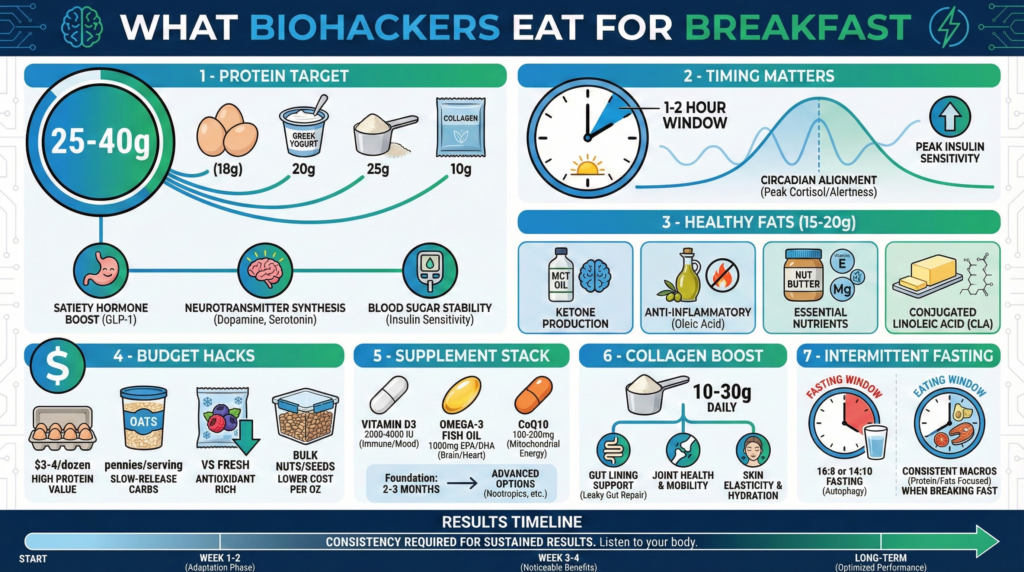
Most biohackers aim for 25-40 grams of protein at breakfast. This amount effectively triggers satiety hormones, provides amino acids for neurotransmitter production, and stabilizes blood sugar throughout the morning.
Three eggs deliver about 18 grams, so you’ll typically need to mix protein sources or add Greek yogurt, protein powder, or collagen to hit these targets consistently.
Does breakfast timing really matter for metabolism?
Eating breakfast within one to two hours of waking and maintaining consistent timing daily reinforces your circadian rhythm and improves nutrient processing efficiency. Your insulin sensitivity peaks in the morning, making this the optimal time for nutrient intake.
Consistency matters more than the exact time you choose.
What are the best fats to include in breakfast?
MCT oil provides quick-converting ketones for brain fuel. Extra virgin olive oil offers anti-inflammatory polyphenols.
Nut butters deliver vitamin E, magnesium, and fiber.
Grass-fed butter or ghee contains useful fatty acids. Aim for 15-20 grams of healthy fats at breakfast to slow digestion, stabilize blood sugar, and increase satiety.
Can I improve breakfast on a budget?
Eggs are cost-effective at roughly $3-4 per dozen. Bulk-bought oats cost almost nothing per serving.
Frozen berries are often cheaper than fresh and keep most of their nutritional value.
Buying nuts and seeds in bulk dramatically reduces costs. The core principles of adequate protein, healthy fats, and micronutrient density can be achieved with inexpensive whole foods.
What supplements should I take with breakfast?
Start with foundational supplements before considering advanced options. Vitamin D (2000-4000 IU), omega-3 fatty acids (1000mg EPA/DHA), and CoQ10 (100-200mg) are fat-soluble and should be taken with breakfast when you’re consuming healthy fats.
Establish this foundation for 2-3 months before adding advanced supplements like NMN.
Is collagen worth adding to breakfast?
Collagen provides glycine and proline, which support gut lining integrity, joint health, and skin elasticity. Most biohacker protocols include 10-30 grams of collagen daily.
While it doesn’t qualify as a complete protein because it lacks tryptophan, it complements other protein sources effectively and has research-backed benefits for connective tissue health.
Should I eat breakfast if I practice intermittent fasting?
If you practice intermittent fasting and eat your first meal later in the day, the same principles apply when you break your fast. Emphasize protein and healthy fats over simple carbohydrates.
Your body becomes particularly sensitive to how you reintroduce food after a fasted state, making composition even more critical.
How long does it take to see results from optimizing breakfast?
Meaningful optimization benefits accumulate over weeks and months of consistency. Allow at least three to four weeks of consistent implementation before changing variables or concluding a protocol isn’t working.
Your body needs time to adapt to new patterns before you can accurately assess effectiveness.
Key Takeaways
Biohacker breakfasts prioritize 25-40 grams of high-quality protein, 15-20 grams of strategic healthy fats, and micronutrient density. This composition directly influences cognitive performance, energy stability, and metabolic health throughout the entire day.
Timing consistency matters as much as nutritional composition. Eating breakfast within one to two hours of waking at roughly the same time daily reinforces circadian rhythms and improves nutrient processing efficiency.
Sleep quality determines breakfast effectiveness. Poor sleep undermines even perfectly optimized nutrition, making sleep hygiene the highest-leverage intervention before advanced dietary protocols.
Foundational supplementation, vitamin D, magnesium, omega-3, and CoQ10, must precede advanced supplements. Establishing micronutrient sufficiency creates the metabolic environment where macronutrient optimization can deliver meaningful results.
Individual tracking provides more valuable insights than following generic protocols. What works optimally for professional biohackers may not work optimally for your specific metabolism, goals, and lifestyle context.
The principles matter more than specific foods. Adequate protein, healthy fats, micronutrient density, and consistent timing can be achieved through expensive specialty products or affordable whole foods with similar metabolic outcomes.
Implementation needs deliberate practice and patience. Meaningful optimization benefits accumulate over weeks and months of consistency.
Allow adequate time for adaptation before changing variables or concluding a protocol isn’t working.