
Introduction
Bulletproof hit the market with a bold claim. Mix grass-fed butter and MCT oil into your coffee, and you’ll get sustained energy without crashes.
Dave Asprey built the whole company around this idea after trying yak-butter tea in Tibet. That single coffee hack turned into an entire line of supplements, protein powders, and functional foods.
The brand targets a specific group—professionals who make a decent living and want an edge.
Executives juggling packed schedules.
Parents trying to balance family stuff while staying sharp. Fitness people who actually track their numbers.
But here’s what matters for this Bulletproof review. Do their products actually deliver results that justify the premium pricing?
Because that’s the real test. Anyone can slap fancy labels on supplements and charge extra.
The question is whether you’re paying for real quality or just marketing.
Features Overview
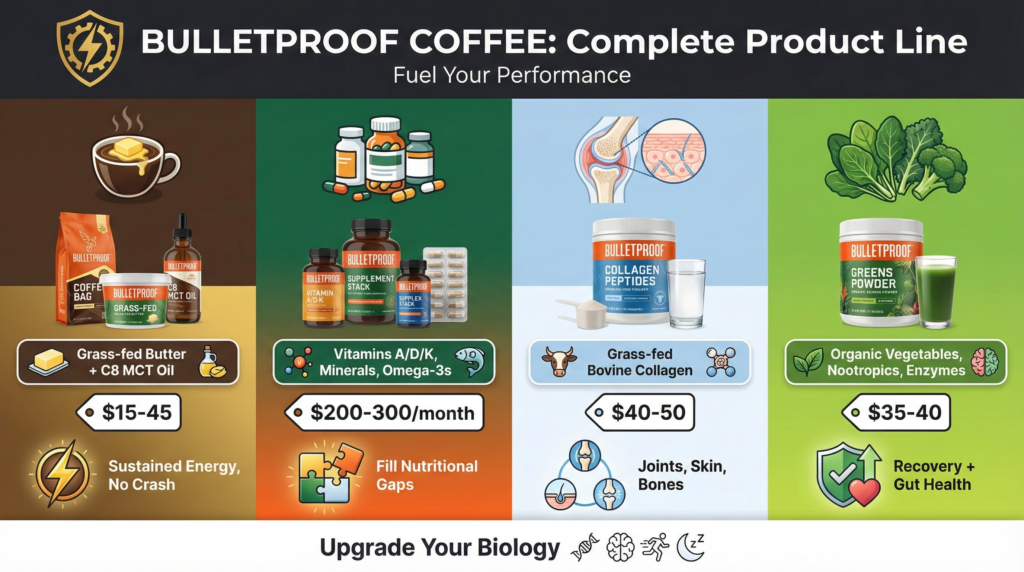
Bulletproof breaks down into three main product categories. Let’s walk through what they actually offer.
The Coffee System
The flagship product remains their coffee and creamer combo. They source beans selected specifically for lower mycotoxin levels (the mold compounds that can show up in regular coffee).
The creamer blends grass-fed butter with their Brain Octane C8 MCT oil. The goal is sustained energy without the crash you get from black coffee by itself.
Their roasting process uses proprietary methods, though the specifics aren’t fully public. Standard coffee marketing stuff, to be honest.
Supplement Line
This is where things get complicated. Bulletproof offers what they call their “top 10 supplements everyone should take.”
The list includes Vitamin D, K2, A, C, Iodine, Krill Oil, Magnesium, L-Tyrosine, Zinc/Copper combo, and Methyl Folate with B-12.
Instead of selling these separately, they bundle complementary nutrients. Their Vitamins A-D-K softgels mix all three fat-soluble vitamins in one capsule.
The Omega Krill Complex mixes krill oil with fish oil for broader omega-3 coverage, plus astaxanthin thrown in.
It’s a combination approach. Whether that’s better than basic supplements depends on your current regimen and budget.
Collagen and Protein Products
The collagen line gets heavy promotion. They market it for joint support, skin health, and bone strength.
The source is grass-fed, pasture-raised cows. Each serving contains 20g of collagen peptides.
They also produce green powders, energy-supporting collagen blends, and immune formulations that combine multiple ingredients.
Quality Testing Claims
Bulletproof says they use a four-stage testing process:
- Verification that listed ingredients are actually present (not diluted)
- Screening for contaminants
- Analysis of active ingredient strength
- Composition testing to confirm label accuracy
That sounds good on paper. The real question is whether third-party testing backs this up (more on that in a minute).
| Product Category | Key Ingredients | Typical Price Range | Primary Benefit Claim |
| Coffee & Creamer | Grass-fed butter, C8 MCT oil | $15-45 | Sustained energy, no crash |
| Supplement Stack | Vitamins A/D/K, minerals, omega-3s | $200-300/month | Fill nutritional gaps |
| Collagen Peptides | Grass-fed bovine collagen | $40-50 | Joint, skin, bone support |
| Greens Powder | Organic vegetables, nootropics, enzymes | $35-40 | Recovery, gut health |
Performance Analysis: What Actually Works
This is where we separate hype from reality.
Cognitive Function and Energy
One user reported improved focus within 30 minutes of using Bulletproof products. No crash or energy fluctuations throughout the day.
But (and this matters) that’s one person’s experience. It’s not controlled study data.
The ingredients they use for cognitive support include Lion’s Mane, L-Theanine, and Coffeeberry. These have some research backing them individually.
Whether Bulletproof’s specific formulations work better than buying these separately remains unclear.
The coffee and MCT oil combo does have logic behind it. MCTs convert to ketones quickly, providing fuel for your brain. That part checks out scientifically.
The Supplement Strategy
Here’s where Bulletproof takes a different approach than most brands.
They mix nutrients that work together biochemically. Pairing Vitamins A, D, and K makes sense because these fat-soluble vitamins activate different proteins and pathways that need each other.
Combining krill oil with fish oil theoretically gives you a broader omega-3 spectrum. The phospholipid form in krill might absorb better than standard fish oil (though the research on this isn’t totally settled).
The problem is that Bulletproof’s specific combinations haven’t been tested independently. You’re trusting their formulation logic without peer-reviewed studies proving their blend beats simpler options.
Collagen Results
Several users mentioned improvements in skin health and joint flexibility after using the collagen peptides. One person noted better recovery from training.
Another user said they experienced less bloating and improved gut health from the green powder when used daily.
These anecdotal reports align with general collagen research. But results vary wildly between individuals.
Some people respond well to collagen supplementation, while others notice nothing.
Greens Powder Performance
The green powder contains only one gram of sugar per serving while delivering organic vegetables, nootropics, and digestive enzymes.
One reviewer called it “hands-down the best greens powder” they’d tried. They noticed differences in training recovery specifically.
The ingredient transparency stands out here. They list specific vegetables instead of hiding behind proprietary blends.
That’s a plus for evaluating what you’re actually getting.
To try the greens powder specifically, you can check current pricing here (just know it’s pricier than most competitors).
Pros and Cons
Let’s break down the real advantages and disadvantages.
What Works
Transparent ingredients. They list specific quantities rather than hiding behind proprietary blends. You know exactly what you’re getting.
Source quality. The grass-fed, pasture-raised sourcing appeals to people who care about sustainability and ethical production. Whether you taste the difference is debatable, but the principle matters to some buyers.
Testing standards. They do screen for purity and strength. That reduces contamination risk compared to brands without published testing protocols.
Logical formulations. The nutrient combinations follow biochemical logic. They’re pairing things that work together synergistically rather than throwing random ingredients in a bottle.
Taste feedback. Users consistently mention good taste, especially for the coffee and greens powder. That matters for products you use daily.
What Doesn’t Work
Price premium. This is the biggest issue. Bulletproof costs significantly more than comparable supplements.
A green powder at $35 competes with brands offering similar ingredients for $15-25. The collagen costs roughly twice what generic choices charge.
For someone adopting their full “top 10” supplement regimen, you’re looking at $200-300+ monthly depending on dosing. That’s not pocket change.
Limited independent research. While individual ingredients like collagen, magnesium, and L-Theanine have research support, Bulletproof’s specific formulations lack peer-reviewed studies demonstrating superiority.
You’re trusting their internal formulation decisions without external validation.
Regulatory history. In 2020, the FDA sent Bulletproof a warning letter about violations. They made disease treatment claims that classified certain products as unapproved drugs rather than dietary supplements.
Specifically, claims about Curcumin Max treating inflammation-related conditions and Mitosweet supporting heart function exceeded permissible supplement marketing.
The FDA also documented that Bulletproof failed to establish proper product specifications for composition limits on contamination in certain collagen protein products.
This doesn’t mean their products are unsafe. It means they’ve overstepped regulatory boundaries and made claims exceeding their authority.
That’s worth knowing.
Information overload. The extensive product lineup creates decision paralysis for newcomers. Where do you even start?
The company recommends consulting healthcare providers before beginning, yet their marketing targets self-optimizers, making independent choices.
User Experience: Real-World Application
One reviewer tested many Bulletproof products over several weeks. Here’s what they reported.
The coffee creamer created a frothy texture that required patience to mix properly. But it eliminated the jittery sensation typical of black coffee consumed alone.
The collagen powder had a minimal chalky aftertaste when combined with the creamer. Mixed with water alone, the texture was less appealing.
The green powder tasted better than expected despite being earthy. There was subtle sweetness making it palatable enough for daily use.
The Setup Factor
Here’s something that doesn’t get mentioned enough in Bulletproof reviews. The setup isn’t effective.
You’re adding extra steps to your coffee routine. Mixing powders.
Managing many products if you use the full supplement stack.
For executives and entrepreneurs who claim time scarcity as a pain point, this contradicts the convenience narrative. You’re not grabbing coffee and running out the door anymore.
That said, if you’ve already committed to a supplement routine, adding these products doesn’t increase complexity much. It’s more about replacing what you now use rather than adding entirely new steps.
Recovery Benefits
This came up repeatedly in user feedback. Better recovery from training.
Reduced bloating.
Improved gut health.
These effects matter to fitness-oriented users tracking progress quantifiably. If you’re measuring performance metrics, changes in recovery time show up in your data.
Whether that’s worth the premium price depends on your training goals and budget priorities.
For casual exercisers, you probably won’t notice enough difference to justify the cost. For serious athletes or people training daily, the recovery benefits might provide measurable value.
Check out the full Bulletproof product line here if you want to explore their complete range.
Value for Money: Running the Numbers
At premium pricing, Bulletproof forces a hard value calculation.
A single bottle of collagen peptides costs roughly twice what generic choices charge. Supplements alone (following the “top 10” regimen) easily exceed $200-300 monthly.
The company’s argument rests on three factors:
- Sourcing quality (grass-fed, pasture-raised, tested)
- Ingredient bioavailability (forms that absorb better)
- Formulation optimization (combining synergistic nutrients)
For consumers already committed to health optimization with disposable income, these justifications carry weight.
For budget-conscious shoppers, generic multivitamins and basic protein powder serve identical baseline functions. You won’t get the sourcing quality or specific formulations, but you’ll hit the same basic nutritional targets.
Where the Value Makes Sense
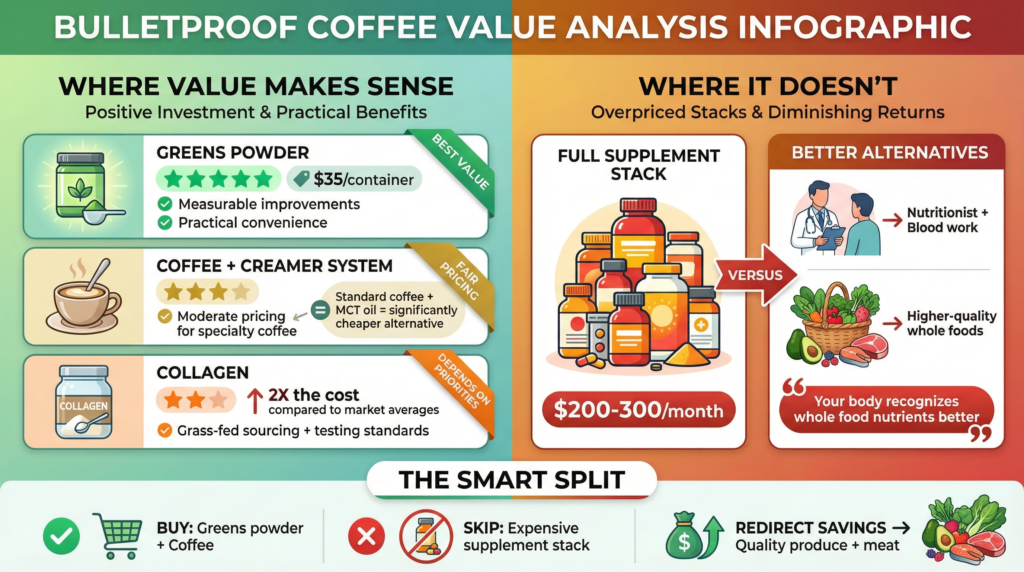
The greens powder represents better value than the supplement stack, in my opinion. Users noted measurable improvements and practical convenience at $35 per container.
The coffee and creamer system offers moderate pricing for specialty coffee. Though standard coffee plus standard MCT oil costs substantially less if you’re price-sensitive.
The collagen becomes harder to justify purely on value. You’re paying double for grass-fed sourcing and testing standards.
Whether that matters depends on your priorities.
Where It Doesn’t
The full supplement stack at $200-300 monthly competes with working with a nutritionist and getting blood work to identify actual deficiencies.
That money could go toward higher-quality whole foods, which provide nutrients in forms your body recognizes better than isolated supplements.
Or you could split the difference. Buy their greens powder and coffee, skip the expensive supplement stack, and spend the savings on better produce and meat.
If you’re specifically interested in their coffee system, you can grab it here to test whether the energy claims hold up for you.
Final Verdict
Bulletproof occupies a legitimate space in the functional nutrition market. They deliver what they promise: clean-sourced, tested products with transparent ingredients in doses reflecting reasonable supplement science.
Their origin story appeals to early adopters and biohackers. The branding works well for their target demographic.
But the premium pricing, regulatory history, and lack of differentiated research outcomes mean Bulletproof works best for specific buyers.
Who This Makes Sense For
Professionals with actual budgets for optimization. If you’re clearing six figures and health optimization matters to your performance, the premium cost becomes negligible relative to your earning potential.
People already committed to supplementation are seeking better quality. If you’re already spending $100+ monthly on supplements, upgrading to Bulletproof’s formulations might provide incremental improvements.
Fitness enthusiasts tracking measurable recovery metrics. If you’re logging training data and can measure recovery changes quantitatively, the collagen and greens powder might deliver visible results.
Who Should Skip It
Budget-conscious consumers can get 80% of the benefits from generic choices at 40% of the cost. The quality gap exists, but doesn’t justify doubling your supplement budget for most people.
Supplement skeptics should start with basic nutrition optimization first. Bulletproof won’t fix a poor diet.
Clean up your food choices before spending $300 monthly on supplements.
People seeking magic bullets will be disappointed. These products provide incremental improvements for people already doing the basics well. They won’t improve your health by themselves.
Is Bulletproof Worth It for You?
Answer honestly to discover if Bulletproof products align with your priorities and budget.
The Practical Approach
Start with the greens powder or coffee system. These generated the most consistent positive feedback and represent reasonable entry points without massive financial commitment.
The broader supplement stack suits people already convinced of supplementation’s value and seeking upgraded formulations.
Skip the full product line initially. Test one or two products for 30-60 days and measure whether you notice tangible differences before expanding your order.
Browse the complete Bulletproof catalog here to compare products and pricing.
The products aren’t necessary. You can achieve better results through disciplined nutrition, consistent training, and basic supplementation from mainstream brands.
Bulletproof packages these fundamentals with better ingredients and quality control, commanding a price premium for that optimization. Whether that premium makes sense depends entirely on your budget, priorities, and current health status.
For this Bulletproof review, the final assessment comes down to value alignment. If premium sourcing, testing standards, and formulation optimization matter enough to justify 2-3x pricing, Bulletproof delivers on its promises.
If you’re seeking the most value per dollar, generic choices serve the same basic functions at significantly lower cost.
The choice depends on where you are financially and what level of optimization you’re pursuing. Neither answer is wrong; they’re just different approaches to the same goal.