The Whoop band doesn’t work like your typical fitness tracker. There’s no screen to check during meetings, no buzzing notifications, and honestly, no step counter to make you feel guilty about being lazy.
The whole thing collects data about your body all day and night. Then the app crunches those numbers into insights about recovery, strain, and sleep.
That’s basically it.
For people trying to balance demanding work schedules with staying in decent shape, the appeal is pretty straightforward. You get actual data instead of just guessing whether you should hit the gym hard or take it easy.
Instead of scrolling through conflicting fitness advice on Reddit at 11 pm, you check your recovery score and make a decision. The device tries to solve a real problem, having way too much information but not enough personal data that actually matters.
This Whoop review looks at what the tracker actually does, where it messes up, and whether paying a subscription forever makes any sense for your situation.
Features Overview
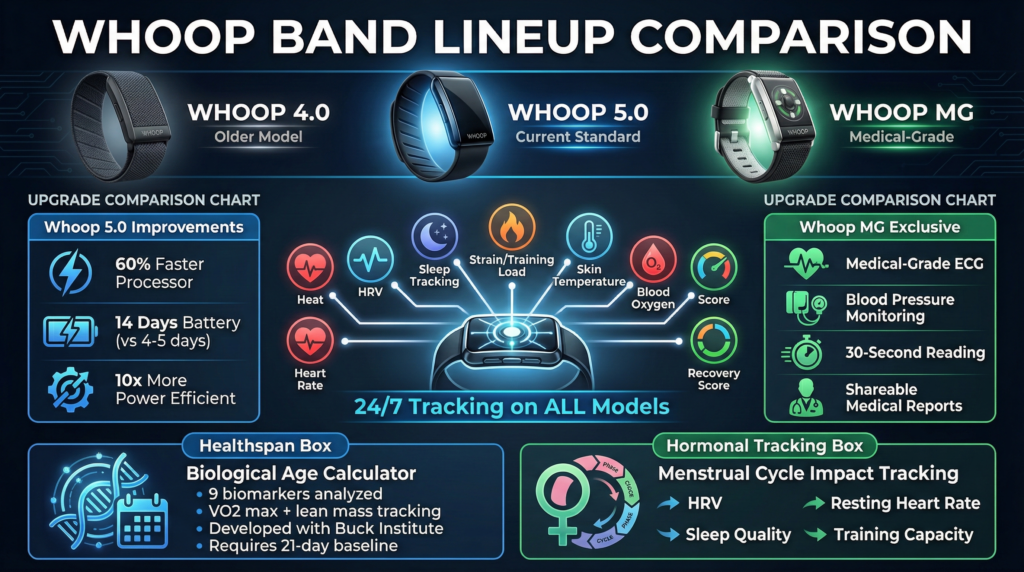
Whoop sells three different hardware versions now. You’ve got the Whoop 4.0 (older model), Whoop 5.0 (current standard one), and Whoop MG (medical-grade version).
The differences actually matter because you don’t get all features on every model.
What All Models Track
Every Whoop device watches your sleep, strain (basically training load), and recovery. It tracks heart rate, HRV (heart rate variability), skin temperature, and blood oxygen levels continuously.
The band sits on your wrist collecting data 24/7, syncing to your phone when you’re nearby.
Sleep tracking shows your cycles, how much you tossed around, and whether you’re consistent. Recovery scores factor in your resting heart rate, HRV, and how those numbers shifted after sleeping.
Strain measures how hard you push yourself during workouts and regular daily activity.
Updates With the 5.0 and MG Models
The Whoop 5.0 added a processor that’s 60% faster and 10 times more power-efficient than the 4.0. That means the app syncs faster, and tracking accuracy improves a bit.
Battery life jumped from about 4-5 days up to 14 days. That’s actually huge because constantly charging a device you’re supposed to wear nonstop gets annoying fast.
The MG model goes further by adding medical-grade ECG and blood pressure monitoring. You put your thumb and index finger on sensor spots in the clasp for 30 seconds.
It spits out an ECG reading with a detailed report in about a minute.
You can share that report with your doctor if needed.
Subscription Tiers Lock Features
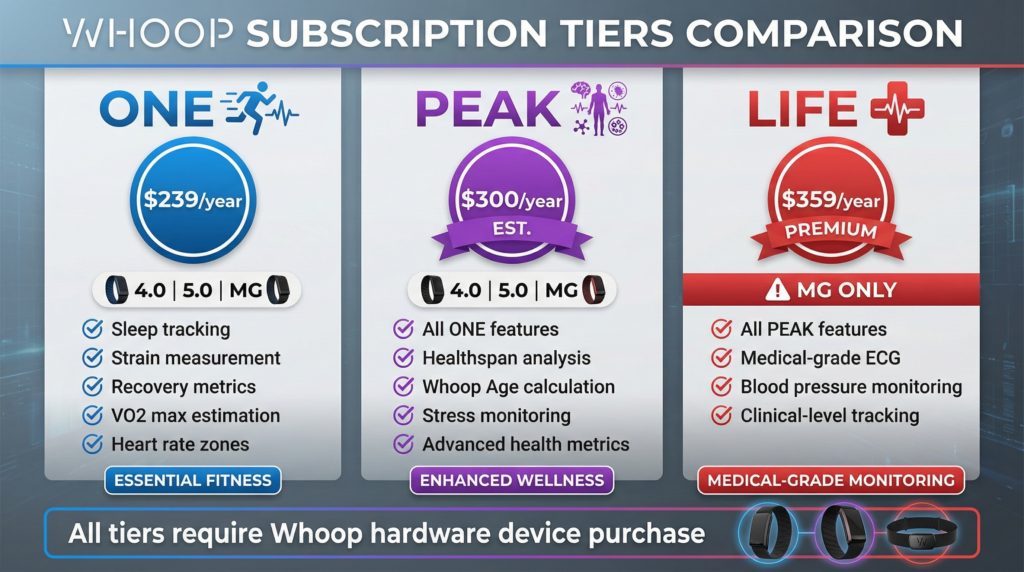
Whoop runs on a three-tier membership now: One, Peak, and Life.
The One tier costs $239/year and includes basic sleep, strain, and recovery scores, plus VO2 max estimates and heart rate zones.
Peak adds Healthspan information (including Whoop Age and Pace of Aging), Health Monitor metrics like resting heart rate and respiratory rate, plus stress monitoring.
Life runs $359/year and unlocks the medical-grade ECG and blood pressure features, but you need the MG hardware for those.
| Membership Tier | Annual Cost | Key Features | Hardware Required |
| One | $239 | Sleep, strain, recovery, VO2 max, HR zones | 4.0, 5.0, or MG |
| Peak | ~$300 (estimated) | Healthspan, Whoop Age, stress monitoring, health metrics | 4.0, 5.0, or MG |
| Life | $359 | Medical-grade ECG, blood pressure monitoring, all Peak features | MG only |
Healthspan and Whoop Age
This feature combines nine biomarkers, time in specific heart rate zones, sleep consistency, VO2 max, lean body mass (if you sync a smart scale), and others, to calculate your biological age and track how fast you’re aging.
They built the algorithm with Dr. Eric Verdin from the Buck Institute for Research on Aging, so it’s not just made-up numbers.
You need 21 days of baseline data before it shows results, though. New users won’t see this right away.
Hormonal Tracking for Women
The enhanced hormonal tracking helps women understand how their cycle phase impacts HRV, sleep quality, resting heart rate, and how hard they can train.
This addresses a real gap, to be honest. Most fitness trackers completely ignore hormonal fluctuations that legitimately affect training capacity and recovery needs.
Performance Analysis
Heart rate accuracy matters a lot because all of Whoop’s other metrics, strain, recovery, and readiness, come from that foundation. This is where things get messy.
Accuracy Issues
Testing shows that Whoop MG and 5.0 devices give inconsistent heart rate readings depending on what you’re doing and how hard you’re going.
During steady-paced runs, the MG reported higher heart rates than reference devices like Garmin chest straps and Apple Watch Ultra 2. Sometimes 5-8 bpm higher.
During high-intensity stuff like tennis and gym workouts, the same device read lower than the reference devices.
On interval training runs, readings matched up pretty well with gold-standard monitors.
The problem isn’t just that readings are sometimes off. The calibration isn’t predictable.
If you’re relying on precise heart rate zone training or analyzing every data point, this variability gets frustrating.
If you’re using Whoop mainly for sleep and recovery trends instead of workout-by-workout precision, the inconsistency matters less.
Where You Wear It Affects Accuracy
Independent testing shows Whoop gets better heart rate accuracy when worn on the biceps during endurance sports compared to the wrist.
That’s relevant if you plan to wear it primarily during training instead of 24/7, though the whole value proposition assumes you’re wearing it constantly.
What Actually Works Well
Auto-detection of workout start and end times improved substantially with the 5.0 and MG models. It now locks onto active periods pretty accurately, often down to the minute.
Sleep cycle identification and overall trend tracking seem accurate enough for guiding recovery decisions. Stress monitoring is subjective, but some users report seeing patterns in their daily tension levels they weren’t aware of before.
ECG and Blood Pressure Limitations
The on-demand ECG can detect atrial fibrillation, but it has limitations. It can’t reliably detect AFib in people with resting heart rates below 50 bpm, which is common in endurance athletes.
Blood pressure readings are estimates based on calibration as opposed to true cuff measurements. Better viewed as trend data than absolute values.
Pros and Cons
What Works
The 14-day battery life removes a genuine pain point. You’re not charging every few days, which helps a lot.
The coaching insights have proven useful for many users, particularly the Daily Outlook feature. It synthesizes your data into specific recommendations for training intensity and recovery needs. Instead of just showing raw metrics and leaving you to figure it out, the app suggests actionable steps.
The absence of a screen means the device is actually invisible during daily life and sleep. It reduces the mental burden of wearing a tracker.
There’s no urge to check notifications or get distracted by alerts.
For women, the hormonal insights represent a meaningful feature that most mainstream trackers completely ignore.
The medical-grade ECG on the MG model provides legitimate convenience for people wanting daily cardiovascular monitoring without clinical visits (within clear limitations, though).
To check out the current models and pricing, you can go here to see all the membership options laid out. You can also find some deals on authorized retailers occasionally.
What Doesn’t Work
The subscription model is non-negotiable. You can’t buy the device outright and use it without ongoing payments.
This cost compounds over the years and eliminates the option for people who want to own their hardware and data completely.
Whoop 4.0 bands are incompatible with the new 5.0 and MG models because of hardware redesign. If you’re upgrading from the previous generation, you’re buying entirely new straps.
Heart rate accuracy inconsistency is a meaningful drawback for a premium-priced device positioned as a performance tool, even if it’s okay for trending purposes.
The device lacks GPS. Outdoor runs and bike rides require syncing with your phone or a separate device to capture route data.
For some people, this is fine; for others, it’s a limitation compared to integrated sports watches.
The learning curve on the app is steeper than that of typical fitness trackers. You need to understand concepts like HRV, strain calculations, and recovery scores to extract value instead of just glancing at a daily step count.
User Experience
Setup and Daily Use
Initial setup involves charging the band, downloading the app, and syncing via Bluetooth. The app walks you through entering personal details needed for personalized metrics.
The interface organizes information into daily cards showing your recovery score, recommended strain level, and sleep quality.
Most of the real value lives in the app as opposed to the wearable itself. You need regular phone access to get actionable insights.
The band is purely collecting sensor data.
Workout Tracking
Whoop auto-detects many workouts, but you can manually log activities in the app too. You specify the activity type, running, cycling, strength training, sports, whatever, and the app tracks your heart rate zones during that session.
After completion, it calculates your strain contribution and provides coaching notes.
GPS needs syncing with Strava or another fitness app. Whoop doesn’t track routes natively. This works but adds an extra step compared to all-in-one sports watches.
Sleep and Recovery
The app displays your sleep stages, showing time in light sleep, deep sleep, and REM. It calculates sleep consistency, whether you’re sleeping at similar times and durations across days.
The recovery score updates each morning, telling you whether your body is ready for hard training or should emphasize recovery.
For athletes optimizing training loads, this daily readiness assessment drives real decisions about whether to go hard or back off.
Value for Money
Whoop pricing creates a tiered entry point.
Entry Level (Whoop One, $239/year): Basic sleep, strain, and recovery. Adequate for someone wanting foundational tracking without advanced metrics.
Mid-Tier (Whoop Peak, estimated ~$300/year): Adds Healthspan features, stress monitoring, and health metrics. Useful for people interested in aging and long-term health signals.
Premium (Whoop Life with MG hardware, $359/year): Adds medical-grade ECG and blood pressure monitoring. Requires purchasing the MG device separately.
Consider that a typical sports watch costs $300-$500 once, while Whoop costs $239-$359 annually forever. Over five years, you’re spending $1,200-$1,800 just on membership, not including the hardware cost.
The value calculation depends on whether you actually use the insights to change your behavior. If daily recovery scores influence your training decisions and improve your outcomes, the cost justifies itself.
If the app becomes another thing you check passively without acting on it, the subscription feels expensive.
For people with decent disposable income who prioritize health optimization, $300-$400 annually is manageable. Whether it’s worth spending depends entirely on commitment to acting on the data.
You can compare current membership plans and Whoop bands and accessories here
Who Should Actually Consider This
Strong fit: Endurance athletes (runners, cyclists, triathletes) already obsessed with training data who want a device optimized for sleep and recovery instead of on-wrist training metrics. Many people use Whoop alongside a sports watch for complete coverage.
Reasonable fit: Busy professionals interested in longevity metrics who want daily quantified feedback on whether their body is recovering well from work stress and exercise. The Healthspan features provide aging-related insights you don’t get elsewhere.
Questionable fit: People wanting step counting, notifications, or casual fitness tracking. You’re paying for sophisticated physiological monitoring.
If you just want to know you moved around enough, cheaper trackers serve that purpose better.
Poor fit: Anyone unwilling to commit to a subscription model or unable to tolerate heart rate accuracy variations. Also problematic if you want a standalone device without requiring regular app engagement.
Final Verdict
Whoop represents a legitimate step forward in wearable sophistication, particularly with the 5.0 and MG improvements in battery life, processor speed, and new health metrics like Healthspan. The device delivers meaningful data for users willing to engage with complexity and act on insights.
The main trade-offs: convenience of hardware you own versus ongoing subscription dependency. Simplicity of a traditional sports watch versus the depth of physiological monitoring.
Mainstream wearable ecosystem compatibility versus specialized performance optimization.
For professionals juggling demanding careers and fitness goals, Whoop makes sense if you’re already paying for biohacking subscriptions, training programs, and supplements. Adding another $300-$350 annually to your health budget for actionable sleep and recovery data fits that approach.
The device asks you to commit to the data-driven approach instead of intuitive training. That appeals to people who already think that way.
The remaining question is execution. Testing the device with a trial period first makes sense.
Whoop sometimes offers trials to assess whether the app insights actually change how you train and recover, or whether they simply reinforce decisions you’d make anyway.
If the daily coaching meaningfully influences your choices, the subscription is worth considering. If you end up ignoring the recommendations, save your money.
Bottom line: This Whoop review shows the device works best for people already committed to quantified self-tracking who will actually use the recovery data to change their training. The subscription model and heart rate inconsistencies are real drawbacks.
But for the right person who acts on the insights, the continuous monitoring and coaching features justify the ongoing cost.
Just make sure you’re that person before signing up for years of payments.