
I used to think people who obsessed over their sleep scores and tracked every meal were just neurotic. Then I hit 38 and realized I couldn’t power through all-nighters like I used to, my afternoon energy crashes were getting worse, and my brain felt foggy more often than sharp.
That’s when I started paying attention to this whole biohacking thing.
Not because I wanted to become some cyborg superhuman, but because I was tired of feeling tired. What I uncovered completely changed how I think about my body and health.
The first thing that surprised me was that biohacking doesn’t require following some guru’s protocol or buying expensive gadgets (though plenty of people will try to sell you both). Biohacking means treating yourself like a science experiment where you’re both the researcher and the subject.
And honestly, once you start seeing actual data about what’s happening inside your body, it becomes really hard to go back to just guessing.
Understanding the Biohacking Mindset
The systematic approach separates someone who biohacks from someone who just tries to eat healthy or exercise regularly.
When most people decide to “get healthier,” they might start going to the gym or cut out sugar.
A biohacker does something fundamentally different. They establish a baseline first.
Let me give you a concrete example. Last year, I noticed I was waking up around 3 AM almost every night.
Instead of just accepting this as “getting older” or trying random sleep supplements, I started tracking my sleep architecture with a wearable device.
What I uncovered was fascinating. My deep sleep percentage was consistently below 15% when it should have been closer to 20-25%.
Without that baseline measurement, I would have been shooting in the dark trying to fix a problem I couldn’t even quantify.
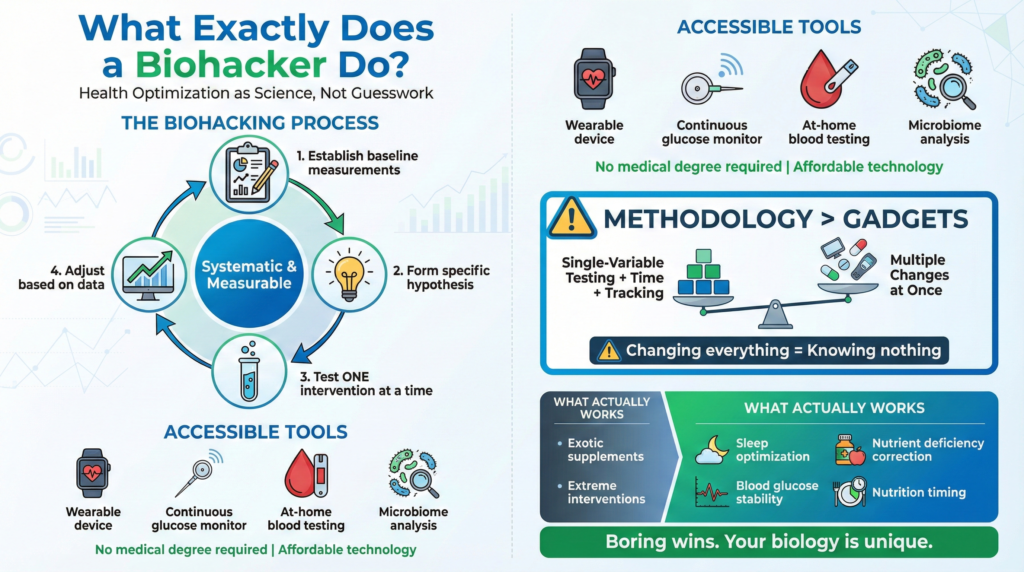
This is really what biohackers do all day. They identify a specific, measurable problem.
They research potential interventions based on actual science (not Instagram wellness influencers).
They implement one change at a time. They measure the results.
And then they adjust based on what the data shows, not what they hope is working.
The Core Tools and Technologies
The biohacking toolkit has exploded in the last five years, and this is both exciting and overwhelming. You don’t need everything, but understanding what’s available helps you choose what actually matters for your specific goals.
Continuous glucose watches have become surprisingly mainstream among biohackers who don’t even have diabetes. These small sensors stick to your arm and track your blood sugar levels in real-time throughout the day and night.
What makes them valuable is understanding how your individual body responds to specific foods, stress, sleep quality, and exercise timing. Seeing the numbers gives you this understanding.
I wore one for three months and discovered that my supposedly “healthy” morning oatmeal was spiking my glucose to 160 mg/dL and leaving me crushed and irritable by 11 AM. Switching to a protein-heavy breakfast eliminated my mid-morning brain fog.
But I never would have known this without the data.
Wearable devices have moved way beyond simple step counting. The Oura Ring, for instance, tracks heart rate variability, which basically measures how much variation exists between your heartbeats.
This sounds technical, but heart rate variability serves as one of the best indicators of how well your nervous system is recovering from stress.
When my HRV drops below 40, I know I need to prioritize recovery as opposed to pushing through another intense workout. This single metric has probably prevented more overtraining and illness than any other change I’ve made.
Blood testing has also become much more accessible. You can now order comprehensive panels that measure 50+ biomarkers without even visiting a doctor’s office.
Companies like Life Force will send you a phlebotomist quarterly to track everything from inflammatory markers to hormone levels to nutrient deficiencies.
This is where biohacking gets really precise. You’re not guessing about whether you need vitamin D or magnesium.
You’re seeing your actual levels and supplementing accordingly.
The Supplementation Strategy
Most people get biohacking completely wrong here. They read an article about some secret supplement, order it on Amazon, take it for a week, don’t feel dramatically different, and move on to the next thing.
That’s just throwing money at hope.
Real biohackers supplement based on identified deficiencies or specific, measurable goals. When my blood work showed my magnesium was at 1.7 mg/dL (low end of the normal range), and I was tracking poor sleep quality and muscle tension, supplementing with magnesium glycinate made sense.
I gave it six weeks, retested, and saw my levels rise to 2.1 mg/dL.
More importantly, my sleep scores improved, and the muscle tension decreased. That’s a closed feedback loop.
NAD+ boosters have become really popular in biohacking circles, and there’s actually some interesting science here. NAD+ (nicotinamide adenine dinucleotide) is crucial for cellular energy production and DNA repair, but it declines significantly as we age.
Supplementing with NMN (nicotinamide mononucleotide) theoretically increases NAD+ levels.
I tried this for three months while tracking my energy levels, recovery time after workouts, and even some cognitive tests. Did it make me feel 20 again?
No. Did I notice genuinely better recovery and more consistent energy?
Actually, yes. But the key was tracking it systematically as opposed to just hoping it worked.
The supplement world is absolutely full of overhyped garbage, though. PQQ (pyrroloquinoline quinone) gets marketed as this amazing mitochondrial enhancer, and while there’s some research showing it might protect existing mitochondria, the evidence for dramatic energy improvements is pretty thin. I tried it for two months with zero measurable change in any biomarker or subjective experience.
That’s fine. That’s what self-experimentation teaches you.
But I stopped taking it because the data didn’t support continuing.
Sleep Architecture Optimization
Most people think they’re “working on their sleep” if they aim for 8 hours in bed. Biohackers dig way deeper into sleep architecture, the actual structure of sleep cycles throughout the night. Your sleep isn’t a single state.
Sleep is a carefully orchestrated progression through light sleep, deep sleep, and REM sleep, cycling many times per night.
Deep sleep is when your body does physical restoration: tissue repair, immune system strengthening, and hormonal balance. REM sleep is when your brain consolidates memories and processes emotions.
If you’re getting 8 hours but spending most of it in light sleep, you’re not getting the restoration you need. This is measurable, and you can actually improve it.
Temperature manipulation turned out to be one of my biggest sleep wins. Your core body temperature naturally drops when you fall asleep and rises before you wake up.
By cooling my bedroom to 65°F and using a weighted blanket (which slightly raises skin temperature while keeping core temperature low), I increased my deep sleep percentage from 14% to 22% over about six weeks.
That’s a massive change that I can see clearly in my Oura Ring data.
Light exposure timing is another lever that most people completely ignore. Your circadian rhythm is primarily controlled by light hitting your eyes, specifically the ratio of blue light to red light throughout the day.
Getting bright light (ideally sunlight) within 30 minutes of waking signals to your body that it’s daytime and helps set your cortisol rhythm.
Blocking blue light 2-3 hours before bed by wearing blue-blocking glasses or using apps that shift screen color temperature helps melatonin production start earlier. These aren’t just theories.
You can measure the impact on sleep latency (how long it takes to fall asleep) and sleep quality scores.
Metabolic Flexibility and Nutrition
One concept that completely changed how I think about food is metabolic flexibility, your body’s ability to efficiently switch between burning carbohydrates and burning fat for fuel. Most people are metabolically inflexible, meaning they’re dependent on regular carbohydrate intake and experience energy crashes when blood sugar drops.
Building metabolic flexibility involves teaching your body to efficiently access and burn stored fat. This doesn’t necessarily mean going full keto or carnivore (though some biohackers do).
For me, it meant implementing a consistent eating window (roughly 12-8 PM most days) and being strategic about carbohydrate timing, concentrating them around workouts when my muscles can actually use them, as opposed to having them with every meal.
The Lumen device measures your metabolic state by analyzing CO2 in your breath. Each morning, you breathe into it, and it tells you whether you’re primarily burning carbs or fat.
Over several months of tracking, I could see patterns emerge.
Morning workouts before eating improved my fat-burning capacity. High-carb dinners meant I woke up still in carb-burning mode.
This kind of immediate feedback made adjusting my approach really straightforward.
Genetic testing revealed I have a variant in my APOE gene that means I process saturated fat less efficiently than average. This explained why my LDL cholesterol was creeping up despite an otherwise healthy diet.
Reducing saturated fat intake from animal sources and increasing omega-3s from fish resulted in a 30-point drop in LDL within three months.
Without genetic testing, I might have spent years trying different approaches without understanding this individual quirk of my metabolism.
The Recovery Equation
Recovery is where a lot of biohackers find their biggest performance gains, whether that’s athletic performance or just daily energy and cognitive function. Your body doesn’t improve during training or work.
It improves during recovery.
The problem is that most people only focus on the stress side of the equation.
Heart rate variability tracking has become my go-to recovery metric. Every morning, my Whoop strap gives me a recovery score based on HRV, resting heart rate, and sleep quality.
When my recovery is in the green (typically HRV above 55 for me), I know my nervous system has recovered, and I can handle intense training or demanding work.
When it’s in the red (HRV below 35), pushing hard is counterproductive and will likely just dig me into a deeper hole.
Cold exposure has genuinely impressive research behind it for reducing inflammation and improving recovery. I started with simple cold showers, 30 seconds at the end of my regular shower, gradually working up to 2-3 minutes.
After about two months, I invested in a cold plunge setup (a chest freezer conversion, not some $5,000 fancy tub).
Measuring the impact was interesting. My subjective soreness after hard workouts decreased noticeably, and inflammatory markers (specifically CRP) on my quarterly blood tests dropped from 1.8 mg/L to 0.6 mg/L over six months.
Sauna use follows a similar pattern. Regular heat exposure (I aim for 20 minutes at 170°F, four times per week) has research showing improvements in cardiovascular health, longevity markers, and even some cognitive benefits.
More immediately, I noticed it dramatically improved my sleep quality on days I used it in the evening.
The temperature drop after leaving the sauna apparently mimics the natural temperature decline that promotes deep sleep.
Cognitive Performance and Nootropics
Brain optimization is where biohacking can get really interesting or really pseudoscientific, depending on how rigorous you are. There’s a massive industry selling nootropics, substances that supposedly enhance cognitive function, with wildly varying levels of evidence behind them.
Caffeine and L-theanine together are probably the most reliable cognitive enhancement stack with solid research backing. The combination of caffeine’s alertness-boosting effects with L-theanine’s anxiety-reducing properties creates focused energy without jitters.
I tested this systematically using cognitive performance tests (processing speed, working memory tasks) before and after supplementation.
The improvement was modest but measurable, about 8% faster processing with maintained accuracy.
Alpha-GPC, a choline compound that supposedly enhances acetylcholine production in the brain, had biohacking communities really excited a few years ago. I tried it for two months with daily cognitive testing.
Result?
Absolutely nothing measurable. This is important to share because not everything works, and being honest is part of legitimate biohacking.
What actually made the biggest difference in my cognitive performance wasn’t supplements. Sleep optimization and glucose stability had far more dramatic effects on my mental clarity and focus than any nootropic I tested.
The Gut-Brain-Body Connection
Your gut microbiome, the trillions of bacteria living in your digestive system, influences everything from immune function to mood to metabolism. This isn’t wellness nonsense.
There’s really solid research showing these connections.
Biohackers approach gut health systematically as opposed to just randomly taking probiotics.
I did a comprehensive stool test through a company called Viome that analyzes your gut microbiome composition and provides personalized food recommendations. The results showed I had low diversity in useful bacteria and higher than ideal levels of certain inflammation-associated bacteria.
The recommendations were surprisingly specific: increase prebiotic fibers from specific vegetables, add resistant starch, and reduce certain lectins that my particular microbiome struggled with.
Implementing these changes while tracking digestive symptoms, energy levels, and inflammatory markers showed genuine improvements over about four months. My CRP (inflammatory marker) dropped further, bloating decreased noticeably, and subjectively, my energy was more stable.
Someone else’s gut microbiome is completely different, so what worked for me might not work for you.
That’s why testing and tracking your individual response matters.
Common Mistakes and Misconceptions
The biggest mistake I see people make with biohacking is changing too many things at once. You get excited, order five new supplements, start a new diet, buy a cold plunge, and begin a new workout routine all in the same week.
Two months later, if you feel better, you have no idea what actually worked. If you don’t feel better, you don’t know what to change.
Single-variable testing takes discipline, but it’s the only way to actually know what’s working. Change one thing, give it enough time to have an effect (usually 4-6 weeks minimum for most interventions), measure the results, and then decide whether to continue, change, or abandon it before moving to the next experiment.
Another trap is falling for correlation without causation in your own data. Just because your HRV was high on days you took a certain supplement doesn’t mean the supplement caused it.
Maybe you slept better, or had less stress at work, or any number of other variables.
Looking for consistent patterns over weeks and months, and ideally validating with controlled testing, helps separate signal from noise.
The most dangerous misconception is thinking that more extreme equals better results. Some people in biohacking communities push into territory that’s genuinely risky: experimental peptides without proper research, extreme fasting protocols without medical supervision, or implanting devices without understanding infection risks.
The grinder subculture of biohacking, people implanting magnets and chips into their bodies, is fascinating from a transhumanist perspective, but carries real risks that most people shouldn’t take on.
Building Your Personal Protocol
Starting your biohacking practice doesn’t require thousands of dollars in equipment or dozens of supplements. It needs a systematic approach and patience to actually measure results as opposed to chasing feelings.
Begin with one clear goal and one measurable outcome. “Feel better” isn’t specific enough.
“Increase deep sleep percentage from 12% to 18%” is specific.
“Have more energy” is vague. “Reduce afternoon energy crashes measured by continuous glucose stability and subjective energy ratings” is measurable.
Get baseline data before changing anything. If your goal is sleep improvement, track your sleep for two weeks before implementing any interventions.
If it’s metabolic health, get comprehensive blood work and maybe wear a CGM for two weeks to understand your current glucose patterns.
This baseline is essential because it’s what you’ll compare your results against.
Choose one intervention based on research and your specific situation. If your blood work shows vitamin D at 18 ng/mL (deficient) and you have poor sleep quality, supplementing vitamin D is a logical first intervention.
If your CGM shows you spike to 180 mg/dL after breakfast, changing your morning meal composition makes sense as a starting point.
Give it adequate time and track consistently. Most physiological changes take weeks to manifest.
Supplement interventions typically need 6-8 weeks before blood levels stabilize.
Sleep protocol changes might show effects sooner, sometimes within 1-2 weeks, but confirming they’re sustainable takes longer.
Retest and evaluate objectively. After your testing period, look at the data.
Did your deep sleep improve?
Did your vitamin D levels increase? Did your glucose stability improve?
If yes, great, keep that intervention and consider adding another.
If not, adjust or try something different.
People Also Asked
What does heart rate variability tell you?
Heart rate variability (HRV) measures the variation in time between consecutive heartbeats. Higher HRV generally shows better cardiovascular fitness and stress resilience, while lower HRV can signal overtraining, illness, or chronic stress.
Tracking HRV each morning helps you decide whether your body has recovered enough for intense training or needs a recovery day.
How accurate are continuous glucose watches for non-diabetics?
Continuous glucose watches (CGMs) are highly accurate for tracking glucose trends and responses to food, stress, and exercise in non-diabetics. While they may have a margin of error of 10-15% compared to laboratory blood tests, they’re excellent for identifying patterns in how your body responds to specific meals, sleep quality, and timing of carbohydrate intake.
Does cold exposure really improve recovery?
Cold exposure after exercise has solid research supporting its benefits for reducing muscle soreness and inflammation. Studies show that cold water immersion (50-59°F for 10-15 minutes) can lower inflammatory markers and improve perceived recovery.
However, timing matters; cold immediately after strength training might blunt some muscle growth adaptations, so many athletes save cold exposure for rest days or after endurance workouts.
What is metabolic flexibility and why does it matter?
Metabolic flexibility refers to your body’s ability to efficiently switch between burning carbohydrates and fats for fuel based on availability and demand. People with poor metabolic flexibility are dependent on frequent carbohydrate intake and experience energy crashes when blood sugar drops.
Building metabolic flexibility through strategic eating windows and carbohydrate timing can improve energy stability and body composition.
Are nootropics worth taking for cognitive performance?
Most nootropics have limited evidence supporting dramatic cognitive improvements in healthy adults. The caffeine plus L-theanine combination has the best research backing for improved focus and attention.
Expensive proprietary blends often lack quality studies.
You’ll likely see bigger cognitive improvements from optimizing sleep quality, stabilizing blood glucose, and addressing any nutrient deficiencies revealed through blood testing.
How long does it take to see results from biohacking?
The timeline varies significantly depending on what you’re optimizing. Sleep quality improvements from temperature and light optimization might be noticeable within 1-2 weeks.
Supplement interventions for nutrient deficiencies typically require 6-8 weeks for blood levels to change and symptoms to improve.
Metabolic flexibility from dietary changes often takes 2-3 months of consistent practice before you notice stable energy throughout the day.
Key Takeaways
Biohacking means treating your health optimization as a systematic, measurable process as opposed to guessing or following generic advice. You establish baseline measurements, form specific hypotheses, test interventions one at a time, and adjust based on data as opposed to hope.
The tools have become remarkably accessible. Wearable devices, continuous glucose monitors, at-home blood testing, and microbiome analysis are all available without requiring a medical degree or spending tens of thousands of dollars.
But tools alone don’t make you a biohacker.
The methodology matters more than the gadgets.
Real results come from single-variable testing with adequate time and consistent tracking. Changing everything at once prevents you from knowing what actually works for your unique biology.
What works for one person often doesn’t work identically for another, which is precisely why individual testing is essential as opposed to just copying someone else’s protocol.
The most effective interventions are usually the least glamorous. Optimizing sleep architecture, stabilizing blood glucose, fixing nutrient deficiencies revealed by blood testing, and building metabolic flexibility through strategic nutrition timing typically produce more dramatic results than exotic supplements or extreme interventions.