
Have you ever found yourself staring at your third cup of coffee by noon, wondering why you still feel foggy? Or maybe you’ve invested in a fancy fitness tracker only to realize you have absolutely no idea what all those numbers actually mean for your daily performance?
I’ve been there, and honestly, the whole biohacking world felt really overwhelming at first.
Everyday biohacking means taking a strategic approach to the small decisions you make every single day. I’m referring to the distinction between mindlessly scrolling through your phone for 20 minutes after waking up versus getting outside for natural light exposure.
Between reaching for the standard coffee that leaves you jittery by 10 AM and choosing something that actually supports sustained cognitive function.
I’m not talking about perfection. This is optimization within the constraints of a genuinely busy life, and I’m going to walk you through exactly how to build a system that works for you specifically.
Understanding the Foundation of Practical Biohacking
Before we get into specific tools and protocols, you need to understand what biohacking actually means in a practical context. The term itself has become so diluted that it now encompasses everything from basic sleep hygiene to experimental gene therapy.
That’s not helpful.
For busy adults with demanding careers and complex lives, biohacking breaks down into three actionable categories. First, lifestyle optimization means getting the fundamentals right.
This means prioritizing sleep quality, managing stress effectively, moving your body regularly, and eating foods that support rather than undermine your energy levels.
These aren’t sexy topics, but they’re absolutely non-negotiable. You cannot supplement or track your way around chronically poor sleep and constant stress.
Second, technology-enabled tracking gives you devices like the WHOOP band, Oura Ring, or continuous glucose watches. These tools collect real data about how your body actually responds to different inputs, and that data eliminates the guesswork that keeps most people stuck in suboptimal patterns for years.
Third, strategic supplementation and functional nutrition include products like MUDWTR, which combines lower caffeine content with functional mushrooms and adaptogens to support cognitive function without the crash that comes from traditional coffee. This category includes targeted supplements like magnesium for sleep, omega-3s for inflammation, or creatine for cognitive performance.
The keyword here is strategic, meaning you’re choosing specific interventions based on identified needs as opposed to just taking everything that sounds promising.
The real magic happens when you mix all three categories systematically. Your wearable data reveals that your deep sleep decreased significantly after late-night carbohydrate consumption.
That insight drives a dietary adjustment.
You track the results for two weeks and confirm the improvement. Then you layer in magnesium glycinate supplementation to further improve sleep architecture.
That’s biohacking that actually compounds over time.
The Time-Constrained Reality
Let me be really honest with you. Most biohacking content is written by people who have the luxury of treating optimization as a full-time job.
They’ve got the time for 90-minute morning routines, elaborate meal prep sessions, and midday recovery protocols.
That’s fantastic for them, but completely useless for someone managing a demanding career, family responsibilities, and all the other complexities of adult life.
The approach I’m sharing here is different because it works around a single constraint: you don’t have extra time to add new things. What you do have is the opportunity to improve things you’re already doing.
You’re already drinking something in the morning, so you might as well make it something that supports your cognitive function for the next six hours.
You’re already sleeping every night, so you might as well improve the conditions to maximize recovery. You’re already eating lunch, so you might as well understand how different foods affect your energy levels throughout the afternoon.
This reframe is absolutely crucial. You’re optimizing your existing life through strategic adjustments that need minimal extra time investment but deliver disproportionate returns.
Building Your Personal Data Infrastructure
Here’s where most people go wrong. They either track nothing and operate on pure intuition, or they track everything obsessively and drown in data they can’t interpret.
Neither approach works.
What you actually need is a focused measurement system that tracks the specific metrics that matter for your personal bottlenecks. If poor sleep is your primary limiting factor, then sleep metrics become your priority.
If inconsistent energy is the problem, then glucose tracking and subjective energy logging matter most.
If recovery from training is limiting your performance, then heart rate variability and readiness scores deserve attention.
I started with the absolute basics. Every morning, I logged three things in a simple notebook: what time I went to bed, what time I woke up, and how I felt on a scale of one to ten.
That’s it.
After just two weeks, clear patterns emerged. Late-night screen time consistently correlated with worse subjective ratings. Alcohol consumption, even moderate amounts, destroyed my sleep quality.
Going to bed at the same time every night, even on weekends, made a measurable difference.
That basic tracking cost me literally nothing and provided actionable insights that immediately improved my daily performance. Only after I’d optimized based on those basic insights did I invest in technology to go deeper.
When I did add technology, I chose the Oura Ring specifically because it provides comprehensive sleep and recovery data without requiring me to wear a watch around the clock. The continuous tracking revealed insights I couldn’t have discovered otherwise.
For instance, I learned that my deep sleep percentage increased significantly when I kept my bedroom temperature at 67 degrees versus my previous 72 degrees.
That’s a free optimization that I never would have tested without real data.
The WHOOP band offers similar insights with a focus on strain and recovery that’s particularly valuable if you’re training seriously. It tells you objectively whether your body is ready for a hard workout or needs a recovery day.
For people who tend to overtrain, this is incredibly valuable information.
Continuous glucose monitors represent a more advanced tracking option, but they’ve been absolutely transformative for understanding personal nutrition. I discovered that oatmeal, widely considered a healthy breakfast, spiked my glucose dramatically and consistently led to an energy crash by mid-morning.
Meanwhile, a breakfast of eggs, avocado, and vegetables kept my glucose stable and my energy consistent.
That insight alone justified the cost of the CGM experiment.
Strategic Supplementation and Functional Nutrition
Now we enter the territory where cutting through the noise becomes particularly challenging. The supplement industry is massive, and most products deliver minimal actual benefit despite impressive marketing claims.
So, how do you approach this intelligently?
Start by identifying your specific bottleneck through tracking. If your data shows that focus and mental clarity are inconsistent, then cognitive support becomes the priority.
If energy crashes every afternoon, then metabolic support and caffeine optimization matter most.
If recovery from stress or training is slow, then adaptogenic support and sleep optimization deserve attention.
Let’s talk specifically about coffee, since most busy professionals are consuming it daily anyway. Traditional coffee delivers somewhere around 95 milligrams of caffeine per cup, which creates a sharp spike in alertness followed by an inevitable crash.
You’re essentially borrowing energy from your future self.
For some people, this works fine. For many others, particularly those already dealing with stress and sleep issues, it creates a cycle of dependence that undermines baseline performance.
This is where something like MUDWTR becomes interesting from a biohacking perspective. This gives you an alternative that provides sustained cognitive support without the downsides.
MUDWTR combines 35 milligrams of caffeine with a blend of functional mushrooms, including lion’s mane, cordyceps, chaga, and reishi, plus adaptogens and spices.
The lion’s mane mushroom has been studied for its potential effects on nerve growth factor, which is involved in neuroplasticity and cognitive function. Cordyceps have traditionally been used to support energy and endurance.
Chaga provides antioxidant compounds.
Reishi is considered adaptogenic, potentially supporting stress response and immune function. The L-theanine content promotes calm focus by influencing alpha brainwave activity.
The combination is designed to provide alertness and cognitive support without the jittery overstimulation and subsequent crash that many people experience with high-caffeine coffee. The lower caffeine dose means you’re not overwhelming your adrenal system, and the functional ingredients provide complementary cognitive benefits that compound over time with consistent use.
I personally cycle between regular coffee and MUDWTR depending on my sleep quality and stress levels. If I sleep poorly or I’m dealing with elevated stress, I’ll choose MUDWTR because my system doesn’t need the extra caffeine load.
If I slept great and I’m training hard, I might opt for regular coffee.
This flexibility is more sophisticated than just habitually consuming the same thing every day, regardless of context.
Beyond coffee choices, there are really only a few supplements that have strong enough evidence to warrant consideration. Creatine monohydrate supports cognitive function, particularly during sleep deprivation or high cognitive demand.
Omega-3 fatty acids, specifically EPA and DHA from fish oil, support brain health and manage inflammation.
Magnesium glycinate supports sleep quality and stress management. Vitamin D is essentially a hormone that most people are deficient in, particularly if you work indoors.
That’s basically it for supplements with robust evidence. Everything else is either highly personal, minimally effective, or needs specific deficiencies to justify.
The supplement industry wants you to believe you need dozens of products, but the reality is much simpler.
Optimizing Your Morning Routine for Cognitive Performance
Your morning sets the trajectory for your entire day, and most people completely waste this leverage point. The typical routine involves hitting snooze repeatedly, immediately checking email and social media, rushing through getting ready, grabbing coffee on the way out the door, and arriving at work already depleted. That’s survival mode.
Here’s what a genuinely optimized morning looks like for a busy professional. You wake up at the same time every day, including weekends, because consistency is more important than perfection.
Within 15 minutes of waking, you get outside for natural light exposure.
This doesn’t need a long walk, just step outside for ten minutes. This single action regulates your circadian rhythm, increases cortisol appropriately for morning alertness, and begins the countdown to melatonin production 12-14 hours later for quality sleep.
While you’re outside, you can mix this with light movement. A short walk checks many boxes simultaneously: sunlight exposure, movement for metabolic activation, and mental clarity before the day’s demands begin. This isn’t a workout, just deliberate movement to shift your physiology from sleep mode to performance mode.
When you come back inside, you hydrate properly. Most people are significantly dehydrated after 7-8 hours of sleep, and dehydration directly impairs cognitive function.
Drink 16-24 ounces of water, ideally with a pinch of sea salt to provide electrolytes.
This simple action improves mental clarity more than most nootropics.
Then you have your morning beverage, whether that’s coffee, MUDWTR, or something else. The key is consuming it after you’ve already optimized the foundational elements.
The caffeine or functional ingredients work much more effectively when you’re properly hydrated, and you’ve already activated your system through light and movement.
Your breakfast should prioritize protein and healthy fats while minimizing refined carbohydrates. This keeps your glucose stable and your energy consistent throughout the morning.
If you’re experimenting with intermittent fasting, that’s fine, but make sure you’re doing it for specific reasons backed by your tracking data as opposed to just following a trend.
The entire routine I just described takes 30-45 minutes at most, and most of that time is combined activities like getting light while moving. This restructures the time you already spend to maximize cognitive and physical performance.
Common Implementation Mistakes and How to Avoid Them
I’ve made every mistake possible in this space, so let me save you some time and frustration by highlighting the most common pitfalls, problems, and issues.
The biggest mistake is trying to change everything simultaneously. You read an article like this one, get motivated, and immediately try to apply fifteen new habits while also buying five new devices and ten supplements.
Within two weeks, you’re overwhelmed, and you abandon everything.
Then six months later, you repeat the cycle. This is worse than doing nothing because it reinforces the belief that optimization doesn’t work for you.
The solution is almost embarrassingly simple. Pick literally one thing.
Implement it consistently for a full month.
Track the results. Only after you’ve confirmed that it’s working and it’s become habitual do you add the next thing.
This approach feels painfully slow, but it actually moves much faster because the changes actually stick.
Another common mistake is optimizing in the wrong order. People buy expensive treatments before fixing their sleep.
They invest in advanced tracking before establishing basic habits.
They focus on exotic interventions while ignoring the fundamentals that would actually move the needle. The hierarchy matters.
Sleep, stress, movement, and nutrition form the base.
Technology and tracking come next. Supplementation and advanced protocols come last.
Trying to build from the top down doesn’t work.
People also tend to track too much without analyzing what the data actually means. You’re wearing three different devices, logging fifteen metrics daily, and drowning in information you can’t interpret.
The solution is to focus your tracking on one or two key metrics that directly relate to your primary bottleneck.
Measure those consistently, look for patterns, make adjustments based on what you find, then measure again to confirm the effect. This creates a feedback loop that actually drives improvement as opposed to just generating noise.
Another mistake is rigidity as opposed to flexibility. You read that fasting provides benefits, so you fast every single day regardless of context.
You commit to a specific supplement stack and take it identically every day, regardless of whether your needs change.
Effective biohacking needs responsiveness to feedback. Your wearable shows terrible recovery, so you adjust your training that day.
Your glucose watch reveals a specific food causes crashes, so you eliminate or modify it.
You’re adjusting based on personal data.
Finally, people ignore the social and psychological aspects of optimization. You adopt habits that isolate you from friends and family.
You become obsessed with tracking to the point where it creates anxiety as opposed to insight.
You judge yourself harshly when you don’t execute perfectly. This undermines the entire purpose of optimization, which is to improve your actual lived experience as opposed to becoming a slave to protocols and metrics.
Frequently Asked Questions
Does MUDWTR really work for focus?
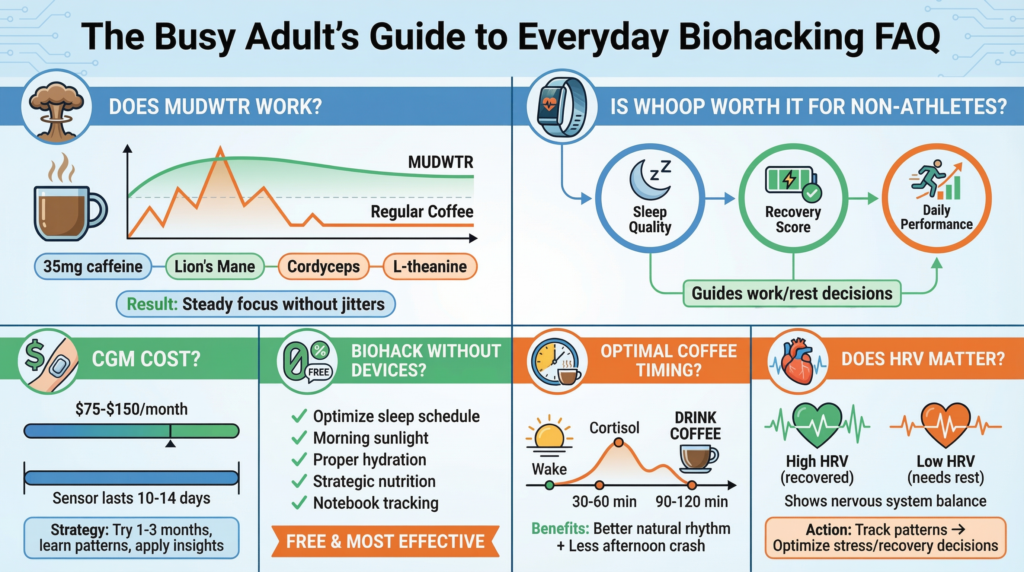
MUDWTR contains 35 milligrams of caffeine combined with functional mushrooms like lion’s mane and cordyceps, plus L-theanine. The combination provides cognitive support and alertness without the jittery overstimulation that high-caffeine coffee often causes.
The lower caffeine dose means you’re getting sustained energy as opposed to a sharp spike followed by a crash.
Individual responses vary based on caffeine sensitivity and personal physiology.
Is the WHOOP band worth it for someone who doesn’t train intensely?
The WHOOP band provides value even if you’re not an athlete. The recovery score helps you understand how stress, sleep quality, and daily activities affect your nervous system.
This information guides decisions about when to push hard at work versus when to prioritize recovery.
The sleep tracking alone justifies the investment if you’re trying to improve cognitive performance and energy management.
How much does continuous glucose monitoring cost?
Continuous glucose monitors typically cost between $75 and $150 per month, depending on the brand and subscription model. Some need a prescription while others are available directly to consumers.
The sensors usually last 10-14 days before needing replacement.
Many people use CGMs for short experiments of 1-3 months to understand their personal glucose responses, then apply those insights without needing continuous monitoring.
Can you biohack without expensive devices?
Absolutely. The most effective biohacking starts with optimizing sleep schedule, getting morning sunlight, proper hydration, and strategic nutrition choices.
These cost nothing and provide better returns than any expensive device.
Basic tracking with a notebook logging sleep times and subjective energy ratings reveals patterns that drive meaningful improvements. Technology becomes valuable after you’ve optimized the fundamentals and need deeper insights.
What time should I drink coffee for optimal performance?
Your cortisol naturally peaks 30-60 minutes after waking, so consuming caffeine immediately upon waking works against your natural rhythm. Waiting 90-120 minutes after waking allows your natural cortisol to do its job, then caffeine enhances, as opposed to replacing that alertness.
This timing also reduces the likelihood of afternoon crashes and sleep disruption.
Does heart rate variability actually matter?
Heart rate variability measures the variation in time between heartbeats and reflects your nervous system balance. Higher HRV generally shows better recovery and stress resilience.
Tracking HRV consistently reveals patterns that help you make better decisions about training intensity, stress management, and recovery needs. When your HRV is significantly suppressed, your system needs recovery as opposed to extra stress.
Key Takeaways
Effective biohacking for busy adults prioritizes optimization of existing habits as opposed to adding new time commitments to an already full schedule.
Measurement drives everything. Without tracking, you’re just guessing about what actually works for your unique physiology and lifestyle.
The fundamentals of sleep, stress management, movement, and nutrition provide dramatically better returns than expensive treatment or exotic protocols, and you cannot skip them.
Strategic supplementation and functional nutrition like MUDWTR provide real value when chosen based on identified bottlenecks as opposed to marketing claims or trends.
Wearable technology and tracking devices like WHOOP or Oura Ring become valuable after you’ve established consistent habits and need deeper insights for continued optimization.
Implementation needs patience and focus. Changing one variable at a time and measuring results over weeks as opposed to days allows you to actually identify what works versus what is just noise.
Your biohacking practice should scale gradually over time, starting with fundamentals and basic tracking, then adding technology and targeted interventions as you build competence and identify specific needs.