
What MUDWTR Actually Is
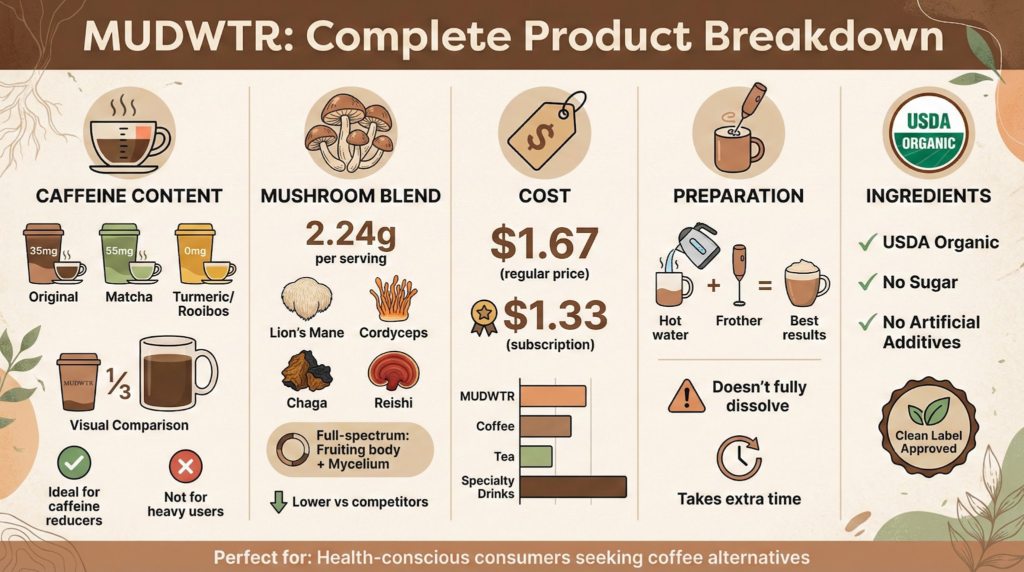
MUDWTR is a powdered drink mix that’s supposed to replace your morning coffee. The main version (which they call Rise Cacao) contains approximately 35mg of caffeine per serving.
That’s roughly one-third of what you’d get from regular coffee.
The ingredient list reads like someone raided a health food store. You’ve got four types of mushrooms (lion’s mane, cordyceps, chaga, and reishi), plus black tea, cacao, and a bunch of spices like cinnamon, turmeric, and ginger.
Everything’s organic.
No sugar added—no artificial anything.
They make four different blends. The original cacao one for mornings.
A matcha version with more caffeine (55mg).
A turmeric blend. And a nighttime rooibos one with sleep herbs.
Each serving has about 2.24 grams of mushroom powder. That’s less than some competitors, but MUDWTR uses what they call “full spectrum” mushrooms.
Both the fruiting body and the mycelium, instead of just the extracts.
The Ingredient Breakdown
The Mushroom Situation
Lion’s mane gets talked about a lot for focus and brain health. Although there is research on it, it is still in its early stages.
Most studies happen in labs or with animals.
The human trials are small and not super conclusive.
Cordyceps supposedly helps with energy and athletic performance. Again, the evidence is interesting but not definitive.
Chaga and reishi have some research backing up immune system support and anti-inflammatory effects. Reishi has been especially studied for stress response.
But these studies used higher doses than what you’re getting in a single serving of MUDWTR.
The thing about functional mushrooms is that the marketing claims run way ahead of the actual science. These ingredients show promise.
They include bioactive compounds that have various effects on your body.
But nobody can guarantee you’ll feel different after drinking this for a week.
The Spice Mix
Turmeric has curcumin, which has legit anti-inflammatory properties backed by research. Cinnamon provides antioxidants.
Ginger helps with digestion for some people.
Black pepper is in there, too, which actually matters because it helps your body absorb the curcumin better. So at least they thought that part through.
The amounts are probably more for flavor than therapeutic dosing, though. You’re not getting the same concentration you’d get from actual supplements.
The Caffeine Source
The black tea in the original blend gives you 35mg of caffeine. It’s enough to feel something, but not enough to replace coffee if you’re used to drinking three cups before noon.
The matcha version bumps it up to 55mg. Still way less than coffee. This is intentional; the whole point is lower caffeine with other ingredients that supposedly support focus without the jitters.
Check current MUDWTR pricing and availability here
How It Actually Tastes
This part is divisive as it’s based on user feedback across review sites.
The texture doesn’t fully dissolve. It settles at the bottom of your cup.
You’ll need to keep stirring or just accept that the last few sips will be grainy.
The flavor gets described as “earthy” a lot. Some people love it.
Others say it tastes like dirt.
The cacao and chai spices help make it more palatable than straight mushroom powder would be.
Mixing it with milk (dairy or non-dairy) and using a frother makes a huge difference. With water alone, it’s pretty intense.
With frothed oat milk, it tastes like a dirty chai latte that’s been toned down a bit.
The company sells a creamer and a sweetener to go with it. The creamer has coconut, so watch out if you’re allergic.
Without any additions, MUDWTR is pretty bitter.
What People Report Feeling
The energy effect seems to be subtle. Users say they feel alert but not wired. No jitters.
No racing heart.
But also, no major burst of energy as you’d get from a double espresso.
The focus benefit is even harder to pin down. Some people swear they can concentrate better.
Others don’t notice anything different.
This is probably where the placebo effect plays a role, along with whatever the lion’s mane is actually doing.
The crash avoidance is real, according to most reviews. Since there’s less caffeine, there’s less of a dramatic drop later in the day.
But if you’re switching from heavy coffee consumption, you might feel tired in the afternoon just from caffeine withdrawal.
Sleep quality supposedly improves when people switch from coffee to MUDWTR, but that’s probably just from cutting caffeine by two-thirds.
| Product Feature | Details | What It Means for You |
| Caffeine Content | 35mg (original), 55mg (matcha), 0mg (turmeric/rooibos) | About 1/3 the caffeine of coffee, good for reducing intake, not for heavy caffeine users |
| Mushroom Content | 2.24g per serving (lions mane, cordyceps, chaga, reishi) | Full-spectrum blend with fruiting body and mycelium, lower amount than some competitors |
| Cost Per Serving | $1.67 regular, $1.33 with subscription | More expensive than coffee or tea, similar to specialty coffee drinks |
| Mixing Requirements | Best with hot water and frother, doesn’t fully dissolve | Takes more effort than instant coffee, not ideal for rushed mornings |
| Ingredients | USDA organic, no sugar, no artificial additives | Clean label for people avoiding processed ingredients |
The Stuff You Need to Watch Out For
Medication Interactions
The nighttime rest blend has ashwagandha, valerian root, passionflower, and chamomile. All of these can interact with sedative medications.
If you take anything for sleep, anxiety, seizures, or related conditions, you need to check with your doctor before trying that blend.
The other versions might interact with diabetes medications, blood thinners, or blood pressure meds because of the herbs and mushrooms.
This isn’t just a beverage. It’s a beverage with active compounds that do things in your body.
Treat it accordingly.
The California Prop 65 Warning
MUDWTR has to display a Prop 65 warning for California customers. This is about naturally occurring compounds like lead that plants can pick up from the soil.
It doesn’t mean the product is toxic or dangerous at normal consumption levels.
The company says they do third-party testing. The transparency on what those tests show and what the standards are could be better.
Texture Issues
If you hate grainy textures, this will bother you. The powder doesn’t dissolve completely.
It settles.
You’ll get sediment at the bottom of your cup.
Using a milk frother or blender helps a lot. But it’s never going to be as smooth as regular coffee or tea.
Pros and Cons Based on User Feedback
What Works
Lower caffeine content helps people step down from heavy coffee consumption without going cold turkey. You still get some stimulation, but way less intensity.
The organic ingredient list appeals to people who care about that stuff. No artificial flavors or sweeteners.
No added sugar.
Everything is pronounceable.
The ritual aspect has value for some people. Taking time to froth and prepare the drink becomes part of a morning routine.
That matters more than you’d think.
Some users genuinely feel better switching from coffee to this. Whether that’s the mushrooms or just cutting caffeine is unclear.
What Doesn’t Work
The taste is polarizing. Plenty of people can’t get past the earthy flavor even with milk and a sweetener.
The cost adds up fast at $1.33 to $1.67 per serving. That’s $40-$50 per month if you drink it daily.
The energy boost is subtle to nonexistent for people used to high caffeine. If you need a kick in the ass to start your day, this probably won’t cut it.
The cognitive benefits are impossible to measure. You might feel more focused. You might not.
There’s no way to know if it’s the lion’s mane, just a placebo effect, or just having a consistent morning routine.
The mixing situation is annoying if you’re in a hurry. You can’t just pour and go like with instant coffee.
Who This Actually Makes Sense For
Coffee Reduction People
If you’re drinking four cups a day and dealing with anxiety or sleep problems because of it, MUDWTR gives you a way to cut back while still having a morning ritual. The small amount of caffeine prevents total withdrawal while getting you down to more reasonable levels.
Adaptogen Experimenters
If you’re already interested in functional mushrooms and adaptogens and want an easy way to consume them, this works. It’s more convenient than taking a bunch of separate capsules.
The taste might grow on you.
Morning Ritual Enthusiasts
Some people genuinely value the process of preparing something intentionally each morning. If you’re that type, the extra steps of mixing and frothing might actually be a feature instead of a bug.
Who Should Skip It
Heavy caffeine users won’t get what they need from 35mg. You’ll end up drinking MUDWTR and then making coffee anyway.
People on a tight budget can’t justify $40-50 per month for a drink when coffee or tea costs a fraction of that.
Anyone who needs convenience in the morning will get annoyed with the mixing requirements fast.
If you hate earthy flavors, this will sit in your cupboard after the first week.
View MUDWTR options at your preferred retailer here
The Value Question
At $40 for a 30-serving tin (with subscription), you’re looking at about $480 per year if you drink it daily.
Compare that to:
- Decent coffee beans: $15-20 per pound (roughly $200-300 per year)
- Basic black tea: under $100 per year
- Specialty mushroom supplements: $30-50 per month separately
So, it’s more expensive than coffee, but potentially cheaper than buying functional mushroom supplements separately.
The question is whether you actually get $480 worth of value from it. That depends entirely on whether the ingredients do anything noticeable for you specifically.
For someone making six figures who’s already spending money on supplements and optimization, $40 per month is negligible. For someone watching their budget, this is a tough sell.
Final Thoughts on This MUDWTR Review
MUDWTR delivers on being a lower-caffeine alternative to coffee with organic ingredients and no artificial additives. The ingredient list includes compounds that have some research backing, even if that research doesn’t guarantee you’ll personally feel different.
What it doesn’t deliver is obvious, measurable cognitive enhancement or energy that you can point to and say, “Yes, that’s definitely the mushrooms working.” The effects are subtle at best. For some people, subtlety is enough.
For others, subtle might as well be a placebo.
The taste is acceptable with the right additions (milk, sweetener, frother). Without those, it’s pretty rough for most people based on user reviews.
The price positions this as a premium product for people who are willing to pay more to experiment with functional ingredients. If you’re that person, the cost won’t bother you.
If you’re not, regular coffee or tea will serve you just fine for a fraction of the price.
The real value might be in what MUDWTR helps you avoid (excessive caffeine and the crashes that come with it) as opposed to what it actively provides. If cutting your caffeine intake while maintaining some morning stimulation matters to you, this works for that purpose.
Check current MUDWTR pricing and see if it fits your budget here
If you want to try MUDWTR yourself, they have a starter kit that includes a frother and a tin. That’s probably the best way to test it since the frother actually matters for texture.
For comparing different flavors, the variety pack lets you test the original, matcha, and turmeric versions without committing to 30 servings of one flavor you might hate.
If you’re skeptical about the price, start with a single tin before subscribing. The subscription saves you money but only makes sense if you actually like the stuff and drink it consistently.