
They read about some compound that supposedly turns your brain into a supercomputer, order it immediately, take it inconsistently for a week, feel nothing dramatic, and declare the whole category snake oil. Or worse, they stack five different products together, feel weird and jittery, and blame the entire concept instead of their haphazard approach.
Choosing a nootropic stack needs more thought than most people give it. You’re not picking a multivitamin here.
You’re selecting compounds that interact with neurotransmitter systems, stress response pathways, and cellular energy production in your brain. Getting this right means understanding what these products claim to do, how they actually work, and whether the science backs up those mechanisms for someone like you.
I’ve seen the confusion firsthand. Professionals with genuinely demanding cognitive workloads who would benefit from the right support get paralyzed by conflicting information and marketing noise.
The supplement industry hasn’t made this easier, with products ranging from rigorously formulated stacks backed by clinical research to essentially random combinations of trendy ingredients at doses that wouldn’t affect a mouse.
What I want to share here is how to cut through that noise with a framework for evaluating what actually matters when you’re investing in cognitive support.
You might also like to read:
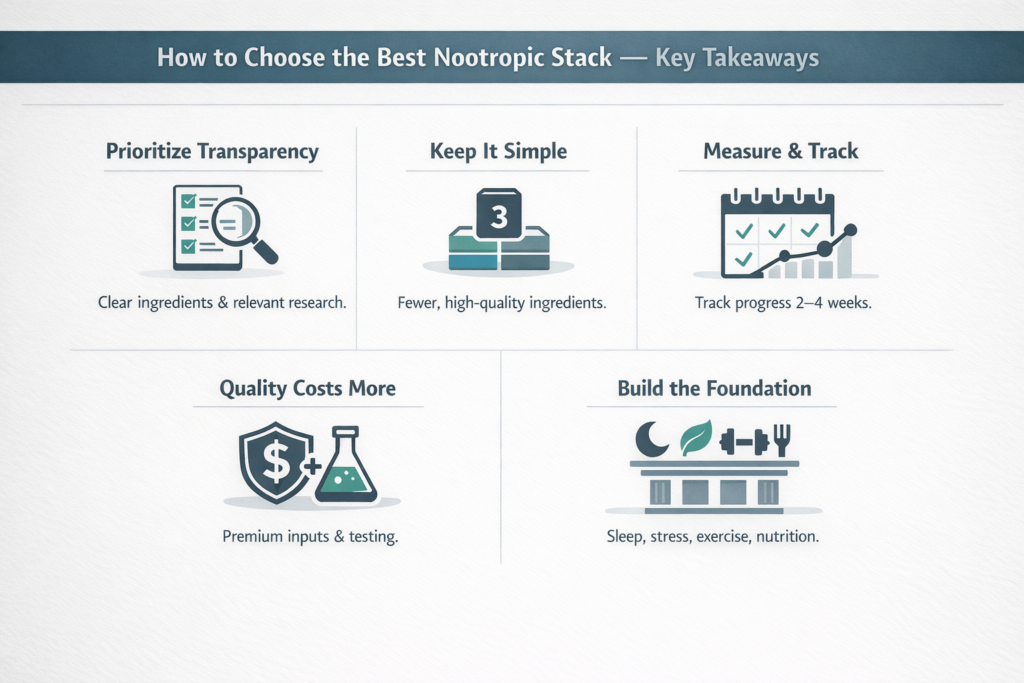
Table of Contents
What Makes Nootropic Stacks Different From Single Ingredients
When you take a single nootropic ingredient, say, just citicoline or just bacopa, you’re targeting one specific mechanism. Citicoline supports acetylcholine synthesis and membrane health.
Bacopa influences memory consolidation pathways.
Each does its thing independently.
Stacks operate on a fundamentally different principle. Cognitive performance comes from many systems working together.
Your ability to focus for three hours straight depends on neurotransmitter availability, cellular energy production, stress hormone regulation, and neuroplasticity mechanisms, all functioning optimally at once.
A well-designed stack addresses several of these pathways simultaneously, creating what researchers call synergistic effects. In theory, this means 2+2 equals 5.
The combined impact exceeds what you’d get from taking ingredients separately.
Here’s where I need to be honest with you, though. The research on specific stack combinations is genuinely thin. We have decent evidence for nootropic compounds.
We have some evidence for specific two-ingredient combinations.
But finish multi-ingredient formulations? The clinical trials just don’t exist in most cases.
This doesn’t mean stacks don’t work. It means you need to assess them based on the evidence for their personal components, the logic of how those components might interact, and the integrity of the company making formulation decisions.
You’re making an informed bet, not following a guaranteed blueprint.
The better manufacturers understand this reality. They design stacks around ingredients that have been studied independently with clear mechanisms of action, then mix them in ways that target complementary pathways as opposed to creating massive ingredient lists hoping something works.
This approach allows you to trace the reasoning behind each component as opposed to just trusting that fifteen different compounds thrown together will somehow produce optimal results.
The Ingredient Quality Problem Nobody Talks About
Most people compare nootropics by looking at ingredient lists. They see “bacopa extract” on two different products, assume they’re getting the same thing, and choose whichever costs less.
This is a massive mistake that probably explains half the “nootropics don’t work” complaints online.
Herbal extracts vary wildly in potency depending on how they’re processed and standardized. Bacopa provides a perfect example. The clinical research showing memory benefits used extracts standardized to contain 50% bacosides.
Those are the active compounds that actually do something in your brain. But plenty of supplements use bacopa extracts with just 15-20% bacosides, or worse, don’t specify the standardization at all.
You could take the recommended dose of a low-potency bacopa product and receive one-third the active compounds used in successful clinical trials. Then you conclude bacopa doesn’t work, when really you just took a weak version of it.
This pattern repeats across nearly every herbal ingredient in nootropic stacks. Ashwagandha extracts range from 1.5% to 10% withanolides.
Rhodiola varies in rosavins and salidrosides.
Ginseng extracts differ in ginsenoside content.
Premium manufacturers specify these standardization levels clearly on their labels and use the potencies that match clinical research. Budget products often skip this entirely, listing ingredients by name without quality specifications.
The price difference reflects whether you’re actually getting therapeutic doses of active compounds.
When I assess a stack now, I specifically look for standardized extract information before I even consider whether I want those ingredients. A perfectly formulated stack using low-quality sources will underperform a simpler stack using clinical-grade ingredients every single time.
The transparency around sourcing tells you a lot about a company’s priorities. If they’re willing to detail exactly where ingredients come from, what standardization levels they use, and how potency gets verified, they’re confident in their formulation.
When companies hide behind vague descriptions or proprietary blends, they’re usually concealing weak dosing or inferior sources.
Why Demographics Matter More Than You Think
Here’s something that bothered me when I started really digging into nootropic research. Most clinical trials are conducted on elderly populations with age-related cognitive decline.
This makes sense from a research funding perspective.
Cognitive decline is a medical problem, so studies get grants. But if you’re a healthy 38-year-old professional trying to improve already-normal cognition, do those studies actually apply to you?
Sometimes yes, often no. The mechanisms might translate, but the effect sizes frequently don’t.
An ingredient that significantly improves memory in 70-year-olds with measurable impairment might do very little for someone whose memory works fine already.
The companies that take formulation seriously actively seek out research conducted on young, healthy adults as opposed to just relying on the larger body of aging-population studies. This demographic difference actually influenced HVMN’s decision to switch from alpha-GPC to citicoline in their Rise reformulation.
Both compounds support acetylcholine production, but citicoline has stronger evidence in younger demographics, while alpha-GPC research focuses heavily on elderly populations.
This demographic matching should influence your evaluation process. When you’re researching an ingredient, don’t just look for studies showing it works.
Look for studies showing it works in people similar to you.
A 45-year-old executive and a 75-year-old with mild cognitive impairment have very different baselines and very different response profiles.
Age affects how you metabolize supplements, what deficiencies you’re likely to have, and what cognitive functions need the most support. The ingredient selection that makes sense for someone trying to slow age-related decline doesn’t necessarily make sense for someone trying to improve peak performance during demanding work periods.
The Simple Stack Philosophy
There’s a really strong temptation in supplement formulation to keep adding ingredients. If bacopa helps memory and ashwagandha reduces stress and citicoline supports focus, why not add rhodiola for energy and lion’s mane for neurogenesis and phosphatidylserine for cellular health…, and you see where this goes.
The problem is that every ingredient you add creates potential interactions with every other ingredient. With five ingredients, you have ten possible two-way interactions.
With ten ingredients, you have forty-five possible two-way interactions, plus three-way interactions, plus four-way interactions.
Almost none of these combinations have been studied. You’re essentially running an uncontrolled experiment on your own neurochemistry.
The best formulators I’ve encountered have moved toward what they call simple stacks. Fewer ingredients at higher quality and clinical doses.
HVMN’s Rise contains just a handful of primary active ingredients.
This doesn’t mean they couldn’t afford more ingredients or didn’t know about other compounds. They prioritized known quantities over theoretical benefits.
This philosophy makes even more sense when you consider that most people using nootropic stacks also take other supplements. If you’re already getting omega-3s separately, vitamin D separately, maybe magnesium and probiotics separately, adding all of those to your nootropic stack just creates redundancy and potential overdosing issues.
I’ve actually found that simple, focused stacks combine better into existing supplement routines precisely because they don’t try to be everything at once. You can mix a well-designed cognitive stack with your separate foundational supplements without worrying about getting 200% of something or creating weird interactions.
The other advantage of simpler formulations is that you can actually track what’s working. When you take fifteen ingredients simultaneously, you have no idea which ones are contributing to positive effects and which ones are just along for the ride.
With a focused stack, you can more easily connect specific ingredients to specific outcomes in your own experience.
How HVMN Actually Approaches Formulation
Looking at specific products helps illustrate these principles in practice. HVMN’s approach to their Rise stack shows what rigorous formulation looks like.
Their transparent explanation of ingredient selection reveals the thought process that separates evidence-based products from marketing-driven ones.
Their current Rise formulation centers on three primary ingredients: bacopa, ashwagandha, and citicoline. Each serves a distinct function with solid research backing.
The bacopa they use is standardized to 50% bacosides, matching the potency used in clinical trials showing memory formation benefits. Bacopa influences BDNF production, which affects both cognitive performance and neuroplasticity.
The mechanism is measurable through goal biomarkers, not just subjective feelings.
Their choice of ashwagandha over the previous rhodiola formulation reflects updated research priorities. Both are adaptogens that help manage stress, but ashwagandha has stronger evidence for reducing both subjective anxiety and goal cortisol levels in working-age adults.
The interesting bonus is that quality ashwagandha research also shows benefits for muscle strength and cardiovascular fitness, making it relevant for people optimizing physical performance alongside cognitive function.
The citicoline selection shows demographic thinking. Alpha-GPC has a larger research base overall, but much of it focuses on elderly populations or people with cognitive impairment.
Citicoline has cleaner evidence in young, healthy adults actually trying to improve normal function as opposed to treating decline.
One ingredient isn’t universally better. It comes down to matching the research population to the actual user base.
HVMN’s secondary product, Kado, takes a different angle entirely by focusing on foundational micronutrients as opposed to acute cognitive enhancement. The combination of omega-3s, vitamin D, vitamin K, and astaxanthin addresses underlying nutritional needs that affect brain health over time, as opposed to providing immediate cognitive effects.
What I appreciate about this two-product approach is the implicit acknowledgment that cognitive optimization works on different timescales. You need foundational nutritional support for long-term brain health, and you need targeted nootropic support for immediate cognitive demands.
Trying to mix everything into one mega-formula creates the interaction problems I mentioned earlier.
What About Momentous and Kion
The market definitely includes other legitimate options beyond HVMN. Momentous takes a more modular approach with simpler formulations focusing on single mechanisms.
Their Alpha-GPC product, for instance, provides cholinergic support without combining it with adaptogens or other pathways.
This approach has real merit for people who want precise control over their stack. You can add or remove components based on your response, as opposed to committing to a pre-designed combination.
The downside is complexity.
You’re essentially building your own stack, which needs more research and experimentation to get right.
Kion, backed by Ben Greenfield, emphasizes premium ingredient sourcing and tends toward minimalist formulations as well. Their philosophy aligns with the simple stack approach, though specific formulations vary by product line.
The honest assessment is that several companies are doing this thoughtfully now. What separates the good from the mediocre is transparency about why those ingredients were chosen, willingness to reformulate based on new evidence, and commitment to quality control through batch testing and third-party verification.
Building Your Personal Selection Framework
When you’re actually choosing a stack for yourself, you need to work through several layers of evaluation beyond just reading marketing claims.
Start by defining your actual cognitive goal with specificity. “Better focus” is too vague.
Are you trying to extend deep work sessions from 45 minutes to 90 minutes?
Improve information retention during learning? Maintain decision-making quality under stress?
Reduce mental fatigue during afternoon hours?
Your specific goal immediately eliminates most products because they’re optimized for different outcomes. A stack designed primarily for memory formation won’t necessarily excel at sustained attention.
An energy-focused formula might not help with stress resilience.
Next, assess your baseline honestly. If you’re sleeping five hours per night, chronically stressed, eating poorly, and sedentary, no nootropic stack will deliver impressive results.
These products amplify solid fundamentals.
They don’t replace them. I’ve seen people invest in premium stacks while ignoring basic sleep and stress management, then wonder why they feel nothing.
You also need to identify your constraints. Budget obviously matters.
Clinical-grade ingredients cost more than commodity versions, and that price difference shows up in results.
Sensitivity to stimulation matters too. Some people feel great with mild stimulant-like effects from certain nootropics, while others find even subtle stimulation uncomfortable.
Existing supplement routines create constraints as well. If you’re already taking separate choline, omega-3s, and adaptogens, a stack containing all those ingredients might create unnecessary redundancy.
The Research Process for Specific Ingredients
Once you’ve shortlisted products based on your goals and constraints, dig into the actual ingredient research. This means looking up the primary compounds on databases like Examine.com or PubMed to see what the science actually shows.
For each main ingredient, you’re looking for several things. First, clinical trial data on human subjects, not animal studies or in-vitro research.
Animal studies provide interesting mechanisms but don’t prove human efficacy.
Second, dosage information from successful trials. Third, whether the product you’re considering matches those clinical dosages.
Fourth, consistency of results across many independent studies as opposed to one or two positive findings.
Pay particular attention to effect sizes in research. A statistically significant result might show just a 5% improvement, or it might show a 30% improvement.
Both are “significant,” but one matters more practically than the other.
Also, check whether studies used the compound alone or in combination with other ingredients. If the research showing benefits used a multi-ingredient formula, you can’t necessarily attribute effects to just one component of that formula.
This research process sounds time-consuming, and honestly, it is. But you’re making a decision about compounds that will interact with your neurochemistry potentially for months or years.
An afternoon of research before committing seems reasonable due diligence.
Quality Control and Manufacturing Standards
Manufacturing quality separates premium supplements from commodity products even when ingredient lists look similar. Legitimate manufacturers apply several practices that protect product integrity.
Batch testing both before and after production catches contamination and verifies that finished products actually contain what the label claims. Third-party verification from organizations like NSF or Informed-Sport adds another layer of accountability.
The manufacturer doesn’t just test their own products.
An independent lab confirms the results.
Transparent disclosure of ingredient sourcing and potency standardization signals confidence in the formulation. When companies use proprietary blends that hide personal ingredient amounts, they’re often concealing weak dosing or low-quality sources.
Certificate of Analysis documents should be accessible, showing detailed test results for purity, potency, and contamination screening. Companies serious about quality make this information available without you having to specifically request it.
These quality practices cost money to apply, which is part of why premium supplements cost more. You’re paying for verification systems that confirm you actually receive what you’re buying, not just for fancy packaging.
Starting Your Trial Protocol
When you’ve selected a stack and you’re ready to actually try it, establish a measurement protocol before you start. Without baseline data, you have no way to separate placebo effects from genuine results.
Document your current cognitive performance across whatever metrics matter for your goals. If focus is your target, time how long you can sustain attention on demanding work before distraction.
If memory is your goal, test information retention using specific material.
If stress resilience matters, note your subjective stress levels and, if possible, goal markers like resting heart rate variability.
Start with half the recommended dose for the first few days. Many nootropics show dose-response curves where doubling intake doesn’t double benefits and sometimes creates unwanted effects.
Finding your personal least effective dose often means starting low and increasing only if needed.
Consume the stack consistently at the same time each day for at least two to four weeks before evaluating results. Some ingredients, particularly adaptogens, need sustained use to show full effects.
Intermittent use won’t give you accurate information about what the stack actually does.
Track your metrics weekly as opposed to daily. Day-to-day variation from sleep quality, stress, diet, and dozens of other factors creates noise that masks genuine trends.
Weekly averages smooth out that noise and reveal actual patterns.
Note timing effects as well. When you take the stack relative to meals, caffeine, exercise, and demanding work.
Many people find that nootropics perform optimally when consumed 30-45 minutes before mentally intensive tasks as opposed to randomly throughout the day.
Common Implementation Mistakes
The most frequent mistake I see is expecting a dramatic, immediate transformation. People take a nootropic stack and wait to feel superhuman.
When they just feel slightly clearer or moderately more focused, they assume it didn’t work.
Realistic expectations matter here. Quality nootropics typically produce 15-30% improvements in specific cognitive metrics.
Longer focus duration, faster information retrieval, and better stress regulation.
These are meaningful improvements that compound over weeks and months, but they’re not going to feel like suddenly having superpowers.
Another common error is using stacks to compensate for inadequate sleep. You cannot supplement your way out of chronic sleep deprivation.
Cognitive enhancement needs cognitive recovery, and recovery happens during sleep.
If you’re regularly getting less than seven hours, fixing that should be your first priority, not adding supplements.
People also frequently ignore potency standardization, as I mentioned earlier. Seeing the same ingredient name on two products doesn’t mean you’re getting equivalent formulations.
Always verify standardized extract percentages before assuming products are comparable.
Overlapping ingredients across many supplements create both waste and potential problems. If your multivitamin already contains B-vitamins and your nootropic stack does too, and you take a separate B-complex, you might end up with unnecessarily high doses that don’t provide extra benefits and might cause side effects.
There’s also the mistake of never cycling off to assess the baseline. If you take the same stack continuously for months, you lose track of what your performance looks like without it.
Periodic breaks, maybe one week off every eight to twelve weeks, let you verify whether the stack is still providing benefits or whether you’ve adapted to the point where effects have diminished.
Frequently Asked Questions
Does bacopa help with memory?
Bacopa monnieri has been shown in many clinical trials to improve memory formation and retention, particularly when standardized to 50% bacosides. The effects typically become noticeable after several weeks of consistent use as opposed to immediately.
Studies conducted on younger adults show moderate improvements in information processing and memory consolidation.
What does citicoline do for the brain?
Citicoline supports acetylcholine production, a neurotransmitter involved in memory and attention. It also contributes to phospholipid synthesis, which maintains healthy cell membranes in brain tissue.
Research in healthy adults shows improvements in attention and focus, particularly during mentally demanding tasks.
Is ashwagandha good for brain function?
Ashwagandha primarily functions as an adaptogen, helping regulate stress responses and cortisol levels. By reducing stress and anxiety, it indirectly supports cognitive performance, particularly in situations where stress would normally impair focus and decision-making.
Some research also suggests benefits for memory and reaction time.
How long does it take for nootropics to work?
The timeframe varies significantly by ingredient type. Some compounds like caffeine or citicoline, may produce noticeable effects within 30-60 minutes.
Adaptogens like ashwagandha typically need 2-4 weeks of consistent use to show full benefits.
Bacopa often needs 6-8 weeks before memory improvements become obvious.
Can you take nootropics every day?
Most nootropic ingredients are designed for daily use and show better results with consistent consumption as opposed to sporadic dosing. However, occasional breaks every few months can help you assess whether the stack is still providing benefits and prevent potential adaptation to certain compounds.
Do I need to cycle off nootropics?
Cycling depends on the specific ingredients in your stack. Some compounds benefit from periodic breaks to maintain effectiveness, while others work better with continuous use.
A reasonable approach is to take one week off every 8-12 weeks to reassess your baseline cognitive performance and verify ongoing benefits.
What should I look for on a nootropic supplement label?
Look for standardized extract percentages that match clinical research doses, clear disclosure of personal ingredient amounts as opposed to proprietary blends, third-party testing verification, and transparent information about ingredient sourcing. These factors show quality and allow you to compare products accurately.
Are expensive nootropics worth it?
Price often reflects ingredient quality, standardization levels, and manufacturing standards as opposed to just marketing. Premium products typically use clinical-grade extracts at research-backed doses with third-party testing verification.
Budget products may contain the same ingredient names, but at lower potencies or inferior quality, which can significantly affect results.
Key Takeaways
Choose nootropic stacks based on transparent ingredients, standardized extract potencies, and research conducted on demographics similar to your own, as opposed to just marketing claims or ingredient count.
Simple, focused formulations with fewer high-quality ingredients typically outperform complex stacks with dozens of components because they minimize unstudied interactions.
Establish baseline measurements before starting any stack and track specific metrics weekly for at least 2-4 weeks to separate genuine effects from placebo responses.
Quality supplements cost more because premium ingredients, standardization verification, and third-party testing all need investment. Price differences reflect actual formulation quality, not just branding.
Nootropic stacks amplify solid fundamentals in sleep, stress management, exercise, and nutrition, but cannot replace them. Optimization needs a foundation worth optimizing.