
Introduction
For the past decade, I’ve watched the biohacking movement evolve from a fringe subculture of self-experimenters into a legitimately sophisticated approach to human optimization. This article outlines essential Biohacking Tips for Busy Professionals, enabling them to incorporate comprehensive methodologies into demanding schedules without losing their minds or their weekends.
The challenge I’ve consistently encountered, both personally and through working with high-performing professionals, is that most biohacking advice assumes you have unlimited time, resources, and the ability to restructure your entire life around optimization protocols. The reality is fundamentally different.
You’re managing teams, traveling across time zones, navigating back-to-back meetings, and somehow trying to maintain relationships and sanity simultaneously.
Through years of experimentation and refinement, I’ve learned that effective biohacking for professionals involves identifying high-leverage interventions that deliver measurable returns with minimal time investment. The most successful professionals I’ve worked with don’t try to improve everything simultaneously.
They systematically apply specific protocols that compound over time, creating sustainable enhancement as opposed to temporary spikes followed by inevitable crashes.
You might also like to read:
Table of Contents
Understanding the Foundation of Professional Biohacking
In this section, we will delve deeper into the Biohacking Tips for Busy Professionals and explore how leveraging specific protocols can enhance productivity and health simultaneously.
The theoretical framework underlying practical biohacking rests on a surprisingly simple premise: biological systems respond predictably to specific inputs. Your body operates according to evolutionary programming that hasn’t fundamentally changed despite our radically transformed environment.
The mismatch between ancestral conditions and modern professional life creates most of the dysfunction we experience as stress, fatigue, brain fog, and metabolic dysfunction.
What makes biohacking particularly relevant for busy professionals is the concept of leverage. Traditional wellness advice often recommends sweeping lifestyle changes that require a complete restructuring of your daily routine.
Biohacking, when properly implemented, identifies the specific interventions that produce disproportionate results relative to time invested. We’re talking about measurable improvements in cognitive function, energy stability, and stress resilience within weeks, not marginal gains accumulated over decades.
The practical application of biohacking principles involves understanding that your biology operates through interconnected systems, rather than isolated functions. When you improve sleep architecture, you’re simultaneously improving cognitive performance, metabolic function, and immune response.
When you enhance mitochondrial efficiency, you’re upgrading energy production, reducing inflammation, and supporting cellular repair mechanisms.
This systemic approach means that strategic interventions create cascading benefits throughout many biological pathways.
The challenge most professionals encounter is distinguishing between evidence-based protocols and speculative trends. The biohacking space is unfortunately cluttered with overhyped interventions lacking robust scientific support.
Through extensive research and personal experimentation, I have found that the most effective protocols typically rest on well-established physiological principles, even when the specific application represents a novel approach.
1. Morning Light Exposure Protocol
The single most underutilized biohacking intervention among busy professionals is deliberate morning light exposure. Your circadian timing system, controlled primarily by the suprachiasmatic nucleus in your hypothalamus, needs specific light inputs to maintain optimal synchronization.
When you expose your eyes to bright light within the first hour of waking, you trigger a cascade of hormonal and neurological responses that set the tone for your entire day.
The mechanism here is really fascinating. Specialized photoreceptors called intrinsically photosensitive retinal ganglion cells detect blue wavelengths in natural sunlight and send signals directly to your circadian control centers.
This starts cortisol release for alertness, suppresses residual melatonin, and starts a countdown timer that decides when melatonin production will resume approximately 14-16 hours later.
Implementing this protocol needs absolutely no special equipment or significant time investment. Step outside within 30 minutes of waking and expose your eyes to natural outdoor light for 5-10 minutes.
Even on overcast days, outdoor light provides substantially more luminosity than indoor lighting.
If you’re in a location or season where early outdoor access is impractical, position yourself near a window during your morning routine or invest in a 10,000 lux light therapy device.
The practical benefits manifest across many domains. Professionals who consistently apply morning light exposure report improved sleep onset latency, reduced afternoon energy crashes, better mood regulation, and enhanced cognitive performance during morning work blocks.
The protocol becomes particularly valuable when managing jet lag or recovering from schedule disruptions.
I’ve personally found that this single intervention has done more for my energy stability than any supplement or fancy device I’ve tried.
The key is consistency. Your circadian system responds to regular, predictable signals.
Missing a day here and there won’t derail your progress, but erratic implementation prevents your biology from establishing reliable rhythms.
Make this part of your non-negotiable morning routine, like brushing your teeth. The time investment is minimal, but the downstream effects touch virtually every aspect of your performance and recovery.
2. Strategic Caffeine Timing
Most professionals consume caffeine completely wrong, undermining both its acute benefits and their natural energy rhythms. The standard practice of immediately reaching for coffee upon waking actually works against your biology as opposed to supporting it.
Your cortisol naturally peaks in the first 60-90 minutes after waking, providing organic alertness without external stimulation.
Understanding the pharmacological properties of caffeine changes how you approach this hidden stimulant. Caffeine has a half-life of approximately 5-6 hours for most people, meaning that if you drink a cup at 3 PM, 50% of the caffeine will still be active at 9 PM.
This residual caffeine interferes with adenosine receptors that signal sleep pressure, disrupting sleep architecture even when you subjectively feel you’re sleeping fine.
The optimized approach involves delaying first caffeine consumption until 90-120 minutes after waking, allowing your natural cortisol peak to provide morning alertness. This strategic delay actually increases caffeine’s effectiveness when you do consume it because you’re working with natural energy dips instead of against cortisol peaks.
Set a hard cutoff for caffeine consumption at least 10 hours before your target bedtime.
For professionals managing demanding schedules, this timing adjustment creates more stable energy throughout the day. You’ll notice reduced late-afternoon crashes because you’re not fighting caffeine withdrawal, and improved sleep quality because adenosine signaling remains intact during evening hours.
The modification needs zero extra time investment while delivering substantial returns on cognitive performance and recovery.
I’ll be honest, the first week of delaying my morning coffee felt genuinely difficult. I’d built such a strong association between waking and caffeine that breaking the pattern created real psychological discomfort.
But after pushing through that initial adjustment period, I found that my natural morning alertness actually improved, and when I did have caffeine, it worked noticeably better.
My afternoon energy became far more predictable and stable.
3. Time-Restricted Eating Windows
Metabolic flexibility represents one of the most valuable yet underappreciated aspects of physiological optimization for professionals. Your body can derive energy from either glucose or fatty acids, but most modern eating patterns lock you into glucose dependence, creating energy instability and metabolic dysfunction.
Time-restricted eating addresses this by consolidating food intake into specific time slots, typically 8-10 hours.
The mechanisms at work go well beyond merely limiting calories. You can improve insulin sensitivity, boost mitochondrial function, encourage metabolic switching between fuel sources, and activate cellular cleanup processes called autophagy by extending the fasting time between dinner and breakfast to 14–16 hours.
These changes translate directly into more stable energy, improved focus, and reduced inflammation.
Implementation looks different for each professional depending on schedule constraints and personal preferences. A common approach involves finishing dinner by 7 PM and delaying breakfast until 9-11 AM, creating a 14-16-hour overnight fast.
During the fasting window, water, black coffee, and plain tea are acceptable.
The eating window itself doesn’t require special foods or restrictions, though food quality obviously influences results.
Professional environments actually make this easier than it seems. Not having to plan and prepare breakfast makes morning meetings more manageable.
Energy stays stable without mid-morning snacking.
Mental clarity often improves during fasted states once you’re adapted, typically after 2-3 weeks of consistent practice. The key is maintaining consistency as opposed to pursuing aggressive fasting protocols that create unnecessary stress.
The adjustment period varies considerably between people. Some people transition smoothly within days, while others need several weeks before fasted mornings feel comfortable.
Your personal response depends partly on your current metabolic flexibility and partly on how carbohydrate-dependent your existing diet is.
If you’re now eating high-carb meals throughout the day, the transition will take longer than if you’re already eating moderate carbs with adequate protein and fat.
4. Heart Rate Variability Tracking
For busy professionals, measuring recovery capacity is a revolutionary use of wearable technology. Heart rate variability measures the fluctuation in time intervals between heartbeats, providing a reliable window into autonomic nervous system balance.
Higher HRV generally shows better stress resilience and recovery capacity, while declining HRV signals accumulated fatigue or inadequate recovery.
The physiological basis here involves the interplay between sympathetic and parasympathetic nervous system activity. Your heart rate constantly fluctuates in response to breathing, stress, recovery, and metabolic demands.
When you’re well-recovered and stress-resilient, your nervous system displays flexibility reflected in high beat-to-beat variability.
Chronic stress, inadequate sleep, or overtraining reduces this variability.
Tracking HRV needs minimal investment in either a chest strap watch or a wrist-worn device paired with analysis software. The most actionable approach involves measuring HRV each morning immediately upon waking, creating a baseline over 2-3 weeks, then using daily readings to guide training intensity, workload, and recovery prioritization.
When HRV drops significantly below your baseline, you apply aggressive recovery protocols as opposed to pushing through.
For professionals, this creates an objective metric for decision-making around schedule intensity. Instead of relying on subjective energy assessments, you have quantifiable data indicating when to push hard versus when to prioritize recovery.
I’ve seen executives use HRV data to strategically schedule high-stakes presentations, delay intensive travel, and improve training around important professional events.
The data removes guesswork and prevents the common pattern of accumulating stress until you’re forced into recovery by illness or injury. You learn to recognize the early warning signs that your system needs restoration, then act on that information proactively.
This approach changes recovery from something that happens passively into an active component of your performance strategy.
5. Nasal Breathing Practice
Respiratory patterns profoundly influence autonomic nervous system activity, cognitive performance, and metabolic efficiency, yet most professionals default to suboptimal breathing mechanics. Chronic mouth breathing, common especially during sleep and exercise, bypasses the nose’s filtration, humidification, and nitric oxide production functions while promoting sympathetic nervous system dominance.
The nose produces nitric oxide, a molecule that dilates blood vessels, improves oxygen utilization, and supports immune function. When you breathe exclusively through your nose, particularly during low-to-moderate intensity activities, you enhance oxygen delivery to tissues, promote parasympathetic activity, and improve carbon dioxide tolerance.
These changes translate into better stress regulation and sustained cognitive performance.
Implementing nasal breathing starts with conscious awareness during routine activities. Make a deliberate effort to keep your mouth closed and breathe through your nose during desk work, walking, and light exercise.
If you find that nasal breathing feels difficult or restricted, this shows either chronic congestion or inadequate adaptation.
For sleep, some professionals use medical tape to gently keep the mouth closed, forcing nasal breathing throughout the night.
The transition period typically involves 2-4 weeks of conscious practice before nasal breathing becomes automatic. During this time, you’ll likely notice improved sleep quality, reduced morning dry mouth, better daytime energy, and enhanced focus during mentally demanding tasks.
The protocol needs zero time investment beyond initial awareness and delivers continuous benefits 24 hours daily once established.
I found the sleep taping strange and uncomfortable at first, but after the first few nights, I stopped noticing the tape entirely. What I did notice was waking up without the dry mouth and scratchy throat that had been my normal morning symptoms for years.
My sleep tracker showed fewer nighttime disruptions, and I felt genuinely more restored in the mornings.
The improvement was subtle at first, building over several weeks into something really meaningful.
6. Cold Exposure Therapy
Deliberate cold exposure represents one of the most potent hormetic stressors available to busy professionals. Hormetic stress means controlled stress application that creates useful changes in the body.
Brief exposure to cold water or air triggers a cascade of physiological responses, including norepinephrine release, brown fat activation, improved insulin sensitivity, and enhanced immune function.
The mechanism centers on forcing your body to generate heat and maintain core temperature against external cold stress. This metabolic challenge activates brown adipose tissue, specialized fat that burns calories to produce heat as opposed to storing energy.
Cold exposure also triggers significant norepinephrine release, improving mood, focus, and alertness while reducing inflammation through various signaling pathways.
The practical implementation for time-constrained professionals involves ending daily showers with 30-90 seconds of cold water or taking 2-3 minute cold showers 3-4 times weekly. Start with brief exposures at the coolest comfortable temperature, gradually increasing duration and decreasing temperature over several weeks.
The goal is to create moderate discomfort that needs focused breathing as opposed to extreme suffering.
Many professionals report that cold exposure provides an immediate cognitive boost and energy lift that rivals or exceeds caffeine without the downstream crashes. The practice also builds genuine stress resilience by repeatedly practicing calm breathing and mental control during physiological stress.
Over time, you’ll notice improved cold tolerance, faster recovery from workouts, and enhanced mood regulation throughout demanding days.
The psychological component here matters as much as the physiological aspects. Learning to maintain calm breathing and mental composure while your body screams at you to escape the cold translates directly to high-pressure professional situations.
You’re training your nervous system to stay regulated under stress, and that training can be applied to a variety of different stressors.
7. Omega-3 Optimization
Cellular membrane composition fundamentally influences neurological function, inflammation regulation, and metabolic health, yet most professionals consume dramatically not enough omega-3 fatty acids relative to omega-6 intake. This imbalance promotes systemic inflammation, impairs cognitive function, and increases cardiovascular risk.
Correcting this ratio represents one of the highest-leverage nutritional interventions available.
EPA and DHA, the active omega-3 fatty acids found primarily in marine sources, serve as structural components of neuronal membranes and precursors to anti-inflammatory signaling molecules. Adequate intake supports cognitive performance, mood regulation, cardiovascular health, and exercise recovery.
Most professionals require substantially more than current consumption patterns provide through diet alone.
The practical approach involves either consuming fatty fish 3-4 times weekly or supplementing with high-quality fish oil providing at least 2-3 grams combined EPA and DHA daily. Blood testing can quantify your omega-3 index, the percentage of red blood cell membranes composed of omega-3s, with optimal levels above 8%.
This objective measurement removes guesswork from supplementation decisions.
Implementation is really straightforward because it needs only consistent supplementation or dietary adjustment as opposed to complex protocols or timing strategies. Most professionals notice subtle improvements in focus, mood stability, and recovery within 4-8 weeks as membrane composition shifts.
The intervention works continuously in the background, supporting many physiological systems without requiring ongoing attention or time investment.
8. Walking Meetings and Movement Snacking
Sedentary behavior creates profound metabolic and cognitive dysfunction independent of formal exercise. Even professionals who train regularly often accumulate 8-10 hours of sitting during workdays, triggering insulin resistance, reduced blood flow, and decreased cognitive performance.
Breaking up prolonged sitting with brief periods of movement addresses these issues while actually enhancing, as opposed to interrupting, productivity.
The concept of movement snacking involves brief 2-5 minute movement breaks every 45-60 minutes throughout the workday. These breaks reverse the metabolic consequences of sitting, restore blood flow, and provide cognitive refreshment.
Walking meetings represent a longer-form application of the same principle, combining necessary communication with movement.
Implementation needs to deliberately restructure your default meeting and work patterns. Block 5 minutes between calendar events for movement breaks.
Suggest walking meetings for one-on-one discussions or small group brainstorming.
Use phone calls as automatic movement triggers by standing or walking during conversations. Install a pull-up bar or keep resistance bands at your workspace for strength-based movement snacks.
The cognitive benefits surprise most professionals who assume movement breaks reduce productivity. Research consistently shows that brief movement periods enhance subsequent focus, creativity, and problem-solving capacity.
You’re optimizing both productivity and health simultaneously.
The practice becomes particularly valuable during afternoon periods when energy and focus naturally decline.
9. Magnesium Supplementation
Magnesium deficiency affects an estimated 50% of the population yet remains largely undiagnosed because standard blood tests poorly reflect levels stored in bones, soft tissues, and muscle. This mineral serves as a cofactor in over 300 enzymatic reactions, including ATP production, DNA synthesis, nervous system regulation, and muscle function.
Inadequate magnesium manifests as poor sleep quality, muscle tension, anxiety, and reduced stress resilience.
The mechanism involves magnesium’s role in regulating glutamate receptors and GABA activity, neurotransmitter systems that directly influence sleep quality, anxiety, and cognitive function. Magnesium also supports energy production at the mitochondrial level and helps regulate cortisol response to stress.
Busy professionals with high stress levels and demanding physical or cognitive work have increased magnesium requirements.
Practical implementation involves supplementing with 300-500mg of elemental magnesium daily, preferably using highly bioavailable forms like magnesium glycinate, threonate, or malate. Timing matters because magnesium promotes relaxation and sleep quality when taken in the evening.
Some professionals split dosing between morning and evening depending on the person’s response and specific formulations used.
Most people notice improved sleep quality within the first week of consistent supplementation, with deeper sleep, fewer nighttime awakenings, and better morning restoration. Muscle tension often decreases, stress response feels more manageable, and energy production becomes more effective.
Magnesium supplementation represents genuinely foundational optimization that supports every other protocol you apply.
10. Digital Sunset Protocol
Artificial light exposure after natural sunset disrupts circadian rhythms, suppresses melatonin production, and degrades sleep quality more than most professionals realize. Blue wavelengths emitted by screens and LED lighting signal daytime to your circadian system, delaying sleep onset and fragmenting sleep architecture even when total sleep duration seems adequate.
The physiology involves melanopsin, a photopigment in specialized retinal cells that responds strongly to blue light wavelengths between 460 and 480nm. Evening exposure to these wavelengths suppresses melatonin release, shifts circadian phase later, and reduces subsequent sleep quality.
The effect continues even with brief exposures, making typical evening screen use significantly problematic.
Implementation involves progressively reducing light exposure and particularly blue light during the 2-3 hours before sleep. Install blue light filtering software on all devices with automatic activation at sunset.
Switch household lighting to warm-toned bulbs or dimmers in the evening.
Wear blue light-blocking glasses if screen use is unavoidable during evening hours. Create a completely dark sleeping environment using blackout curtains or sleep masks.
The transition feels restrictive initially because most professionals default to screens for evening relaxation. However, sleep quality improvements typically become obvious within days, with faster sleep onset, fewer awakenings, and better morning alertness.
Many professionals report that evening reading, conversation, or light stretching provides more genuine relaxation than screen-based activities once they’ve adjusted to their new routine.
People Also Asked
What is biohacking and how does it work?
Biohacking refers to using science-based interventions to improve your biology and performance. It works by identifying specific inputs like light exposure, nutrition timing, or temperature-related stress that trigger useful physiological changes.
The approach focuses on measurable improvements in energy, cognition, recovery, and health span.
How long does it take to see results from biohacking?
Most foundational biohacking protocols produce noticeable effects within 2-4 weeks of consistent implementation. Sleep-related interventions like morning light exposure and digital sunset protocols often show benefits within days.
Metabolic changes like time-restricted eating typically require 3-4 weeks.
Cellular changes from taking supplements like omega-3s need 6-8 weeks.
Can I do biohacking without expensive equipment?
Absolutely. The most effective biohacking protocols require minimal or no equipment.
Morning light exposure, strategic caffeine timing, nasal breathing, time-restricted eating, and movement snacking cost nothing.
Even HRV tracking and cold exposure require only modest investment in basic devices or utilizing existing shower facilities.
What is the best time to expose myself to sunlight for circadian rhythm?
The optimal window is within 30-60 minutes of waking. This early morning light exposure triggers cortisol release and suppresses melatonin while setting your circadian clock for the day.
Aim for 5-10 minutes of direct outdoor light exposure.
Even overcast conditions provide sufficient intensity to activate the necessary photoreceptors.
Does cold shower therapy actually improve health?
Cold exposure activates brown adipose tissue, increases norepinephrine levels, improves insulin sensitivity, and enhances immune function. Regular cold showers provide measurable benefits, including improved mood, increased alertness, faster workout recovery, and better stress resilience.
Start with brief exposures and gradually increase duration as adaptation occurs.
How much magnesium should I take for better sleep?
Most adults benefit from 300-500mg of elemental magnesium taken in the evening. Use highly absorbable forms like magnesium glycinate or threonate.
Individual needs vary based on stress levels, activity, and dietary intake.
Start with lower doses and increase gradually while monitoring sleep quality and any digestive effects.
What is time-restricted eating and how is it different from intermittent fasting?
Time-restricted eating consolidates all food intake into a consistent daily window, typically 8-10 hours, creating a 14-16 hour overnight fast. This differs from intermittent fasting protocols that may involve longer fasts or alternating fasting days.
Time-restricted eating focuses on circadian alignment and metabolic flexibility as opposed to caloric restriction.
Can nasal breathing really improve performance?
Nasal breathing increases nitric oxide production, improves oxygen utilization, promotes parasympathetic nervous system activity, and enhances carbon dioxide tolerance. These effects translate into better stress regulation, improved sleep quality, more stable energy, and enhanced cognitive performance during mentally demanding work.
Key Takeaways
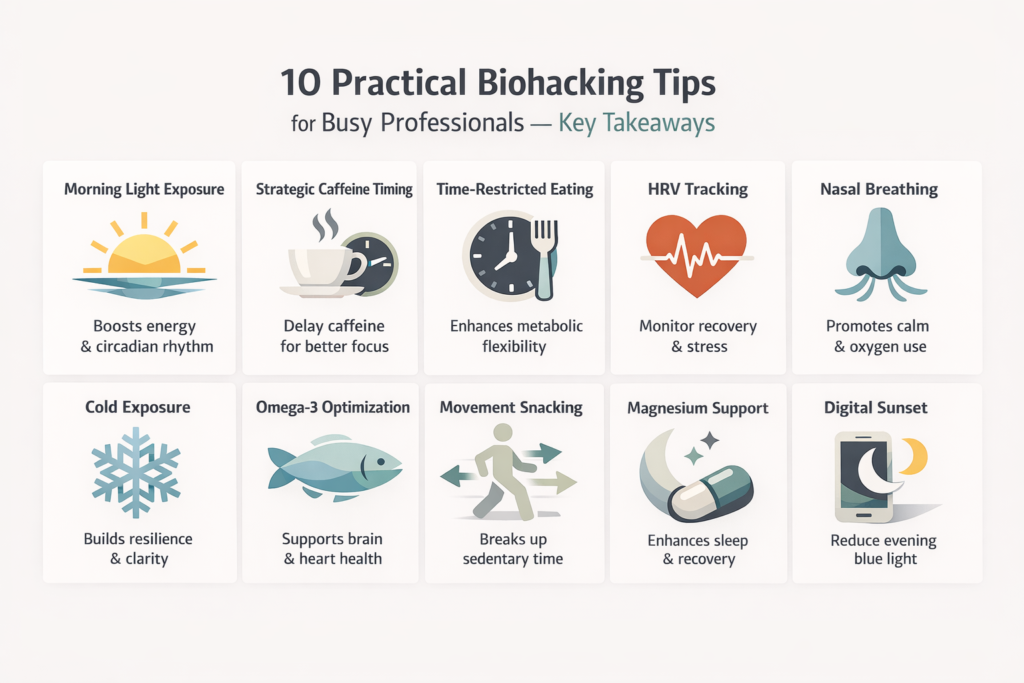
Morning light exposure within 60 minutes of waking represents the highest-leverage circadian intervention, requiring only 5-10 minutes daily while improving sleep quality, energy rhythms, and mood regulation. Strategic caffeine timing, delaying first consumption 90-120 minutes after waking and cutting off 10 hours before sleep, improves both acute effects and nighttime recovery.
Time-restricted eating builds metabolic flexibility and cellular cleanup processes through 14-16 hour overnight fasting windows without requiring dietary restriction. Heart rate variability tracking provides objective recovery data that guides daily intensity decisions and prevents accumulated fatigue.
Nasal breathing practice activates parasympathetic nervous system activity and improves oxygen utilization across all daily activities.
Cold exposure delivers immediate cognitive enhancement and builds genuine stress resilience through controlled hormetic stress. Omega-3 optimization addresses widespread deficiency while supporting cognitive function, inflammation regulation, and cardiovascular health.
Movement snacking breaks up prolonged sitting to reverse metabolic dysfunction and restore cognitive performance.
Magnesium supplementation supports over 300 enzymatic reactions while directly improving sleep quality and stress response. Digital sunset protocols protect circadian rhythms by reducing blue light exposure during evening hours preceding sleep.