When you love everything about your morning coffee ritual except the jittery anxiety that creeps in by noon, you naturally start looking for alternatives. I found myself in exactly that position when I first stumbled across mushroom coffee.
Two brands kept showing up everywhere I looked: Four Sigmatic and MUDWTR.
What I learned pretty quickly is that choosing between them requires understanding what you actually need from your morning drink, not just which one has prettier packaging or better Instagram ads.
Understanding the Mushroom Coffee Movement
The concept of mushroom coffee may sound strange at first. I completely understand that reaction.
Traditional coffee has been our default morning beverage for so long that we stopped questioning whether the jittery energy, afternoon crashes, and acid reflux are really worth it. These side effects have become so normalized that we treat them as just part of drinking coffee.
Functional mushrooms have been used in traditional medicine for thousands of years, especially in Chinese and Ayurvedic practices. What we’re seeing now is Western culture finally catching up to what other parts of the world have known for centuries.
These are medicinal mushrooms, not psychedelic ones. They support cognitive function, immune health, and stress management without altering your consciousness at all.
Four Sigmatic launched in 2015 with a Finnish founder who grew up foraging mushrooms in the forests of Finland. The company started by focusing on instant mushroom coffee packets that could easily slot into your existing morning routine.
MUDWTR came along in 2018 with a different positioning. They created a holistic wellness beverage that happens to replace coffee, as opposed to trying to be a direct coffee substitute.
The daily consumption aspect matters tremendously here. Regular coffee spikes your cortisol and adrenaline hard.
These are your stress hormones, and hitting them repeatedly every morning dysregulates your natural cortisol curve over time.
This makes it harder to wake up naturally and harder to wind down at night. Mushroom-based choices provide gentler energy that works with your natural rhythms instead of overriding them.
Breaking Down the Ingredient Profiles
The ingredient lists are where these two products diverge dramatically, and understanding what you’re putting in your body daily matters.
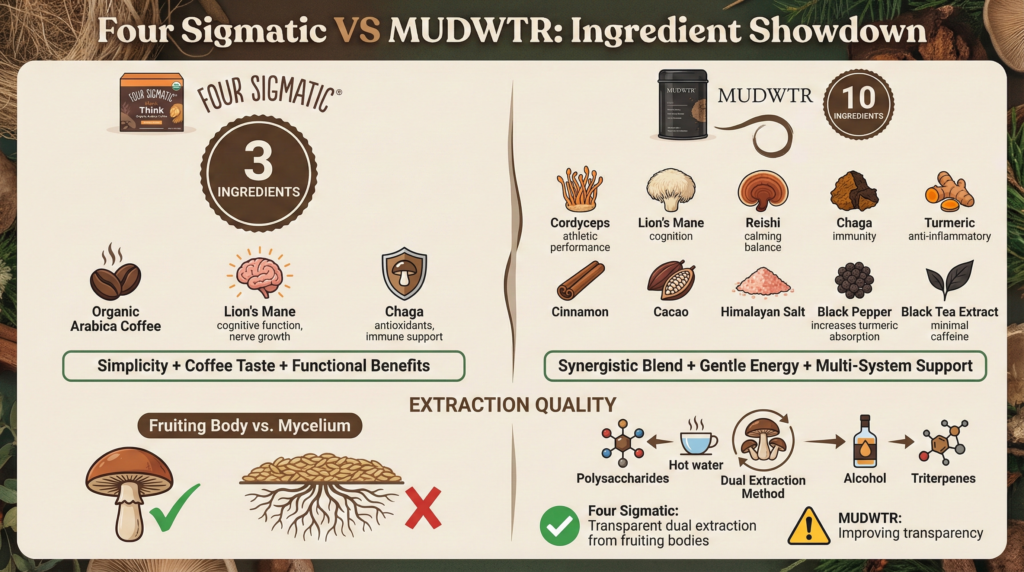
Four Sigmatic’s flagship mushroom coffee contains organic instant coffee, lion’s mane mushroom extract, and chaga mushroom extract. Three ingredients total.
The simplicity is deliberate. They wanted something that tasted like coffee, delivered caffeine, and added functional benefits through mushrooms.
Lion’s mane has solid research supporting cognitive function and nerve growth factor stimulation.
Chaga contains high levels of antioxidants and has been studied for immune system support.
The coffee itself is fairly standard quality Arabica beans, though they source it organically.
MUDWTR takes a completely different approach with ten ingredients: organic cordyceps mushroom, lion’s mane, reishi, chaga, turmeric, cinnamon, cacao, Himalayan salt, black pepper, and a small amount of black tea extract for caffeine. They call this a synergistic blend where all the ingredients work together.
The philosophy here is that you’re creating something entirely new that provides gentle energy while supporting many body systems simultaneously.
The cordyceps in MUDWTR is particularly interesting because it supports athletic performance and cellular energy production at the mitochondrial level. Reishi is calming, often used before bed, which seems odd in a morning beverage until you realize it balances the stimulation from caffeine.
The turmeric and black pepper combination is clever. Black pepper contains piperine, which dramatically increases how much curcumin your body can actually absorb from turmeric.
One challenge with both products is extraction quality. Not all mushroom extracts work the same way.
The most useful compounds come from the fruiting body, which is the actual mushroom part you see, not the mycelium root structure.
Four Sigmatic uses dual extraction methods and sources from fruiting bodies. MUDWTR has been less transparent historically about their extraction methods, though they’ve improved their communication recently.
You want products that specify hot water extraction for polysaccharides and alcohol extraction for triterpenes. That’s how you get the full spectrum of useful compounds from medicinal mushrooms.
Caffeine Content and Energy Delivery
What really matters for most people making the switch is how these products affect their energy levels throughout the day.
Four Sigmatic’s mushroom coffee contains about 50 milligrams of caffeine per serving, roughly half of what you’d get in regular coffee. If you’re someone who drinks many cups throughout the morning, you’ll definitely notice the reduction.
What’s really interesting is that most people report the energy from Four Sigmatic feels cleaner and more sustained than regular coffee, even with less caffeine. This likely happens because the adaptogenic properties of the mushrooms help modulate your stress response.
MUDWTR sits even lower at about 35 milligrams of caffeine per serving, derived entirely from black tea extract as opposed to coffee. This puts it in the same range as green tea.
For someone trying to break a serious coffee habit, this might feel too drastic initially. The withdrawal headaches are real and unpleasant.
MUDWTR is designed to provide gentle, sustained alertness without the spike-and-crash cycle as opposed to being a one-to-one coffee replacement in terms of stimulation.
The energy delivery mechanism is fundamentally different from traditional coffee. Regular coffee works primarily through adenosine receptor antagonism.
Caffeine literally blocks the receptors in your brain that make you feel tired. It’s a temporary mask as opposed to actual energy production.
The cordyceps in MUDWTR and the broader adaptogenic profile in both products support actual cellular energy production and help your body manage stress more effectively. That’s where sustained energy really comes from.
When transitioning from regular coffee, I’ve found the most success comes from gradual reduction as opposed to going cold turkey. You might start by replacing one cup of regular coffee with Four Sigmatic, keeping your other cups regular for the first week.
Then gradually increase the ratio over two to three weeks.
With MUDWTR’s lower caffeine content, you might need an even gentler transition, perhaps mixing it with some regular coffee initially if the caffeine reduction feels too dramatic.
Taste Profiles and Preparation Methods
I’m going to be completely honest here. Neither product tastes exactly like coffee, and if you go in expecting that, you’ll be disappointed.
Four Sigmatic’s mushroom coffee is the closest approximation to traditional coffee. It has that familiar bitter, roasted flavor profile with earthy undertones from the mushrooms.
The earthiness is noticeable but not overwhelming.
Most people describe it as slightly milder and less acidic than regular coffee, which is actually positive if you’ve dealt with acid reflux. The texture is smooth when mixed properly, though it can get gritty if you don’t stir thoroughly.
I’ve found that adding fat, whether that’s MCT oil, butter, or full-fat coconut milk, really improves the mouthfeel and helps with the absorption of fat-soluble compounds in the mushrooms.
MUDWTR tastes nothing like coffee whatsoever. It’s a chai-inspired blend with prominent notes of cinnamon, cacao, and turmeric.
The flavor is warming and slightly spicy with natural sweetness from the cinnamon and cacao.
Some people absolutely love it from the first sip. Others find it takes some getting used to, particularly the subtle earthiness from the mushroom blend.
The turmeric gives it a distinctive golden color that’s visually quite different from coffee’s dark brown.
Preparation matters more than you might think with both products. Four Sigmatic dissolves easily in hot water and can be treated essentially like instant coffee.
You can make it strong or weak depending on how much powder you use relative to water.
It also works well as a base for lattes or blended with ice for cold drinks.
MUDWTR needs more effort to prepare properly. The company sells a special frother because the powder contains cacao and spices that don’t dissolve as readily as instant coffee.
You really need to mix it vigorously for 15 to 20 seconds to get a smooth consistency.
Many people prepare it almost like a matcha latte, whisking it first with a small amount of hot water to create a paste, then adding more liquid gradually. The extra effort is worth it because a poorly mixed MUDWTR is clumpy and unpleasant.
Both products can be enhanced significantly with additions. For Four Sigmatic, I’ve found that a dash of vanilla extract and monk fruit sweetener creates something remarkably close to a vanilla latte.
For MUDWTR, adding honey and coconut milk turns it into something that reminds me of golden milk or a chai latte.
Some people add collagen powder to either one for extra protein and joint support.
Cost Analysis and Value Proposition
Let’s address the elephant in the room. Both products are significantly more expensive than regular coffee.
Four Sigmatic’s mushroom coffee typically costs around two dollars per serving when purchased in their 30-serving containers. If you’re someone who drinks one specialty coffee drink per day from a coffee shop at five or six dollars, this is actually cheaper.
But if you’re comparing it to home-brewed regular coffee at maybe 50 cents per cup, it’s four times more expensive.
MUDWTR runs about two dollars and fifty cents per serving for their 30-serving tin. That’s even pricier than Four Sigmatic. However, MUDWTR positions itself as a finished wellness ritual as opposed to just a coffee replacement, so they’d argue you’re getting more comprehensive benefits that might replace other supplements you’re taking.
Both companies offer subscription models that reduce the per-serving cost by about 15 to 20 percent. The subscriptions come with typical hassles, though.
You need to remember to pause or skip shipments if you’re overstocked, and canceling sometimes means contacting customer service as opposed to a simple online button click.
The value proposition really depends on what you’re comparing these products against. If you’re spending money on coffee plus separate supplements for cognitive function, energy, and immune support, consolidating those into one morning beverage might actually save money.
If you’re a basic black coffee drinker who doesn’t take any supplements, this will definitely increase your morning beverage budget significantly.
One thing worth considering is potential cost savings from improved health outcomes. If mushroom coffee helps you reduce anxiety, improve focus, and regulate your sleep-wake cycle better than regular coffee, what’s that worth?
Fewer doctor visits, better productivity, improved quality of life. These things have real economic value even if they’re harder to quantify on a spreadsheet.
Health Benefits and Scientific Backing
We need to have an honest conversation about what these products can and cannot do based on actual scientific evidence as opposed to marketing hype.
The research on individual mushroom species is actually quite robust, particularly for lion’s mane and reishi. Multiple studies have shown that lion’s mane can stimulate nerve growth factor synthesis and potentially support cognitive function, memory, and focus.
The research is promising, but we’re talking about modest improvements in cognitive testing scores, not dramatic brain transformation.
Reishi has solid evidence for immune system modulation, and some studies suggest benefits for sleep quality and anxiety reduction. Chaga is loaded with antioxidants, though whether the amounts in these beverages are sufficient to produce measurable health benefits is less clear.
Cordyceps has interesting research around athletic performance and energy production, with some studies showing improvements in VO2 max and exercise tolerance. Again, we’re talking about incremental benefits, not turning you into an Olympic athlete overnight.
The challenge with both Four Sigmatic and MUDWTR is that the actual mushroom content per serving is relatively modest, typically around 500 to 1000 milligrams of mushroom extract total across all varieties. Clinical studies often use much higher doses, sometimes several grams of a single mushroom species.
So you’re getting benefits, but they’re likely more subtle than what you’d experience from therapeutic doses of individual mushrooms.
The other ingredients in MUDWTR have their own research backing. Turmeric’s anti-inflammatory properties are well-established, though bioavailability is the key issue.
The cinnamon can help with blood sugar regulation.
The combination of these ingredients creates what herbalists call a synergistic effect, where the whole is greater than the sum of the parts, but this is harder to study scientifically.
One potential challenge is that some people experience digestive upset from concentrated mushroom extracts, particularly when first starting. The polysaccharides in mushrooms can be difficult to digest if your gut isn’t used to them.
Starting with a half serving for the first week can help your system adjust gradually.
Neither product will cause significant side effects for most people, but reishi can have mild blood-thinning properties, and the turmeric in MUDWTR also affects coagulation. If you’re on blood-thinning medications, this is worth discussing with your healthcare provider.
Different Use Cases and Ideal Users
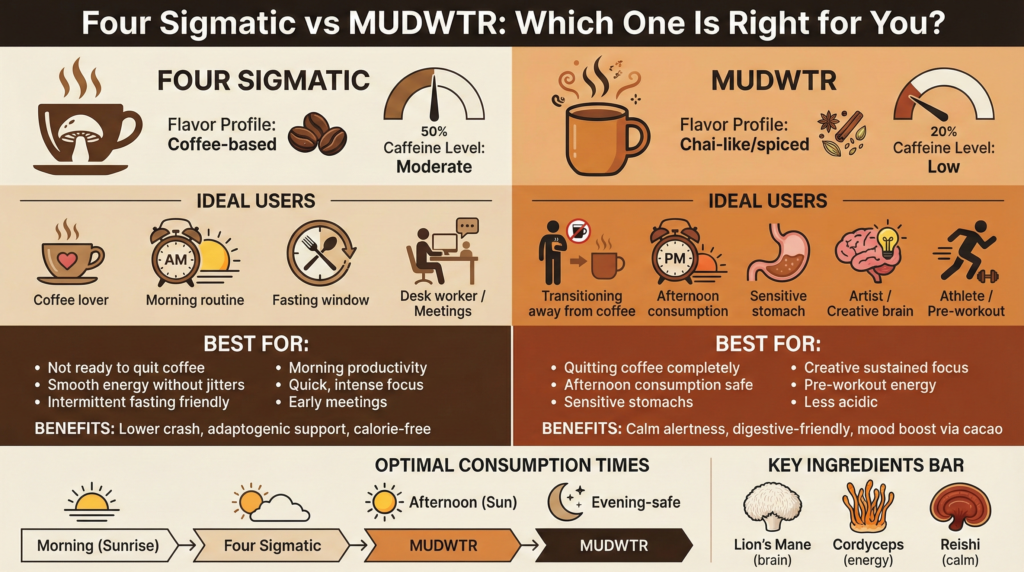
Four Sigmatic works particularly well for people who genuinely love coffee and aren’t ready to give up that flavor profile entirely. If you get jittery and anxious from regular coffee but love the ritual and taste, Four Sigmatic provides a reasonable middle ground.
The lower caffeine content, plus the adaptogenic mushrooms, create a smoother experience without the hard crash.
The product also works well for intermittent fasters because it’s essentially calorie-free and won’t break a fast, while still providing some energy and focus support. I’ve found Four Sigmatic to be excellent for morning consumption when I need to be productive but don’t want to spike my cortisol too dramatically first thing.
MUDWTR is better suited for people who are genuinely trying to move away from coffee entirely and are open to a completely different flavor experience. The chai-like taste profile means it’s particularly appealing to people who already enjoy spiced beverages like golden milk or chai lattes.
It’s also better for afternoon consumption since the lower caffeine content and inclusion of calming reishi won’t interfere with sleep if you drink it at 2 or 3 PM.
People with sensitive stomachs often prefer MUDWTR because it’s much less acidic than coffee, and the spices can actually be soothing to digestion. The cacao provides a gentle mood boost through theobromine, which is a cousin of caffeine but works through slightly different mechanisms.
For creative work that needs sustained focus without anxiety, I’ve found MUDWTR to be superior. The combination of lion’s mane for cognition, cordyceps for energy, and reishi for calm creates this really nice, balanced state where you feel alert but not wired. For tasks that need short bursts of intense focus or early morning meetings where you need to be sharp quickly, Four Sigmatic’s higher caffeine content is more suitable.
Athletes and people with active lifestyles might gravitate toward MUDWTR specifically for the cordyceps content, which supports cellular energy production and oxygen utilization. Having it before a workout provides gentle energy without the jitters that can actually impair fine motor control and coordination.
People Also Asked
What is mushroom coffee and how does it work?
Mushroom coffee combines regular coffee or tea with extracts from medicinal mushrooms like lion’s mane, chaga, and cordyceps. These mushrooms contain compounds that support cognitive function, immune health, and energy production.
The drink provides caffeine for alertness while the mushrooms offer adaptogenic benefits that help your body manage stress more effectively.
Does lion’s mane mushroom actually improve focus?
Research shows that lion’s mane can stimulate nerve growth factor synthesis and may support cognitive function. Several studies have found modest improvements in memory and focus with regular consumption.
The effects are subtle as opposed to dramatic, and they tend to build over time with consistent use as opposed to providing an immediate boost.
How much caffeine is in mushroom coffee compared to regular coffee?
Regular coffee contains about 95 to 100 milligrams of caffeine per cup. Four Sigmatic mushroom coffee has about 50 milligrams per serving, while MUDWTR has only 35 milligrams.
This reduced caffeine content helps avoid the jitters and anxiety that many people experience with regular coffee while still providing alertness.
Can you drink mushroom coffee every day?
Yes, you can drink mushroom coffee daily. The medicinal mushrooms used in these products have been consumed safely for thousands of years in traditional medicine.
The adaptogenic effects actually build with consistent use over time.
However, if you’re on blood-thinning medications, you should talk to your healthcare provider first.
Will mushroom coffee help with caffeine withdrawal?
Mushroom coffee can be an excellent transitional tool for reducing caffeine dependence. The lower caffeine content helps you gradually step down your intake as opposed to quitting cold turkey, which often causes severe headaches and fatigue.
The adaptogenic mushrooms also support your adrenal system during the transition period.
Does MUDWTR taste like coffee?
No, MUDWTR tastes nothing like coffee. It has a chai-inspired flavor profile with prominent notes of cinnamon, cacao, and turmeric.
The taste is warming and slightly spicy with natural sweetness.
People who expect it to taste like coffee will be disappointed, but those who approach it as a completely different beverage often enjoy the unique flavor.
Are the mushrooms in mushroom coffee the same as cooking mushrooms?
No, mushroom coffee uses medicinal mushrooms like lion’s mane, chaga, reishi, and cordyceps, which are different from culinary mushrooms like shiitake or portobello. Medicinal mushrooms contain specific compounds that support health in ways cooking mushrooms don’t.
They also have a more earthy, less mushroomy flavor when properly extracted.
How long does it take to feel the effects of mushroom coffee?
You’ll feel the caffeine effects within 15 to 30 minutes, similar to regular coffee. However, the full adaptogenic benefits of the mushrooms typically become more noticeable after two to four weeks of consistent daily use.
The mushrooms support your body systems in subtle ways that build over time, as opposed to providing immediate, dramatic effects.
Key Takeaways
Four Sigmatic provides a closer coffee experience with moderate caffeine and simple ingredients, making it ideal for people who love coffee but want to reduce jitters and anxiety while adding cognitive support through lion’s mane and immune support through chaga.
MUDWTR offers a finished wellness beverage with lower caffeine, a chai-inspired flavor profile, and a broader range of functional ingredients including cordyceps for energy, reishi for calm, turmeric for inflammation, and cinnamon for blood sugar regulation, best suited for people ready to move beyond coffee entirely.
The caffeine content differs significantly, with 50 milligrams in Four Sigmatic versus 35 milligrams in MUDWTR, which matters tremendously for your transition strategy and how these products will affect your energy throughout the day.
Neither product tastes exactly like coffee, and managing expectations around flavor is critical to having a positive experience as opposed to feeling disappointed.
Both products are more expensive than regular coffee, but potentially cost-effective when compared to coffee shop drinks or when consolidating many supplements into one beverage.
The scientific evidence for individual mushroom species is solid, but the doses in these products are modest compared to clinical studies, so benefits will be subtle as opposed to dramatic.
Proper preparation matters enormously, particularly for MUDWTR, which needs vigorous frothing or whisking to achieve the right texture and taste.
These products work best as part of a gradual transition strategy as opposed to abrupt coffee replacement, allowing your body to adjust to lower caffeine levels while the adaptogens support your stress response system.