
I remember the exact moment I realized I was completely burned out. It was a Tuesday afternoon, around 2:47 PM, as I stared at the clock, waiting for the day to end.
I’d already consumed three cups of coffee, had accomplished maybe an hour of actual focused work, and felt like my brain was wrapped in fog.
The worst part wasn’t just a bad day; it was a series of unfortunate events. It had become my normal.
Like most professionals in their mid-thirties, I’d convinced myself that exhaustion was just the price of ambition. Everyone feels tired, right?
Everyone struggles with sleep.
Everyone hits that 3 PM wall where cognitive function basically flatlines. I genuinely believed that pushing through was the only option, that “rest when you’re dead” mentality that Silicon Valley somehow convinced us was a badge of honor.
What changed everything wasn’t some dramatic lifestyle overhaul or expensive wellness retreat. It was actually a conversation with a former colleague who looked better than he had in years.
When I asked what he’d changed, he showed me his wrist.
He was wearing this sleek black band that I’d never seen before. A WHOOP strap, he explained, and it had completely transformed how he approached his workday.
Performance Wearables have emerged as essential tools for individuals looking to optimize their daily routines and enhance productivity.
I was skeptical, honestly. I’d tried fitness trackers before.
They told me I wasn’t walking enough and congratulated me with virtual badges that meant nothing.
But this felt different. He wasn’t talking about step counts or calorie burns.
He was talking about understanding when his body was actually ready to perform versus when it needed recovery.
He was scheduling his most important meetings and decisions based on what his data indicated about his readiness, not just what his calendar allowed.
That conversation sent me down a rabbit hole that eventually led to a complete restructuring of how I work, sleep, and improve my performance. And the transformation didn’t need becoming obsessed with health metrics or spending hours analyzing data.
By integrating Performance Wearables into my life, I’ve gained valuable insights into my physical and mental well-being.
It required understanding what my body was actually telling me through these devices, and then making really small, strategic adjustments based on that information.
You might also like to read:
- Review of Whoop 5.0: Better Battery, More Data
- Review of The Apollo Neuro: Can a Wearable Really Hack Your Stress?
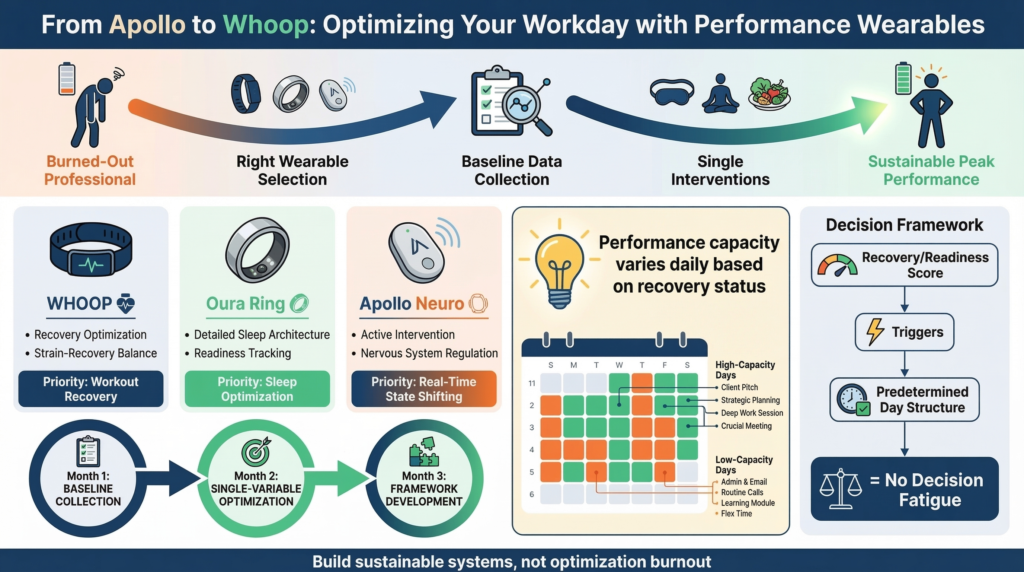
Table of Contents
Understanding What Wearables Actually Measure
The whole wearables space has exploded in the last few years, and it’s really easy to get lost in the marketing hype. Every device promises to “revolutionize your health” or “unlock peak performance,” but most professionals don’t actually understand what these devices are measuring or why it matters.
At their core, performance wearables track three basic aspects of your physiology that directly impact how you work. These are your autonomic nervous system activity, your sleep architecture, and your physiological strain. These aren’t vanity metrics.
They’re actual windows into how your body is managing stress, recovering from exertion, and preparing for performance.
Heart rate variability has become the gold standard metric that serious performance wearables focus on, and it’s absolutely fascinating once you understand what it represents. Your heart doesn’t actually beat like a metronome with perfectly consistent intervals between each beat.
When you’re recovered and your parasympathetic nervous system is dominant, there’s actually significant variation between heartbeats.
When you’re stressed, overtrained, or fighting off illness, that variation decreases, and your heartbeat becomes more metronomic.
I spent probably two weeks just wrapping my head around HRV because it seemed counterintuitive at first. Shouldn’t a healthy heart beat consistently?
But the research is really detailed on this.
Higher HRV correlates with better cardiovascular health, greater stress resilience, and improved cognitive function. Elite athletes have been using HRV tracking for years to prevent overtraining, and now that technology has filtered down to devices that professionals can actually use.
The second critical metric is sleep architecture. Most people think they just need “eight hours,” but what really matters is how much time you’re spending in deep sleep versus REM sleep versus light sleep.
Deep sleep is when your body physically recovers, when growth hormone gets released, and when your immune system does maintenance work.
REM sleep is when your brain consolidates memories, processes emotions, and basically performs cognitive maintenance.
What blew my mind when I started tracking this was realizing that I could sleep eight hours and still feel exhausted because I was barely getting any deep sleep. My sleep efficiency was terrible.
I was in bed for eight hours but actually sleeping maybe six and a half, and the quality of that sleep was really poor.
Without data showing me that pattern, I would have just kept wondering why I felt tired despite “sleeping enough.”
The third component is strain and recovery balance, which is where devices like WHOOP really shine. Every physical and mental stressor you encounter during the day creates strain on your system.
Intense workouts obviously create strain, but so do stressful meetings, difficult conversations, travel, and even eating inflammatory foods.
Your body needs adequate recovery to balance that strain, and if you’re consistently accumulating strain without corresponding recovery, you’re heading straight toward burnout.
The Apollo Neuro Approach
Before diving deeper into tracking devices, I want to talk about something that really surprised me in my research: the Apollo Neuro. This device takes a completely different approach than trackers like WHOOP or Oura.
Instead of just measuring your state, it actually tries to change it through haptic feedback.
The Apollo is a wearable that delivers gentle vibrations to your wrist or ankle in specific patterns designed to activate your parasympathetic nervous system. The science behind it centers on how touch influences our nervous system regulation.
Think about how petting a dog lowers your heart rate, or how rocking calms a baby.
The Apollo essentially provides that same regulatory input through calibrated vibration patterns.
I tested the Apollo for about six weeks, primarily using it during focused work sessions and before sleep. The device has different modes: one for energy and focus, one for unwinding, and one for sleep, and you can control intensity and duration through their app. What I noticed wasn’t dramatic or immediate, but after about two weeks, I realized I was falling asleep faster and feeling more focused during my afternoon work blocks.
The interesting thing about Apollo compared to tracking devices is that it’s actively interventional. You’re not just collecting data and then deciding what to change based on that information.
You’re using the device itself as a tool to shift your physiological state in the moment.
For professionals who get overwhelmed by data analysis, this can actually be a simpler entry point into performance optimization.
The limitation, of course, is that you’re not getting any feedback about whether it’s actually working for you specifically. You’re trusting the technology and hoping the patterns they’ve developed are effective for your nervous system.
That’s where combining Apollo with a tracking device becomes really powerful.
You can use something like an Oura Ring to measure whether the Apollo is actually improving your HRV or sleep quality, creating a closed feedback loop.
The WHOOP System
When I finally invested in a WHOOP strap, I honestly struggled with it for the first month. The device has no screen, no haptic feedback, nothing that tells you in the moment what’s happening.
It just sits on your wrist collecting data, and then you check the app to see your recovery score, strain, and sleep metrics.
What eventually clicked for me was understanding that WHOOP is designed around a specific philosophy. Performance optimization actually comes from recovery optimization.
The conventional approach to productivity is to push harder when you need to accomplish more.
WHOOP flips that completely. It tells you when pushing harder will be productive versus when it will just dig you deeper into a recovery debt that will cost you later.
Every morning, WHOOP gives you a recovery score from zero to one hundred based on your HRV, resting heart rate, respiratory rate, and sleep performance. When I first started using it, I would check that score and then completely ignore it, sticking to whatever I’d planned for the day regardless of what my body was telling me.
But after about three weeks of data, the patterns became impossible to ignore. On days when my recovery score was above seventy-five percent, I was noticeably sharper in meetings, made better decisions faster, and could sustain focus for longer periods.
On days below fifty percent recovery, I would struggle through tasks that should have been straightforward, make careless mistakes, and feel mentally exhausted by mid-afternoon.
The data was showing me something I’d been ignoring for years. My performance varied significantly based on my physiological readiness, not just my willpower or motivation.
The real power of WHOOP emerged when I started actually adjusting my schedule based on recovery data. High recovery days occurred when I scheduled important presentations, difficult conversations with employees, strategic planning work, and creative projects.
Low recovery days became administrative task days: email management, routine meetings, and research rather than execution.
This approach felt really counterintuitive at first because it required admitting that I couldn’t just push through everything with equal effectiveness. But the results were undeniable.
Within about six weeks, I was accomplishing more high-value work in less total time because I was strategically aligning task difficulty with physiological readiness.
The strain tracking component was equally revealing. WHOOP calculates strain based on cardiovascular load throughout the day, combining exercise, stress, and general activity.
What surprised me was how much strain certain meetings created. I had a weekly leadership meeting that consistently spiked my strain almost as much as a moderate workout.
Pure stress response from navigating difficult team dynamics.
Understanding that pattern allowed me to make adjustments. I moved that meeting to mornings when my recovery was higher, and I built in a fifteen-minute buffer afterward for a walking reset before taking a close look at focused work.
Small change, but it prevented that meeting from derailing my entire afternoon like it had been doing for months.
Oura Ring for Sleep Optimization
After about four months with WHOOP, I added an Oura Ring specifically because I wanted more granular sleep data. WHOOP provides excellent sleep metrics, but Oura’s focus is really dialed into sleep architecture and readiness, and the form factor meant I could wear it 24/7 without thinking about it.
The Oura Ring tracks the same basic metrics as WHOOP: HRV, resting heart rate, body temperature, and respiratory rate. But it processes that information through a different lens.
Instead of recovery and strain, Oura focuses on readiness, sleep, and activity.
The readiness score incorporates not just your previous night’s sleep but trends over the past two weeks, giving you a longer-term view of your recovery trajectory.
What I found most valuable with Oura was the body temperature tracking. The ring establishes your baseline temperature and then tracks deviations from that baseline, which can signal everything from overtraining to oncoming illness to hormonal fluctuations.
I actually caught a cold about thirty-six hours before symptoms appeared because my body temperature spiked by 0.8 degrees above my baseline.
That early warning allowed me to clear my schedule, prioritize sleep, and increase my vitamin C and zinc intake before the cold fully manifested. I still got sick, but it was noticeably milder and shorter than usual. Having that advanced notice instead of just waking up one morning feeling terrible was genuinely valuable for managing my work schedule.
The sleep staging data from Oura became a bit of an obsession for me initially, and I had to consciously pull back from analyzing it too deeply. The ring breaks down your sleep into awake time, REM, light, and deep sleep, showing you exactly when during the night you were in each stage.
This is fascinating information, but it’s also easy to fall into the trap of trying to microoptimize every variable affecting your sleep.
What actually moved the needle for my sleep quality wasn’t obsessing over the data. It was identifying the three or four factors that had the biggest impact and focusing exclusively on those.
For me, those factors were: going to bed within the same thirty-minute window every night, keeping my bedroom temperature below 67 degrees, avoiding alcohol within three hours of sleep, and getting morning sunlight exposure within thirty minutes of waking.
Those four changes, tracked and verified through my Oura data, increased my average deep sleep from forty-two minutes per night to seventy-eight minutes over about eight weeks. That improvement translated directly into how I felt during the day.
I stopped needing an afternoon coffee to push through the 3 PM slump because I wasn’t hitting that wall anymore.
Integrating Wearables Into Your Workday
The gap between collecting data and actually changing behavior based on that data is where most people fail with wearables. I’ve talked to dozens of professionals who bought an Oura Ring or WHOOP, tracked obsessively for a few weeks, and then just went back to their old patterns because they didn’t know how to translate the insights into action.
The approach that worked for me was building decision frameworks around my wearable data. These are simple if-then rules that remove the need for constant analysis and decision-making.
I established these frameworks after about three months of baseline data, once I understood my personal patterns.
For morning work planning, my framework is straightforward. If my recovery score is above seventy percent, I schedule deep focused work, difficult problems, and important decisions in my first three hours after my morning routine.
If recovery is between fifty and seventy percent, I frontload communication tasks, collaborative work, and execution of already-made decisions.
If recovery is below fifty percent, that’s an administrative day focused on email, expense reports, reading, and planning rather than execution.
This framework removes the daily negotiation with myself about whether I can push through. The data makes the decision, and I just execute according to the framework.
It sounds rigid, but it’s actually incredibly liberating.
I’m not constantly questioning whether I should be doing something different or feeling guilty about having a low-energy day.
For meeting optimization, I started tracking which types of meetings created the most strain and scheduling them accordingly. One-on-ones with my team are generally low strain, so those can happen anytime.
Budget reviews and performance discussions are high-strain, so those get scheduled on high-recovery mornings only.
This prevents me from stacking three high-strain meetings in one day and completely depleting myself.
The afternoon energy management framework was probably the most impactful. Based on my Oura sleep data, I identified that my deep sleep was significantly impacted by afternoon caffeine consumption.
Even coffee at 1 PM would reduce my deep sleep by about fifteen to twenty percent that night.
Armed with that information, I moved my caffeine cutoff to 11:30 AM and found choice strategies for afternoon energy management.
Those alternatives included: ten-minute walks outside for natural light exposure, cold water on my face and wrists, brief breathing exercises using box breathing, and occasionally a fifteen-minute power nap if my schedule allowed. None of these felt as immediately effective as coffee, but the next-day performance improvement from better sleep made it completely worthwhile.
Common Mistakes That Waste Your Investment
The most expensive mistake I see professionals make with wearables is buying many devices before understanding what they’re actually trying to improve. Someone will purchase an Apple Watch, Oura Ring, and WHOOP simultaneously, creating massive data redundancy and overwhelming themselves with metrics that mostly tell the same story.
Start by identifying your single biggest performance bottleneck. If it’s sleep, Oura Ring gives you the most detailed sleep architecture data.
If it’s understanding strain and recovery for performance optimization, WHOOP is purpose-built for that.
If you want an all-in-one device that handles notifications, fitness tracking, and basic health metrics, the Apple Watch or the Garmin makes more sense. But wearing many devices tracking the same metrics just creates noise.
The second major mistake is treating your recovery score or readiness score as a challenge to overcome rather than information to incorporate. I definitely fell into this trap initially.
If WHOOP told me I had forty percent recovery, I’d view that as a challenge to prove I could still perform at a high level.
This completely defeats the purpose of having the data.
Your recovery score isn’t a test to pass. It’s feedback about your physiological state that should inform your decision-making.
Low recovery days aren’t failures.
There are opportunities to improve your task selection and prevent digging yourself into a deeper hole. Once I shifted to viewing the data as information rather than judgment, the whole system became far more valuable.
The third mistake is changing too many variables simultaneously based on your wearable data. You see that your sleep quality is poor, so you change your bedtime, bedroom temperature, pre-sleep routine, supplement stack, and exercise timing all at once.
Then your sleep improves, but you have no idea which change actually mattered.
The scientific approach is to change one variable at a time, hold it constant for at least a week, and observe the results in your data. This is slower, but it builds real understanding of what actually moves your metrics versus what’s just noise.
After eighteen months of this systematic approach, I know exactly which interventions improve my sleep, recovery, and performance, and which popular biohacks do absolutely nothing for me personally.
Building Sustainable Systems Around Your Data
The long-term value of wearables comes from building sustainable systems that improve your performance without requiring constant attention or decision-making. After using various devices for over two years now, I’ve distilled my approach into a few core systems that run almost automatically.
My morning routine is triggered by my recovery score. I check WHOOP when I wake up, and that number decides which version of my day I’m executing.
High recovery means my full morning routine with intensive, focused work.
Medium recovery means a condensed routine with collaborative work scheduled first. Low recovery means minimal morning routine and administrative tasks.
This removes the daily negotiation about what I should do and replaces it with a clear framework.
My weekly planning session happens every Sunday evening and incorporates my recovery trends from the previous week. If I’ve had three or more low recovery days, the coming week gets structured more conservatively with buffer time built in and fewer high-stakes commitments.
If recovery has been consistently high, I can be more aggressive with what I take on.
This prevents me from overcommitting during weeks when my body is signaling it needs more space.
The sleep optimization system focuses on my three highest-impact variables: consistent bedtime, room temperature, and morning light exposure. I track these daily in a simple spreadsheet along with my Oura sleep score.
When sleep quality drops below my baseline for three consecutive nights, I audit these three variables to see which one I let slip. Usually, it’s bedtime consistency, and bringing that back into alignment fixes the issue within a few days.
For nutrition and energy management, I’ve identified my personal glucose-stable meals for breakfast and lunch. I don’t need the CGM (Continuous Glucose Monitor) anymore because I know through experimentation what works.
Breakfast is always protein and fat-focused. Lunch includes protein, healthy fats, and complex carbohydrates with plenty of vegetables.
Dinner is more flexible because evening glucose stability matters less for my performance.
People Also Asked
Does WHOOP really improve performance?
WHOOP doesn’t directly improve performance. It provides data about your recovery status that allows you to make better decisions about when to push hard and when to pull back.
The performance improvement comes from strategically aligning your most demanding tasks with days when your body is actually ready to handle them, rather than randomly hoping you’ll have enough energy.
How accurate is Oura Ring sleep tracking?
Oura Ring sleep tracking has been validated against polysomnography, the gold standard for sleep measurement, with about 96% accuracy for detecting sleep versus wake states. The sleep stage classification is less accurate, around 60-70%, but the trends and patterns it shows are still valuable for optimization, even if individual nights might be slightly off.
Can I wear WHOOP and Oura Ring together?
You can wear both devices simultaneously, and many people do to get WHOOP’s strain tracking combined with Oura’s detailed sleep analysis. The devices measure similar metrics but present them differently.
If you’re willing to pay for both subscriptions and want comprehensive data, wearing both can provide a fuller picture of your recovery and performance.
Does Apollo Neuro actually work for stress?
Apollo Neuro works for some people and not for others. The research behind haptic feedback for nervous system regulation is legitimate, but people’s responses vary significantly.
The best approach is to try it for at least four weeks while tracking your HRV or stress levels with another device to see if you personally respond to the technology.
What wearable is best for tracking work stress?
WHOOP provides the most direct measurement of stress through HRV and strain tracking. It quantifies how much cardiovascular strain different activities create, including stressful meetings and work situations.
Oura Ring also tracks stress through HRV trends, but focuses more on overnight recovery.
For real-time stress awareness during the workday, WHOOP is generally more useful.
How long does it take to see results from wearable tracking?
You need at least thirty days of baseline data before you can identify meaningful patterns. Real performance improvements typically emerge after sixty to ninety days once you’ve implemented changes based on your data and given your body time to adapt. Quick fixes are rare.
Sustainable optimization needs consistent tracking and gradual adjustments over several months.
Is heart rate variability more important than resting heart rate?
Both metrics provide valuable information, but HRV is generally considered more sensitive to changes in recovery status. Your resting heart rate shows overall cardiovascular fitness and acute stress, while HRV reflects autonomic nervous system balance and readiness to perform.
For daily decision-making about training and work intensity, HRV typically provides more actionable guidance.
Key Takeaways
The transformation from burned-out professional to someone operating at sustainable peak performance requires choosing the right wearable for your specific bottleneck, collecting baseline data without trying to change everything immediately, and then implementing single interventions you can clearly measure.
WHOOP excels at recovery optimization and understanding strain-recovery balance. Oura Ring provides the most detailed sleep architecture and readiness tracking.
Apollo Neuro offers active intervention through nervous system regulation.
Choose based on whether your priority is workout recovery, sleep optimization, or real-time state shifting.
The highest-leverage insight from wearables is understanding that your performance capacity varies significantly day to day based on recovery status. Learning to align your most important work with your highest-capacity days creates massive productivity gains without working longer hours.
Build decision frameworks around your data so you’re not constantly analyzing and deciding. Let your recovery score or readiness score trigger predetermined responses in how you structure your day.
This removes decision fatigue and confirms you actually use the insights your wearable provides.
The three-month transformation framework includes baseline collection, single-variable optimization, and framework development. Follow this sequence before adding complexity, and you’ll build sustainable systems instead of creating optimization burnout.