
Look, I get it. You’re drowning in biohacking gadgets that promise the moon and deliver maybe a night light.
Another wearable claiming it’ll fix your stress, help you sleep, and make you focused sounds like the same pitch you’ve heard a thousand times.
But the Apollo Neuro is actually doing something different than most wearables out there. Instead of just tracking your heart rate or steps and showing you depressing data about how stressed you are (thanks, I already knew that), this thing supposedly intervenes directly with your nervous system through vibrations.
The claim is pretty bold: wear this device, get gentle vibrations sent to your body, and your nervous system shifts from fight-or-flight mode into rest-and-digest mode. Stress decreases.
Focus improves.
Sleep gets better. All without pills, meditation apps, or complex protocols that require 45 minutes you don’t have.
So, does it actually work, or is this just expensive placebo jewelry? That’s what we’re going to figure out, because for the price point they’re asking, you deserve the real breakdown.
Features Overview: What You’re Actually Getting
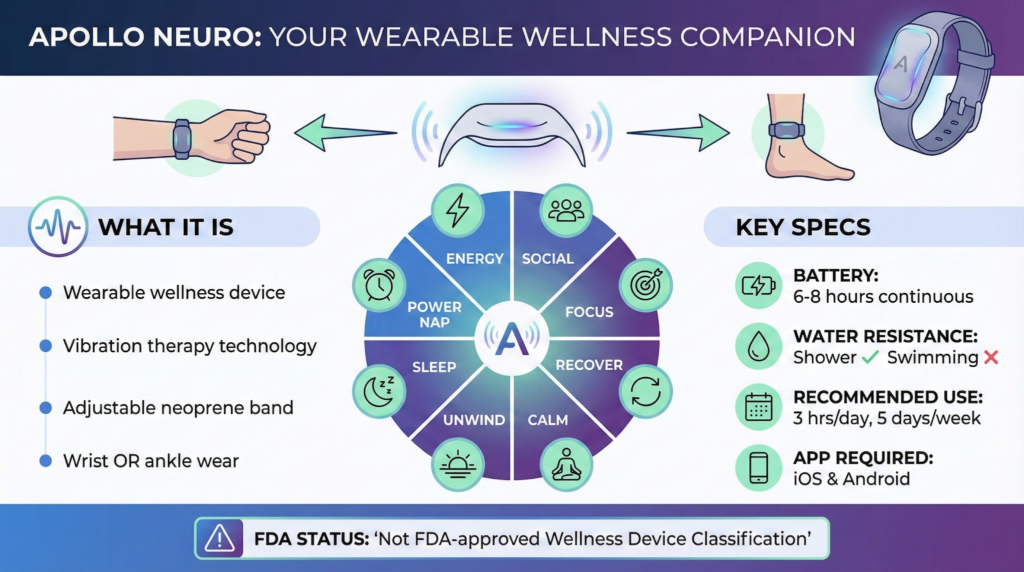
The Apollo Neuro looks like a chunky fitness tracker that you wear on your wrist or ankle. It comes with a neoprene band that uses Velcro to attach, so you can adjust it however you want.
Here’s what makes it different from your Fitbit or Apple Watch: it doesn’t track much of anything. Instead, it delivers what the company calls “Apollo Vibes”, which are low-frequency vibrations designed to stimulate your vagus nerve, which is the main highway between your brain and your parasympathetic nervous system.
You control everything through a smartphone app. The app has seven different vibration modes:
Energy and Awake – higher frequency vibrations meant to boost alertness
Social and Open – designed to help you feel more comfortable in social situations
Clear and Focused – for concentration during work
Rebuild and Recover – post-workout or for active recovery
Calm – stress reduction during the day
Unwind – evening relaxation mode
Sleep and Renew – the lowest frequency for falling asleep and staying asleep
There’s also a Power Nap mode for quick recharge sessions.
For each mode, you pick the duration (usually between 15 and 60 minutes) and adjust the intensity. Some people barely feel anything at 20% intensity, while others find 50% too strong.
You’ll need to experiment.
The newer versions have something called SmartVibes For Sleep, which supposedly detects when you’re starting to wake up in the middle of the night and automatically plays vibrations to help you fall back asleep. Whether that actually works is a whole other question we’ll get into.
Battery life is about 6-8 hours of continuous use, which means you’ll probably need to charge it daily if you’re using it a lot. The company recommends wearing it for three hours a day, five days a week, for the best results.
The device is water-resistant but not waterproof, so you can wear it in the shower but probably shouldn’t take it swimming.
Performance Analysis: What the Research Shows (and Doesn’t)
This is where things get interesting, because unlike most wellness gadgets that have literally zero research backing them up, Apollo Neuro actually has some studies. But before you get too excited, let’s be clear about what the research actually shows.
There’s a study from the University of Pittsburgh Department of Psychiatry and Psychology that found the device improved heart rate variability (HRV) in some users. HRV is basically a measure of how well your nervous system adapts to stress; higher HRV generally means better stress resilience.
So that’s promising.
Another study looked at cognitive function and found improvements in tasks requiring sustained attention and working memory when people used the device regularly. The researchers think this happens because the vibrations help modulate stress responses, which frees up mental bandwidth.
Apollo also ran an evaluation at a skilled nursing facility in Pittsburgh, where nursing staff (who are famously stressed) reported stress score reductions of up to 40% within two weeks of using the device. Users also reported about 25% increased focus and concentration with consistent use.
Here’s the reality, though: these are relatively small studies. The device hasn’t been evaluated or approved by the FDA as a medical treatment because it’s classified as a wellness device, not medical equipment.
Healthcare professionals have been pretty clear that more robust clinical trials are needed before making strong claims about effectiveness.
Translation: there’s enough research to suggest this might actually do something, but it’s not ironclad proof that it’ll work for you specifically. Your mileage will absolutely vary.
The science behind vagus nerve stimulation and parasympathetic activation is legit. That part isn’t controversial.
The question is whether gentle vibrations delivered through a wrist or ankle device are strong enough to produce meaningful effects for everyday biohacking and performance optimization for busy adults.
Some people report noticeable changes. Others don’t feel much difference at all.
We’ll get into why that might be in a minute.
| Feature | Details |
| Device Type | Wearable wellness device with vibration therapy |
| Wear Location | Wrist or ankle with adjustable neoprene band |
| Vibration Modes | 7 modes (Energy, Social, Focus, Recover, Calm, Unwind, Sleep) plus Power Nap |
| Battery Life | 6-8 hours continuous use |
| Water Resistance | Water-resistant (shower okay, swimming not recommended) |
| Recommended Use | 3 hours per day, 5 days per week |
| FDA Status | Not FDA-approved, classified as wellness device |
| App Required | Yes, for iOS and Android |
Pros and Cons: The Honest Breakdown
What Works in Its Favor
It’s completely passive. This is huge if you’re already juggling work, family, and trying to maintain some level of health. You don’t need to meditate, do breathing exercises, or remember to take supplements at specific times.
You just put it on and let it do its thing.
You can wear it during meetings, while working at your computer, or while you’re falling asleep.
Multiple use cases throughout the day. The different modes mean you’re not locked into one specific function. You can use Energy mode in the morning when you’re dragging, Focus mode during work, and Sleep mode at night.
That’s more versatile than most wellness devices that only target one thing.
No reported serious side effects. Unlike supplements or pharmaceuticals, where you’re always playing the “what’s this going to mess up” game, the worst that’s been reported is some skin irritation at the wear site. That’s pretty low-risk.
You can adjust it to your preferences. Some people need higher intensity to feel anything, while others find low intensity works great. You’re not stuck with a one-size-fits-all approach.
It’s discreet. You can wear it under a long-sleeve shirt or pants if you’re wearing it on your ankle. It doesn’t scream “I’m wearing a medical device” the way some wearables do.
What Doesn’t Work So Well
Requires consistency. You’re not going to put this on once and feel like a new person. The research and user reports consistently say you need to use it regularly for at least a couple of weeks before you know if it’s working for you.
That’s a commitment.
The evidence isn’t bulletproof. As much as I want to tell you, “This definitely works,” the clinical studies are preliminary and relatively small. You can’t point to massive, gold-standard research that proves it’ll work for your specific situation.
Some people don’t feel much difference. This is important because you could be one of them. Individual factors like your baseline stress levels, how sensitive you are to subtle interventions, and your overall lifestyle all play a role in whether you’ll respond well to the device.
It’s bulky for some people. If you’re used to sleek fitness trackers, this feels chunkier. Some people don’t mind, others find it annoying, especially on the ankle.
Battery life means daily charging. If you forget to charge it, you’re not using it that day. That adds a small friction point to your routine.
App dependency. You need your phone to control most functions. That’s fine for most people, but if you’re trying to reduce phone time or don’t always have your phone nearby, it’s a limitation.
Price. Let’s just say it outright: this costs more than most fitness trackers and wellness devices. Whether the cost is justified depends entirely on whether it works for you, and you won’t know that until you try it.
Just know what you’re getting into before you buy.
Is Apollo Neuro Right for You?
Answer 6 quick questions to discover if Apollo Neuro could be a good fit for your wellness goals
User Experience: What People Actually Report
The experience with Apollo Neuro seems to fall into a few different categories, and where you land probably depends on factors you won’t know until you try it.
The “This Actually Works” Group
A good chunk of users report noticeable improvements within two weeks of consistent use. These are people who say things like “I didn’t think it was doing anything at first, but after a week I realized I was falling asleep faster and feeling less anxious during the day.”
The Focus mode gets a lot of positive mentions. People using it during work report being able to concentrate for longer periods without getting distracted. One common theme is that the effect isn’t dramatic or obvious: it’s subtle.
You don’t suddenly feel like you’ve taken a focus drug; you just notice you’re not reaching for your phone as much or getting derailed by minor interruptions.
For sleep, many users say they fall asleep faster, and when they wake up in the middle of the night, they can get back to sleep more easily instead of lying there for an hour with their mind racing.
The vibrations themselves are described as subtle but noticeable. You definitely feel them, but they’re not jarring or uncomfortable.
Most people find their sweet spot somewhere between 30-50% intensity.
The “It’s Fine But Nothing Amazing” Group
Then some users report mild improvements, but nothing that dramatically changed their lives. They might notice they’re slightly calmer when using the Calm mode, or that sleep is marginally better, but it’s not a night and day difference.
For these people, whether the device is worth keeping comes down to whether those subtle improvements justify the cost and the hassle of remembering to charge it and wear it consistently.
The “This Doesn’t Work For Me” Group
Some users report basically no noticeable effects even after weeks of consistent use. They followed the recommended protocols, tried different modes and intensities, and just didn’t experience meaningful changes in stress, sleep, or focus.
This group tends to return the device or stop using it after giving it a fair shot.
Comfort complaints are most common when wearing it on the ankle, especially during sleep. Some people find the ankle placement more effective but less comfortable, while others prefer wrist wear even if the effects feel slightly weaker.
The charging requirement annoys some users because it breaks up the routine. You can’t just wear it 24/7 and forget about it.
What Seems to Matter
Individual sensitivity to subtle interventions seems to be a big factor. If you’re someone who notices small changes in how you feel and responds well to gentle approaches like meditation or breathing exercises, you’re probably more likely to respond to Apollo Neuro.
Baseline stress levels matter too. People with moderate to high stress seem to report more noticeable effects than people who are already pretty chill.
Consistency is huge. The people who report the best results are using it daily for many hours, not just throwing it on occasionally.
Value for Money: The ROI Calculation
This is where things get uncomfortable because we’re talking about spending a decent amount of money on something that might not work for you.
Let’s break down the value proposition honestly.
What You’re Paying For
You’re paying for the device itself, the app (which is included), and access to the different vibration modes. There’s no subscription fee, which is good.
You buy it once, and you’re done.
The company offers a return policy, which takes some of the risk out of trying it. That matters because you genuinely won’t know if this works for you until you’ve used it consistently for a couple of weeks.
How to Think About ROI
If the device does what it claims for you specifically, what’s that worth? If it genuinely reduces your stress by 40% and improves your focus by 25% (the numbers from the preliminary studies), that’s potentially worth a lot.
Better stress management could mean:
- Fewer stress-related health issues down the road
- Better decision-making at work
- More patience with your family
- Actually enjoying your downtime instead of being wired
Improved focus could mean:
- Getting more done in less time
- Higher quality work
- Less need for productivity tools and apps
Better sleep could mean:
- More energy during the day
- Better recovery from workouts
- Improved mood and mental clarity
If it delivers on those things, the cost per benefit is pretty reasonable.
But if it doesn’t work for you, it’s a pretty expensive paperweight.
Compared to Alternatives
Compared to ongoing costs like supplements, therapy, or medication, a one-time device purchase is potentially cheaper in the long run if it works.
Compared to other wellness devices, the Apollo is on the pricier end but not outrageous for what it’s attempting to do.
Compared to doing nothing and just accepting stress and poor sleep as your reality, the cost might be worth the gamble even if there’s only a decent chance it’ll work.
You can check the current price and any available deals here to see if it fits your budget
Final Verdict: Should You Try It?
The Apollo Neuro does something genuinely different than most wearables. Instead of just collecting data about your stress and sleep and making you feel bad about it, the device tries to actively intervene in your nervous system.
The science behind vagus nerve stimulation and parasympathetic activation is legitimate. The specific mechanism of using gentle vibrations through a wearable device has some preliminary research supporting it, but not enough to guarantee it’ll work for you.
You Should Probably Try It If:
You’re already investing in everyday biohacking and performance optimization, and you’re looking for tools that don’t require major time commitments or behavior changes.
You’re dealing with stress-driven sleep problems or focus issues, but you want to avoid pharmaceuticals.
You have the budget to try something that might not work without causing financial stress.
You’re willing to commit to wearing it consistently for at least two weeks before deciding if it’s effective.
You respond well to subtle interventions, and you’re generally in tune with small changes in how you feel.
You Should Probably Skip It If:
You’re looking for a quick fix or overnight transformation.
You’re on a tight budget and can’t afford to spend money on something that might not work.
You’re not willing to wear it daily and charge it regularly.
You’re extremely skeptical and need ironclad proof before trying wellness tools.
You already have very effective stress management and sleep protocols that work well for you.
The Bottom Line
For busy professionals, entrepreneurs, and parents trying to improve performance without adding complex protocols to an already packed schedule, the Apollo Neuro offers something appealing: a passive intervention that just works in the background.
Some users get significant benefits from it. Others get mild improvements.
Some don’t notice much at all.
The preliminary research suggests potential benefits, but personal results vary enough that you’re taking a calculated risk when you buy it.
That said, it’s one of the few wellness devices attempting to actively improve your nervous system function as opposed to just tracking your decline. For people serious about everyday biohacking and performance optimization for busy adults, that approach is worth considering.
The device isn’t going to fix fundamental problems like chronic sleep deprivation from working 80-hour weeks or stress from genuinely terrible life circumstances. You still need the basics: adequate sleep, reasonable stress management, decent nutrition, and exercise.
What Apollo Neuro potentially does is enhance your nervous system’s resilience and recovery. Think of it as support, not a solution by itself.
If you’re ready to try it out, you can get more information and see the latest pricing here
Just go in with realistic expectations and give it a fair trial period before deciding if it’s worth keeping.
The truth is that wellness tools like this work differently for everyone. The Apollo Neuro isn’t a scam, and it’s not a secret device.
It’s a legitimate tool with some science behind it that helps some people significantly, helps others marginally, and doesn’t do much for others at all.
Only you can decide if it’s worth trying for your specific situation.