
The sensor technology has become smaller, the battery lasts significantly longer, and they’ve added some genuinely interesting features related to biological aging. However, the subscription model remains in place, which means you’ll be paying $200-$360 every year just to use the service.
I’ve been tracking the Whoop updates for a while because the whole “no screen, just data” approach is different from everything else out there. Most fitness trackers want to buzz your wrist every five minutes.
Whoop doesn’t care about that.
It just quietly collects biometric data and tells you whether your body is ready to train hard or needs to back off.
With the introduction of Whoop 5.0, users can expect not only better battery life but also a wealth of data to optimize their training.
The question with the 5.0 is whether the upgrades actually matter in daily use, and whether the cost makes sense for someone trying to improve performance without turning health tracking into a part-time job.
You might also like to read:
Table of Contents
Introduction
Whoop released version 5.0 with some hardware changes that actually address the biggest complaints people had with the 4.0. The band is 7 percent smaller and lighter, which sounds minor but makes a difference when you’re wearing something constantly. The improvements in Whoop 5.0 enhance user experience significantly.
The processor is 60 percent faster, so syncing doesn’t feel like waiting for dial-up anymore.
Battery life went from around 5 days to over 14 days per charge. That’s huge.
Previous versions died so often that people would forget to put them back on after charging, which defeats the whole purpose of continuous monitoring.
The sensor system now collects data 26 times per second instead of the slower rate on older models. The new wireless PowerPack holds 30 days of charge if you want to go a full month without thinking about it.
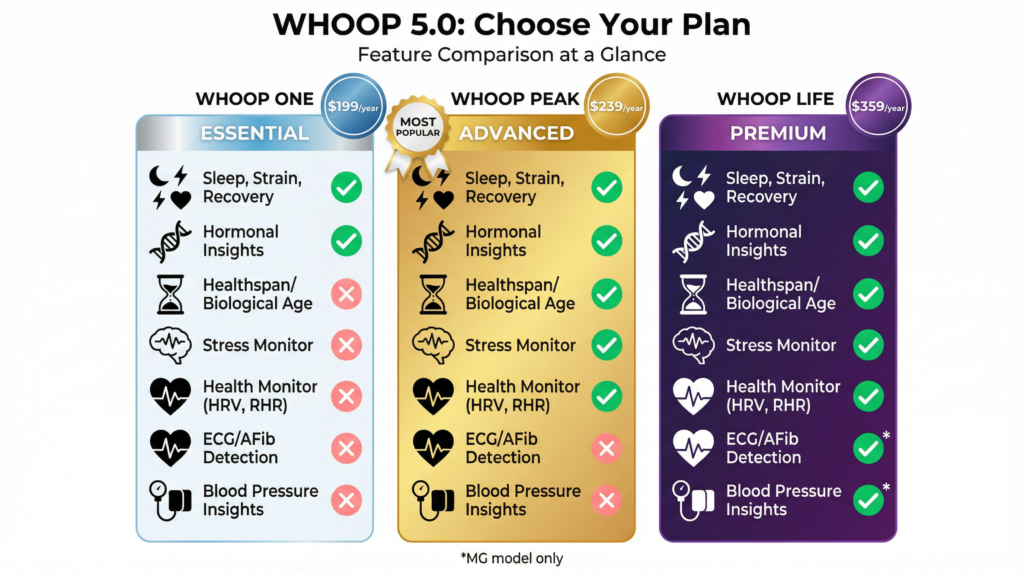
But here’s the thing that matters more than hardware specs. They restructured the entire membership system into three tiers, and what you actually get access to depends on how much you’re willing to pay annually for the Whoop 5.0.
Whoop One costs $199/year and gives you the basics. Peak is $239/year with more features.
Life is $359/year and includes the medical-grade model with ECG and blood pressure monitoring.
So you’re not just buying a tracker. You’re committing to a yearly subscription that costs as much as a decent gym membership.
Features Overview
Recovery and Strain Tracking
The core idea is simple. Whoop measures how much stress you put on your body (strain) and how well you’re recovering from that stress (recovery).
Strain comes from cardiovascular effort and physical activity. Recovery gets calculated from resting heart rate, heart rate variability, and skin temperature collected while you sleep.
You get three daily scores: Sleep, Strain, and Recovery. Each one is a percentage that tells you where you stand.
The Strain score tells you if you worked hard or took it easy. The Recovery score suggests whether your body is ready for intense training or needs a lighter day.
This is useful for everyday biohacking and performance optimization for busy adults because it removes guesswork. You’re not wondering if you should push through that workout or rest.
The data gives you a clear signal.
Healthspan and Biological Age
Version 5.0 added something called Healthspan, which estimates your biological age based on nine biomarkers, including VO2 max, time in different heart rate zones, and recovery patterns.
This addresses something people actually worry about, especially once you hit your 40s. You want to know if your training is making you younger or older relative to your actual age.
The feature shows your “pace of aging.” If you’re 45 but the data suggests you’re aging like a 50-year-old, that’s actionable information you can work with. If you’re aging slower than your chronological age, you know whatever you’re doing is working.
Whether this translates to anything clinically meaningful is debatable, but it gives you a metric to track over time.
Sleep Tracking and Sleep Debt
The Sleep Score got redesigned to focus on things you can actually control. Whoop tracks how long you slept, what stages you hit, and gives you a breakdown of why your sleep was good or terrible.
The sleep debt calculator is more useful than the score itself. It tells you nightly how many hours you need to sleep to feel fully recovered the next day.
You can log caffeine, alcohol, meals, and other variables in a sleep diary to see how they affect your rest. The app has an AI-generated sleep coach that gives specific recommendations based on your patterns.
Reviewers who tested this against Oura Ring and Withings trackers found the sleep metrics mostly aligned, which suggests the accuracy is decent.
Medical-Grade Features (Whoop MG Only)
If you subscribe to the Life tier at $359/year, you get the Whoop MG model with an ECG sensor that can detect atrial fibrillation.
It also provides daily blood pressure insights, though these are estimated ranges based on optical sensors analyzing heart rate, HRV, and blood flow patterns. They’re not as accurate as a traditional cuff and need calibration.
The ECG is valuable for screening, but doesn’t replace continuous cardiac monitoring. For someone tracking cardiovascular health trends over months and years, this adds something legitimately useful.
For most people focused on everyday biohacking and performance optimization for busy adults, the cheaper tiers probably work fine.
Hormonal Tracking
Women get detailed hormonal insights showing which phase of their cycle they’re in and how hormones are affecting sleep, strain, recovery, and overall well-being.
Reviewers have noted this is more advanced than most wearable cycle tracking, especially compared to basic calendar predictions.
Stress Monitoring
The Peak and Life tiers include a Stress Monitor that shows stress levels throughout the day and recommends guided breathwork sessions when tension spikes.
I’m not talking about achieving perfect zen. It’s about recognizing when stress is physiologically affecting your body so you can do something about it before it compounds.
| Feature | Whoop One ($199/yr) | Whoop Peak ($239/yr) | Whoop Life ($359/yr) |
| Sleep, Strain, Recovery | Yes | Yes | Yes |
| Hormonal Insights | Yes | Yes | Yes |
| Healthspan / Biological Age | No | Yes | Yes |
| Stress Monitor | No | Yes | Yes |
| Health Monitor (HRV, RHR, etc) | No | Yes | Yes |
| ECG / AFib Detection | No | No | Yes (MG model only) |
| Blood Pressure Insights | No | No | Yes (MG model only) |
Performance Analysis
Accuracy Considerations
The accuracy matters because you’re making training decisions based on this data. Whoop’s strain calculation is strong for cardiovascular metrics, but has some limitations with musculoskeletal strain from strength training.
It’s more accurate for endurance sports and activities with consistent heart rate elevation. For lifting, the strain calculation is less precise.
Wearing the band on your bicep instead of your wrist improves accuracy for many activities. Whoop sells Body Smart Apparel that lets you wear the sensor on different parts of your body.
Sleep tracking accuracy is solid and compares well to other major wearables. One reviewer found Whoop’s sleep and wake times were sometimes identical to those of other trackers worn simultaneously, though not always perfectly aligned.
That’s normal for wearable sleep tracking. Even clinical polysomnography has margins of error for certain sleep stages.
Recovery and strain calculations improve over time as the algorithm learns your personal patterns. The first week or two of data is less reliable than week four.
Real-Time Feedback Limitations
Whoop deliberately has no screen. You can’t glance at your wrist to check metrics mid-workout.
During exercise, you need your phone open to see real-time data. That’s not ideal if you want live feedback on intensity or pace.
For strength training, you manually log sets and reps, and Whoop tracks overall strain from the session.
The app underwent a redesign with the 5.0. The home screen highlights your daily Strain, Recovery, Sleep, Stress, and Health Monitor scores.
Beneath that are personalized coaching plans that dynamically adjust based on your goals, like fitness boost, longevity, or weight management.
These plans actually track whether you’re meeting recommendations instead of just throwing generic advice at you.
Auto-detection of workouts improved with the new accelerometer and gyroscope. It automatically starts and stops workout logging when it detects movement patterns.
GPS tracking is available through the app if you want route mapping, and you can sync workouts from platforms like Strava.
One practical note is that Whoop 4.0 bands and accessories don’t work with the 5.0 or MG because the clasp system changed.
Pros and Cons
What Works Well
The battery life is genuinely better. Going from 5 days to 14+ days removes a major friction point.
You’re not constantly managing charging, which means you actually wear it continuously.
The processor speed improvement is noticeable. Syncing is faster, and the app feels more responsive.
The Healthspan feature brings something different to the market. Tracking biological age gives you a long-term metric beyond daily recovery scores.
The app coaching is personalized and adjusts based on actual performance. It’s not just static recommendations.
The band is comfortable and lightweight. Multiple reviewers mention forgetting they’re wearing it, which is important for 24/7 use.
What Doesn’t Work Well
The subscription model creates an ongoing cost. You’re not buying hardware once.
You’re committing to $200-$360 every year.
There’s no screen, which means you need your phone for real-time workout feedback. That’s a dealbreaker for some people.
The strain calculation is less accurate for strength training compared to cardio activities.
The blood pressure monitoring on the MG model is estimated and needs calibration with a traditional cuff. It’s not a replacement for medical-grade measurement.
If you’re someone interested in everyday biohacking and performance optimization for busy adults, but you’re not ready to commit to a yearly subscription, the cost structure makes it hard to just try it casually.
User Experience
The Screenless Design
The lack of display is polarizing. Some people love it because there are no distractions and no notifications buzzing on their wrist.
Others hate it because they want to see metrics without pulling out their phone.
The band itself is minimal. It doesn’t look like surveillance tech strapped to your arm.
It’s comfortable enough that you forget about it during sleep and daily activities.
All meaningful data lives in the companion app. That means the app quality directly affects the overall experience. Poor WiFi or app performance impacts everything.
App Interface and Coaching
The redesigned app puts key metrics front and center. You open it and immediately see whether your recovery is high enough to train hard or whether you need a lighter day.
The coaching section gives specific recommendations based on your current status. If you’re in a recovery deficit, it suggests adjusting training intensity.
If your sleep debt is accumulating, it tells you how many hours you need to get back on track.
The sleep diary lets you correlate behaviors with outcomes. You log that you had two beers and a late meal, and the app shows you how that affected your sleep quality and recovery score.
Over time, patterns emerge. You realize caffeine after 2pm consistently tanks your sleep.
Or that certain workouts boost recovery more than others.
That’s where the value shows up. The data creates a feedback loop that actually changes behavior.
Wearing Locations and Accessories
The Body Smart Apparel line lets you wear the sensor on your bicep, torso, or other locations. This matters for activities where wrist wear is uncomfortable or less accurate.
For cycling, rowing, or lifting, bicep placement often gives better data. The apparel is sold separately, which adds to the total cost.
The new clasp system is more secure than previous versions, but it also means your old accessories don’t fit. That’s annoying if you upgraded from 4.0.
Value for Money
Membership Tier Breakdown
Whoop One at $199/year includes the 5.0 band, basic charger, and core features like Sleep, Strain, Recovery, activity tracking, VO2 max, and women’s hormonal insights. You won’t get Healthspan, Stress Monitor, or detailed health monitoring.
Peak at $239/year adds Healthspan, Health Monitor with metrics like resting heart rate, HRV, skin temperature, respiratory rate, and blood oxygen, plus the Stress Monitor.
Life at $359/year is exclusive to Whoop MG and includes ECG, AFib detection, blood pressure insights, and all Peak features.
For existing Whoop 4.0 users, upgrade costs are either $49 one-time or waived if you extend your membership by one year.
Cost vs Alternatives
The subscription model compounds over time. Year one is $199-$359.
Year five is $995-$1,795 just in membership fees.
Compare that to devices you buy once. An Apple Watch costs more upfront but doesn’t have recurring fees.
Oura Ring has a lower yearly subscription.
Garmin watches cost more initially, but no subscription is required.
Many users justify Whoop’s cost by comparing it to personal training, coaching, or biohacking services. One year of membership equals maybe 2-3 sessions with a high-end trainer.
If the data actually changes your training and sleep habits in ways that improve performance, the ROI exists. If you subscribe but ignore the recommendations, you’re just paying for numbers on a screen.
Who Gets Value From This
Athletes and fitness enthusiasts obsessed with recovery metrics get clear value. If you’re already tracking many health variables and want centralized insights, Whoop consolidates that data.
Professionals doing everyday biohacking and performance optimization for busy adults who want data-driven insights into how training and sleep affect work performance will find the recovery scores useful.
People interested in biological aging metrics and comprehensive biomarker tracking over time benefit from the long-term trend data.
If you’re someone who struggles with knowing when to push hard versus when to rest, the daily Recovery score removes guesswork.
Who Shouldn’t Bother
Casual fitness trackers who just want step counts and basic activity logging can get that from cheaper devices. Whoop deliberately doesn’t focus on steps because they don’t matter for recovery.
People who want real-time workout feedback and on-screen metrics won’t like the screenless design. You need your phone, which is inconvenient during training.
Anyone skeptical of subscriptions or unwilling to commit to yearly recurring payments should look elsewhere.
If you need built-in GPS for running and cycling route mapping, Whoop doesn’t have that. The app can use your phone’s GPS, but there’s no GPS in the band itself.
Final Verdict
What Changed With 5.0
The hardware improvements are real and meaningful. The band is smaller, lighter, and more comfortable for continuous wear.
The processor is significantly faster, which makes the app experience better.
The battery lasting 14+ days instead of 5 removes a major pain point.
The sensor collects data 26 times per second, which is a rate that gives more granular information. The wireless PowerPack option means you can go a month without thinking about charging.
The Healthspan feature brings something legitimately different by estimating biological age and the pace of aging. That gives you a long-term metric beyond daily scores.
The app redesign improved usability. The personalized coaching actually works because it adjusts based on what you’re doing, not just generic recommendations.
Whether It’s Worth The Cost
The biggest question is whether you value recovery insights enough to justify $200-$360 annually.
If you’re already investing time and money in training, sleep optimization, and recovery work, Whoop provides data that tightens the feedback loop. You know whether what you’re doing is working or not.
If you’re casually interested in fitness tracking without commitment to acting on the data, save your money. The value comes from changing behavior based on insights, not just collecting numbers.
For professionals and athletes focused on everyday biohacking and performance optimization for busy adults, the Peak tier at $239/year makes sense. You get Healthspan, Stress Monitor, and detailed health metrics without paying for medical-grade features you might not need.
The Life tier only makes sense if you specifically want ECG and blood pressure monitoring. At $359/year, that’s a significant commitment for features most people don’t require.
The Bottom Line
Whoop 5.0 is a genuinely advanced wearable designed for people who are serious about tracking recovery, sleep, and strain. It doesn’t care about step counts or burning calories. It cares whether your body is ready for hard work or needs rest.
The improvements over the 4.0 address real complaints. Better battery, faster processor, more comfortable fit, and more frequent data collection add up to a device you’ll actually wear consistently.
The subscription cost is the barrier. You need to decide if recovery data is worth the ongoing annual expense.
For someone building a protocol around performance optimization without wanting to spend hours analyzing many devices and apps, Whoop consolidates useful information into actionable daily guidance.
The band is minimal and comfortable. The app is clean and gives clear recommendations.
Battery life removes the friction that made previous versions annoying to maintain.
These aren’t minor upgrades. They’re foundational improvements that make consistent long-term use realistic.
Whoop is good at what it does. The question is whether what it does is worth $200-$360 per year to you specifically.
For the right person focused on everyday biohacking and performance optimization for busy adults who want data-backed recovery insights without complexity, the answer is yes. For everyone else, probably not.
The device itself works well. The data is accurate enough to make training decisions.
The app provides genuinely useful recommendations.
Whether you subscribe depends on how much you value having goal data telling you when to push and when to rest. For some people, that’s worth every dollar.
For others, it’s unnecessary.