Simple, science-backed tools that fit into your existing routine without requiring a full lifestyle overhaul.
The biohacking market has experienced significant growth over the past few years, with an increasing number of professionals seeking ways to enhance their cognitive performance and energy levels without requiring extensive time commitment to complex protocols. According to recent market research, the global biohacking market is expected to reach $63.77 billion by 2030, primarily driven by busy adults seeking practical solutions for improved focus and sustained energy.
If you’re dealing with afternoon energy crashes, brain fog during important meetings, or struggling to recover from demanding work weeks, there are tested tools that can help. We’ve compiled 15 evidence-based biohacking products that actual users report making a difference.
These aren’t experimental gadgets or unproven supplements.
They’re practical tools with real research behind them that fit into a normal schedule.
15 Biohacking Products for Energy and Focus
1. Continuous Glucose Monitor (Nutrisense)
A small sensor you wear on your arm that tracks your blood sugar in real-time. You’ll see exactly which foods give you stable energy and which ones cause crashes.
Most users discover surprising patterns within the first week, like how their “healthy” breakfast smoothie actually causes a blood sugar spike followed by an energy crash two hours later.
The data from a CGM removes the guesswork from your diet. Instead of following generic nutrition advice, you see your body’s actual response to different foods, meal timing, and even stress levels.
Time investment: Completely passive once you apply the sensor. It takes about 30 seconds to check your glucose trends in the app.
Setup: About 15 minutes to apply the sensor and download the app.
How easy to start: Very easy. The sensor stays on for 10-14 days, depending on the brand.
Cost: $199-$399 per month, depending on the service.
How fast you’ll see results: Most users identify their personal patterns within 7-10 days.
What users say: The most common feedback is discovering that foods they thought were healthy actually tanked their energy. Many professionals report using CGM data to improve their pre-meeting meals.
2. Smart Ring for Sleep Tracking (Oura Ring Gen 4)
These rings track your heart rate variability, body temperature, sleep stages, and recovery metrics 24/7. Unlike a smartwatch, you barely notice you’re wearing it.
The ring tells you whether your nervous system is recovered enough for a demanding day or whether you need to dial things back.
Heart rate variability is one of the most reliable indicators of stress resilience. When your HRV is high, your nervous system is balanced. When it drops, you’re either overtrained, stressed, or fighting off illness.
Time investment: Zero. Just wear it and check the app in the morning.
Setup: 5 minutes to pair with your phone.
How easy to start: Extremely easy.
Cost: $299-$549 one-time purchase, some need a monthly subscription ($5.99-$6.99).
How fast you’ll see results: You’ll get baseline data within 3-5 nights, then you can start correlating habits with your recovery scores.
What users say: Most people are surprised by how much caffeine, alcohol, and late meals impact their sleep quality and next-day readiness.
3. Red Light Therapy Panel (Hooga Red Light)
Red and near-infrared light wavelengths (660nm and 850nm) penetrate your skin and stimulate your mitochondria, the parts of your cells that produce energy. You stand in front of the panel for 10-15 minutes while getting ready in the morning or checking emails.
Research shows red light therapy improves cellular energy production, reduces inflammation, and supports skin health. Athletes use it for recovery, but professionals report better sustained mental energy throughout the day.
Time investment: 10-15 minutes daily, easily done while multitasking.
Setup: Just plug it in and position it.
How easy to start: Very straightforward.
Cost: $300-$1,200 depending on panel size.
How fast you’ll see results: Many users notice clearer energy within the first week. Cumulative benefits build over weeks.
Need to know: Position the panel 6-12 inches from your body for optimal results. Don’t look directly at the lights.
4. PEMF Mat (HealthyLine)
Pulsed Electromagnetic Field therapy sends gentle electromagnetic frequencies through your body that match natural frequencies found in nature. You lie on the mat for 20-30 minutes while it works.
Think of it as a cellular recharge session.
PEMF therapy has been studied for decades and is FDA-approved for certain medical uses. For busy professionals, it helps with energy production, nervous system regulation, and recovery from physical and mental stress.
Time investment: 20-30 minutes, but you can read, listen to podcasts, or even take work calls while using it.
Setup: Plug it in and lie down.
How easy to start: Extremely easy.
Cost: $800-$2,000 depending on features.
How fast you’ll see results: Most users report feeling more relaxed after the first session. Energy improvements typically show up within a week.
What users say: People with high-stress jobs report this helps them “reset” their nervous system in ways that regular rest doesn’t.
5. NAD+ Booster Supplement (Tru Niagen)
NAD+ is a coenzyme your cells need for energy production and DNA repair. Your levels decline significantly as you age, which contributes to fatigue and brain fog.
Supplements containing NMN or nicotinamide riboside help restore NAD+ levels.
The research on NAD+ supplementation has grown substantially. Studies show it supports cellular energy, cognitive function, and may have anti-aging benefits.
Time investment: 30 seconds to take a capsule.
Setup: None, just start taking it.
How easy to start: As easy as taking a daily vitamin.
Cost: $50-$130 per month.
How fast you’ll see results: Most people report noticing better sustained energy within 1-2 weeks.
Need to know: Take it in the morning with food. Some people report vivid dreams if taken too late in the day.
6. EEG Meditation Headband (Muse S Athena)
This headband uses EEG sensors to read your brainwave activity during meditation and gives you real-time audio feedback. When your mind wanders, the sounds change.
When you’re focused and calm, you hear peaceful weather sounds.
For people who struggle with traditional meditation or wonder if they’re “doing it right,” the Muse removes all doubt. You get goal data on your brain states and can track your progress over time.
Time investment: 10-20 minutes daily.
Setup: Download the app and pair the headband, about 5 minutes.
How easy to start: Very easy with guided sessions.
Cost: $249-$399 depending on the model, plus an optional subscription for premium content.
How fast you’ll see results: Many users report feeling noticeably calmer after their first session. Cognitive benefits compound over weeks.
What users say: Professionals who “couldn’t meditate” before finding the real-time feedback make it actually work for them.
7. Liposomal Glutathione Supplement (CYMBIOTIKA)
Glutathione is your body’s master antioxidant and detoxifier. It binds to toxins and helps eliminate them.
Regular glutathione supplements don’t absorb well, but liposomal delivery wraps the molecules in fat so they actually get into your cells.
Between environmental toxins, stress metabolites, and processed foods, your detox systems work overtime. Supporting glutathione production helps your body handle the load more efficiently.
Time investment: 30 seconds to take it.
Setup: None.
How easy to start: Just add it to your supplement routine.
Cost: $40-$80 per month.
How fast you’ll see results: Most people notice clearer thinking and better energy within a week. Some report improved skin within 2-3 weeks.
8. Creatine Monohydrate (Lineage Provisions)
Most people think creatine is only for bodybuilders. The reality is that creatine supports ATP production in your brain cells, which means better cognitive endurance during long meetings or complex problem-solving sessions.
The research on creatine for cognitive function is solid. It’s especially useful for tasks requiring sustained mental effort and may support long-term brain health.
Time investment: 30 seconds to mix 5 grams in water.
Setup: None.
How easy to start: Extremely simple.
Cost: $15-$25 per month, making it one of the cheapest interventions on this list.
How fast you’ll see results: Cognitive benefits typically show up within 1-2 weeks of daily use.
Need to know: Take it with food. Some people experience minor water retention, which is normal and harmless.
9. Infrared Sauna Blanket (HigherDOSE)
This sleeping-bag-style device delivers infrared heat that penetrates deep into your tissues. Use it for 30-45 minutes while watching TV or listening to audiobooks.
It triggers detoxification pathways, supports recovery, and helps regulate your nervous system.
For people without space or budget for a full sauna, a blanket delivers similar benefits. The deep heat helps with everything from muscle recovery to stress reduction.
Time investment: 30-45 minutes, but you’re multitasking the whole time.
Setup: Plug it in and zip yourself in.
How easy to start: Very straightforward.
Cost: $400-$600.
How fast you’ll see results: Immediate relaxation benefits. Sleep improvements typically show up within a week.
What users say: People report feeling deeply relaxed in ways that regular hot baths don’t provide.
10. Blue Light Blocking Glasses (TrueDark)
Blue light from screens suppresses melatonin production, which disrupts your sleep quality and next-day energy. These glasses filter out the specific wavelengths that interfere with your circadian rhythm.
Wearing them for 2-3 hours before bed helps your body start producing melatonin naturally. Better sleep quality translates directly to better next-day focus and energy.
Time investment: Zero. Just wear them in the evening.
Setup: Put them on.
How easy to start: Extremely easy.
Cost: $60-$100.
How fast you’ll see results: Many people notice easier sleep onset within 2-3 nights.
11. Quality Fish Oil or Algae-Based Omega-3 (Nordic Naturals)
Omega-3 fatty acids, particularly EPA and DHA, support brain cell membrane health and reduce inflammation. Your brain is about 60% fat, and omega-3s are critical structural components.
Most people don’t get enough omega-3s from diet alone. Supplementing supports cognitive function, mood regulation, and may reduce brain fog.
Time investment: 30 seconds daily.
Setup: None.
How easy to start: Add it to your morning routine.
Cost: $25-$50 per month for quality products.
How fast you’ll see results: Cognitive benefits build over 4-8 weeks of consistent use.
Need to know: Take with food to avoid a fishy aftertaste. Look for third-party tested products to avoid contaminants.
12. Essential Amino Acids Supplement (Thorne)
Amino acids are the building blocks of neurotransmitters and muscle tissue. Taking them throughout the day ensures your body has what it needs for sustained energy and cognitive function.
Unlike waiting until you’re exhausted to recover, consistent amino acid intake supports ongoing performance. This is particularly valuable during high-cognitive-demand periods.
Time investment: 30 seconds, 1-2 times per day.
Setup: None.
How easy to start: Very simple.
Cost: $50-$90 per month.
How fast you’ll see results: Most users report more stable energy within 3-5 days.
13. Standing Desk Converter (VariDesk)
Sitting all day tanks your energy and cognitive function. A standing desk converter lets you alternate between sitting and standing throughout the day without replacing your entire desk.
Research shows that alternating positions improves blood flow, reduces fatigue, and supports better focus. The key is varying your position, not standing all day.
Time investment: Zero additional time; you’re just changing position while you work.
Setup: Place it on your existing desk.
How easy to start: Immediate.
Cost: $100-$400.
How fast you’ll see results: Most people notice better afternoon energy within the first week.
What users say: The biggest benefit is avoiding the 2-3 PM energy crash that comes from sitting all day.
14. Mouth Tape for Sleep
Breathing through your mouth during sleep reduces oxygen uptake and can lead to poor sleep quality. Medical-grade mouth tape gently encourages nasal breathing throughout the night.
Nasal breathing filters air, regulates temperature and humidity, and triggers nitric oxide production that supports oxygen absorption. Better oxygen means better sleep quality and recovery.
Time investment: 10 seconds before bed.
Setup: None.
How easy to start: Extremely easy, though it feels weird at first.
Cost: $15-$30 per month.
How fast you’ll see results: Many users report waking up more refreshed within 2-3 nights.
Need to know: Start with a small piece to get used to the sensation. Make sure you can breathe comfortably through your nose before using it.
15. Cold Plunge or Ice Bath (The Cold Pod)
Cold exposure triggers a cascade of useful responses: increased norepinephrine for focus and energy, improved mitochondrial function, reduced inflammation, and enhanced mood via endorphin release.
You don’t need an expensive setup. Some people use a chest freezer conversion, while others just use their bathtub with ice.
The key is water temperature between 45-55°F for 3-10 minutes.
Time investment: 3-10 minutes, 3-5 times per week.
Setup: Ranges from immediate (bathtub + ice) to moderate (setting up a cold plunge).
How easy to start: Physically simple, mentally challenging at first.
Cost: $0-$5,000 depending on your setup.
How fast you’ll see results: Immediate energy boost. Cumulative benefits on focus and mood within 1-2 weeks.
What users say: Most people report that the mental resistance is the hardest part, but the post-plunge energy and clarity make it worth it.
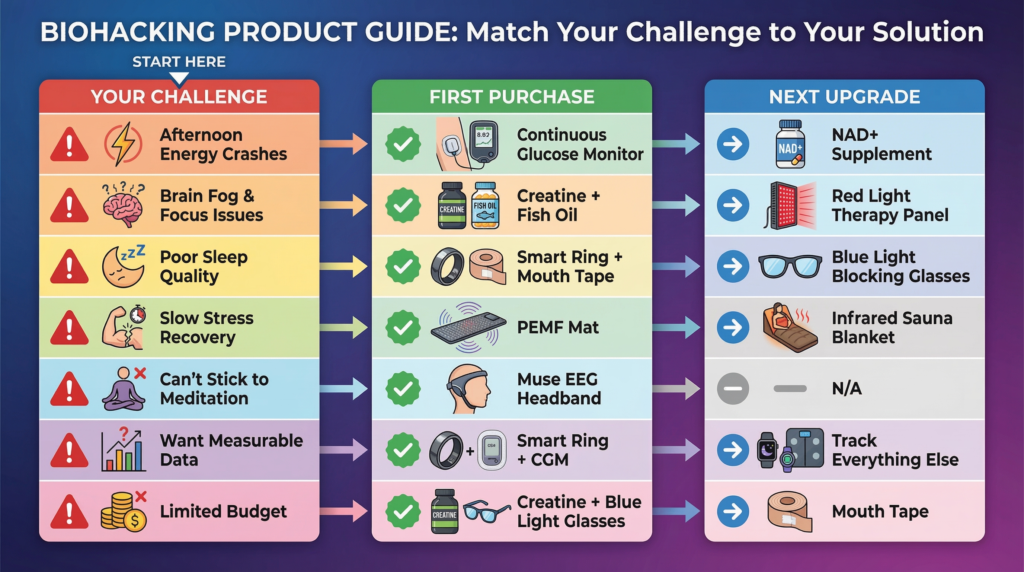
Comparison: Which Product Addresses Your Specific Need?
| Your Primary Challenge | Best First Purchase | Best Second Purchase |
| Afternoon energy crashes | Continuous Glucose Monitor | NAD+ Supplement |
| Brain fog and focus issues | Creatine + Fish Oil | Red Light Therapy Panel |
| Poor sleep quality | Smart Ring + Mouth Tape | Blue Light Blocking Glasses |
| Slow recovery from stress | PEMF Mat | Infrared Sauna Blanket |
| Can’t stick to meditation | Muse EEG Headband | N/A |
| Want measurable data | Smart Ring + CGM | Track everything else |
| Limited budget | Creatine + Blue Light Glasses | Mouth Tape |
Final Thoughts: Start with One, Build from There
The biggest mistake people make with biohacking is trying to apply everything at once. That leads to overwhelm and usually means nothing sticks.
A better approach is to identify your primary bottleneck (energy, focus, sleep, or recovery) and start with the one or two products that directly address that issue.
Use the product consistently for at least four weeks while tracking how you feel. If you’re using a smart ring or CGM, you’ll have goal data on whether it’s working.
If you’re using supplements or devices without tracking, keep a simple journal noting your energy levels, focus quality, and sleep.
Once you’ve established one habit and seen results, add the next piece. This systematic approach helps you understand what actually works for your biology instead of blindly following someone else’s protocol.
For most busy professionals, the sweet spot is everyday biohacking and performance optimization for busy adults that requires less than 60 minutes total daily investment, most of it passive or multitasked. A continuous glucose watch teaches you how to eat for stable energy without taking any additional time. A PEMF mat works while you’re listening to podcasts.
Blue light glasses are just something you wear.
Red light therapy happens while you’re checking email.
The products on this list aren’t about perfection. They’re about practical, measurable improvements that compound over time.
Your cognitive edge comes from consistently using tools that fit seamlessly into your existing routine, not from following complicated protocols that need lifestyle upheaval.
Start with whatever addresses your biggest pain point. Track your results.
Build from there.
That’s the sustainable path to optimized energy and focus that actually works long-term.
Ready to start? The most popular starting point for busy professionals is pairing a continuous glucose watch with a smart ring. Together, they reveal exactly how your food choices, sleep quality, and stress levels impact your energy and recovery.
Get started with Nutrisense CGM here
Frequently Asked Questions
How much should I expect to spend monthly on biohacking?
The range varies dramatically based on your priorities. A minimal budget approach (creatine, mouth tape, blue light glasses) runs about $40-60 monthly after initial purchases.
A moderate approach with tracking tools (CGM, smart ring, core supplements) runs $200-300 monthly.
An intensive approach with devices and comprehensive supplementation can reach $400-600 monthly. Most professionals find the moderate approach offers the best return on investment.
How long does it take to see results from biohacking?
This depends entirely on what you’re using. Some interventions, like cold plunges or red light therapy, provide immediate feedback.
You feel different within minutes to hours.
Others like NAD+ supplements or consistent meditation typically show results within 1-2 weeks. Foundational changes like improved sleep quality might take 2-4 weeks to fully manifest.
The key is consistent use and actually measuring your results instead of just going by how you feel.
Can I mix multiple biohacks or should I start with one at a time?
If you’re new to biohacking, start with one or two interventions that address your primary bottleneck. This helps you understand what’s actually working.
Once you’ve established those habits and seen results, you can add complementary tools.
For example, pairing a CGM with a smart ring makes sense because they track different but related metrics. Adding a PEMF mat and red light therapy together works because they both support cellular energy.
Just avoid trying to apply ten new things simultaneously.
Are expensive biohacking devices worth it compared to basic interventions?
This comes down to what you’re trying to improve and how much you value convenience and data. Basic interventions like creatine supplementation, proper sleep hygiene, and stress management are incredibly effective and cost almost nothing.
Devices like CGMs and smart rings provide data that helps you improve those basics more effectively.
Expensive tools like PEMF mats or quality red light panels offer benefits that are harder to copy cheaply. For most people, starting with tracking tools (to understand your baseline) plus targeted supplements offers the best cost-to-benefit ratio.
How do I know if a biohacking product is actually working?
Track goal metrics whenever possible. Smart rings provide HRV, sleep stages, and recovery scores.
CGMs show your glucose patterns.
Keep a simple journal tracking energy levels (1-10 scale), focus quality during work sessions, and sleep quality. Take notes before starting a new intervention, then track for 4 weeks.
If the numbers improve or you consistently feel better, it’s working.
If nothing changes after a month of consistent use, try something else. The key is measuring, as opposed to just hoping something works.
Is biohacking safe for people with medical conditions?
Many biohacking tools are safe for healthy adults, but you should ask your doctor before starting if you have medical conditions or take medications. This is particularly important for supplements (which can interact with medications), cold plunges (which affect cardiovascular function), or anything that influences blood sugar, sleep, or stress hormones.
Most tracking devices are safe for everyone, but interventions that actively change your physiology should be discussed with a healthcare provider first.
What’s the difference between biohacking and just living healthily?
Healthy living focuses on general wellness principles: eat well, exercise, sleep enough, and manage stress. Biohacking takes a more targeted, data-driven approach to improve specific aspects of performance.
Instead of just “eating healthy,” you use a CGM to see exactly which foods work for your metabolism.
Instead of just “getting exercise,” you track HRV to know when to push hard and when to recover. Biohacking is about precision and measurement as opposed to following general guidelines.
That said, you can’t biohack your way out of terrible baseline habits.
The fundamentals still matter.