
Optimization has taken over. Silicon Valley executives track every biomarker.
Regular professionals wear sleep rings.
Everyone wants to push their biology beyond factory settings.
Biohacking isn’t one unified practice, though. Three distinct approaches exist, all sharing the same goal of making your body and mind work better than they now do.
One person tells you to fast for three days. Another swears by a $400 ring that tracks sleep.
Someone else freezes themselves in ice baths at 6 AM.
They’re all technically biohacking, but they operate in completely different domains with different risk profiles, costs, and time commitments.
Understanding that biohacking breaks into three main areas changed everything for me. It transformed what felt like an overwhelming mess of contradictory advice into a clear framework I could actually use.
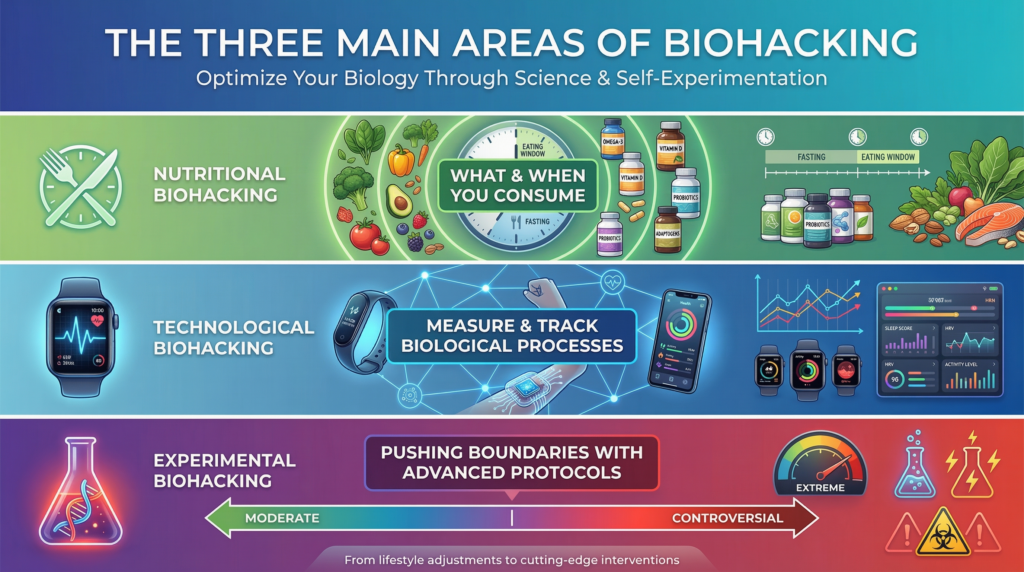
Nutritional biohacking focuses on what you consume and when you consume it. Technological biohacking utilizes devices and diagnostics to measure and track biological processes.
Experimental biohacking pushes boundaries with advanced protocols that range from moderately intense to downright controversial.
Each area offers distinct advantages depending on your goals, resources, and tolerance for risk. More importantly, understanding these categories helps you avoid the biggest mistake most people make: trying to do everything at once and burning out within weeks.
Understanding the Three Core Domains
These three areas matter because they represent fundamentally different approaches to the same problem. Your biology operates according to principles you inherited from ancestors who lived in vastly different environments than you do now.
Your genes expect certain inputs. Nutrient scarcity followed by abundance.
Physical challenges.
Temperature variations. Periods of rest.
Modern life provides none of these in the patterns your body expects.
Biohacking tries to recreate or simulate the environmental conditions your biology evolved to handle. You can approach this from different angles, though.
Nutritional Biohacking Works from the Inside Out
Nutritional biohacking manipulates what enters your digestive system to trigger specific biological responses. This area has the strongest evidence base because humans have been experimenting with diet for thousands of years.
Every traditional culture developed specific eating patterns that worked within its environment. What’s different now is that we can measure the effects with unprecedented precision.
I started here because it required the least financial investment. You’re eating anyway, so why not eat strategically?
The first major shift came when I implemented time-restricted eating, compressing my eating window from the typical 14-16 hours down to 8 hours. Within two weeks, my afternoon energy crashes disappeared. My morning mental clarity improved noticeably.
These weren’t placebo effects.
I tracked my glucose levels with a continuous glucose monitor and watched my blood sugar stabilize in ways it never had before.
The nutrigenomic aspect really opened my eyes. I got my DNA analyzed through a service that examines how specific genetic variants affect nutrient metabolism.
Turns out, I have a genetic variant that significantly impairs my ability to process saturated fats efficiently.
For years, I’d been following high-fat ketogenic diets that influencers promoted, wondering why I never got the promised mental clarity. My genetics explained it.
What worked brilliantly for someone else was actually working against my particular biology.
This is where nutritional biohacking gets really powerful. Instead of following generic dietary advice, you can target interventions based on your actual genetic makeup, current biomarkers, and specific goals.
Someone with insulin resistance needs different macronutrient ratios than someone with optimal metabolic health. Someone with MTHFR gene variants needs methylated B vitamins, not the standard forms.
The gut microbiome component adds another layer. I did a comprehensive stool analysis that revealed I had very low levels of Akkermansia muciniphila, a useful bacterium associated with metabolic health and weight management.
Armed with this information, I added specific prebiotic fibers and polyphenols that preferentially feed this species.
Within three months, follow-up testing showed significant population increases, and my inflammatory markers dropped noticeably.
Supplement protocols fall here, too, but are done intelligently. The shotgun approach of taking 20 supplements because some podcast guest mentioned them wastes money and potentially creates imbalances.
I get comprehensive bloodwork done twice yearly, testing around 45 biomarkers. This reveals actual deficiencies as opposed to imagined ones.
The last panel showed my vitamin D was at 28 ng/mL, well below optimal.
I implemented a loading protocol with 10,000 IU daily for eight weeks, then retested. Levels came up to 52 ng/mL, and my recovery metrics improved measurably.
You’re eating many times daily regardless. Making strategic choices about what, when, and how much you eat costs nothing extra but delivers massive returns.
The personalization possible through genetic testing, microbiome analysis, and continuous glucose monitoring changes nutrition from guesswork into precision medicine.
Technological Biohacking Measures Your Outputs with Increasing Precision
Instead of changing inputs, technological biohacking measures outputs. This area has exploded in the past five years as sensor technology became miniaturized and affordable.
I resisted wearables for a long time. It seemed unnecessarily obsessive to track every metric.
But the data completely changed my behavior in ways I never anticipated.
I started with a basic fitness tracker, then graduated to an Oura Ring, which tracks sleep architecture, heart rate variability, body temperature trends, and respiratory rate continuously.
The insights were genuinely surprising. I uncovered that alcohol, even a single glass of wine with dinner, absolutely decimated my sleep quality.
My deep sleep dropped by 30-40% on nights I drank, and my heart rate variability plummeted.
Seeing this goal data made it easy to cut alcohol almost entirely. I’d attempted this many times based on general health advice but never stuck with it because I couldn’t feel the difference clearly.
The data made it undeniable.
The ring also revealed that my body temperature dropped significantly on nights following intense workouts, indicating my nervous system was struggling to recover. This prompted me to restructure my training, adding more recovery days and reducing workout intensity on days when my readiness score was low.
Within a month, my overall performance improved because I was training smarter, not just harder.
Continuous glucose monitoring opened another dimension. I wore a CGM for three months, not because I’m diabetic, but because I wanted to understand exactly how different foods affected my blood sugar.
The results shocked me. Supposedly healthy foods like overnight oats spiked my glucose to 140 mg/dL, while meals I thought were indulgent like salmon with avocado and vegetables barely moved the needle.
I uncovered that eating carbohydrates after strength training produced dramatically different glucose responses than eating them first thing in the morning. My body handled a sweet potato perfectly fine post-workout but struggled with it at breakfast.
This level of personalization is impossible without measurement technology.
Advanced diagnostics represent the higher end of technological biohacking. I invested in a full-body MRI scan, which uses low-radiation imaging to detect potential issues before symptoms appear.
It’s not cheap, and it’s not necessary for everyone, but given my family history of cardiovascular disease, I wanted baseline data.
The scan revealed mild arterial calcification in my coronary arteries. Nothing immediately concerning, but enough to motivate aggressive prevention strategies.
This kind of early detection is the real promise of technological biohacking.
Most diseases are far easier to prevent or reverse in early stages than to treat once they’re advanced. Waiting until symptoms appear means you’re already behind.
Genetic testing extends beyond nutrition into disease risk assessment. Learning that I carry genetic variants associated with higher inflammation pushed me to prioritize anti-inflammatory protocols more aggressively than I might have otherwise.
Knowing I have favorable variants for power-based athletics, but poor endurance genetics helped me structure training appropriately.
The key with technological biohacking is using data to drive decisions, not just accumulating metrics for their own sake. Every measurement should lead to actionable insights.
If you’re tracking heart rate variability but not adjusting your behavior based on the readings, you’re just generating noise.
Experimental Biohacking Pushes Your Biology into Adaptive Stress Responses
This area includes interventions that push your biology into adaptive stress responses or use cutting-edge techniques that lack extensive long-term human studies.
Cold exposure was my entry point. I started with cold showers, which were absolutely miserable for the first two weeks.
The discomfort was real and significant.
But I stuck with it because the theoretical benefits seemed worth exploring. Improved mitochondrial density.
Brown fat activation.
Enhanced immune function. Mental resilience.
After a month, something shifted. The cold became less punishing and more invigorating. My resting heart rate dropped by five beats per minute.
My subjective stress resilience improved noticeably.
I handled difficult situations at work with more composure than before.
Whether this was a physiological adaptation or psychological conditioning probably doesn’t matter. The effect was real.
I eventually progressed to ice baths, spending 3-5 minutes in 45-degree water several times weekly. The acute stress triggers a massive release of norepinephrine, creating a state of focused alertness that lasts for hours afterward.
I schedule ice baths before cognitively demanding work when possible.
The research on deliberate cold exposure is actually quite robust at this point. Studies show consistent improvements in metabolic markers, inflammation reduction, and mood enhancement.
But it needs consistent practice and isn’t pleasant, which is why it falls into the experimental category as opposed to nutritional or technological.
Heat exposure through sauna use offers complementary benefits. I use a dry sauna at 180-190 degrees Fahrenheit for 20-minute sessions three times weekly.
The cardiovascular conditioning is substantial.
Your heart rate elevates to levels comparable with moderate exercise.
Heat shock proteins get activated, which help with cellular repair and protein folding. Growth hormone release increases significantly during and after sauna sessions.
The combination of hot and cold exposure, which some call contrast therapy, creates hormetic stress. Your body adapts by becoming more resilient to stressors generally.
This principle underlies much of experimental biohacking: exposing yourself to manageable stress forces adaptation.
Extended fasting protocols fall here, too. While intermittent fasting is relatively mainstream now, multi-day water fasts remain experimental.
I’ve done several 72-hour fasts, and the experience is genuinely profound.
The first 36 hours are challenging as your body transitions fully into ketosis. But once you’re past that threshold, mental clarity becomes exceptional.
Your senses sharpen noticeably.
There’s an almost euphoric quality to the mental state.
The autophagy activation during extended fasts is well-documented. Your cells begin recycling damaged components, clearing out cellular debris, and optimizing function. Whether the benefits justify the discomfort depends on your goals and perspective.
I find quarterly extended fasts valuable, but many people achieve similar benefits with less aggressive intermittent fasting protocols.
Nootropic experimentation represents another subset. I’ve tested various cognitive enhancers, from relatively benign compounds like L-theanine and caffeine combinations to more aggressive racetams and peptides.
The effects vary dramatically between people, which is why this area needs careful self-experimentation.
I found that moderate doses of nicotine (without tobacco), delivered via patches or lozenges, significantly enhanced focus and cognitive performance. Nicotine is actually neuroprotective and improves acetylcholine signaling when used without the harmful delivery mechanism of smoking.
But the addiction potential is real, so I only use it sparingly for specific high-demand cognitive tasks.
The most controversial experimental biohacking involves genetic modification and implantable technology. CRISPR-based genetic editing is technically available through underground communities, though the safety profile is completely uncertain. Some biohackers have implanted RFID chips or magnets into their fingertips to interface with technology differently.
I haven’t ventured into these extremes, primarily because the risk-benefit ratio seems unfavorable given current knowledge. But the grinder biohacking community pushes boundaries that mainstream medicine won’t touch, sometimes with interesting results and sometimes with predictable disasters.
Implementing a Multi-Domain Strategy
The real magic happens when you strategically mix elements from all three areas. Pure nutritional biohacking gives you control over inputs but lacks measurement precision.
Pure technological biohacking generates data without necessarily changing anything.
Pure experimental biohacking pushes boundaries but can be reckless without foundational optimization.
My current protocol integrates all three domains thoughtfully. The nutritional foundation includes time-restricted eating with an 8-hour feeding window, personalized macronutrient ratios based on genetic testing, targeted supplementation guided by bloodwork, and a focus on nutrient density and gut health.
This creates the baseline.
The technological layer provides feedback loops. I track sleep quality, heart rate variability, and readiness daily through my Oura Ring.
I use continuous glucose monitoring for one month per quarter to recalibrate my nutrition based on current metabolic health.
I get comprehensive bloodwork twice yearly to catch any developing issues. This measurement infrastructure tells me whether my interventions are working.
The experimental components add adaptive challenges. Cold plunges three times weekly.
Sauna sessions three times weekly.
One extended fast per quarter. Zone 2 cardiovascular training for metabolic flexibility.
These create positive stressors that drive adaptation.
The key is implementing changes sequentially, not simultaneously. When I started, I made the mistake of changing everything at once.
New diet.
New supplements. New workout routine.
Cold showers.
Many tracking devices. It was completely overwhelming, and I had no idea which interventions actually moved the needle.
Now I change one variable at a time, measure it for at least four weeks, and assess the impact before adding the next intervention. This systematic approach provides clarity about what actually works for your particular biology versus what’s just noise.
Common Mistakes and How to Avoid Them
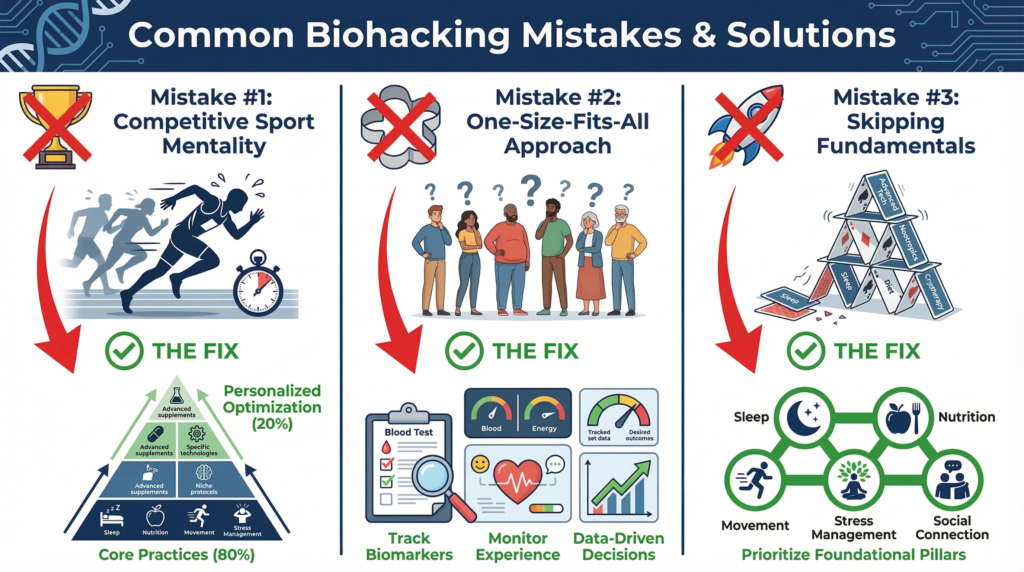
The biggest error is treating biohacking as a competitive sport. Social media amplifies this tendency.
People post their stacks of 30 supplements, their 5 AM ice bath routines, their perfectly optimized biomarkers.
This creates pressure to do more, track more, and improve more.
But optimization has diminishing returns. The first few interventions deliver massive benefits.
Fixing sleep.
Improving diet quality. Managing stress.
Going from sleeping six hours to eight hours improves your life dramatically.
Optimizing your sleep from eight hours to 8.2 hours of perfect sleep architecture probably matters less than the effort required.
I spent a year obsessively tracking every metric, adjusting protocols constantly, trying to squeeze out marginal gains. My HRV improved by three points.
My deep sleep increased by eight minutes.
These improvements were real, but the time and mental energy invested probably weren’t justified by the returns.
The healthier approach is establishing foundational practices that deliver 80% of the benefits, then selectively optimizing specific areas based on your unique constraints and goals. You don’t need to do everything.
Another common mistake is ignoring individual variation. Biohacking content tends to present interventions as universally useful.
But genetic differences, epigenetic factors, current health status, stress levels, sleep quality, and dozens of other variables mean that what works brilliantly for one person might be neutral or even counterproductive for another.
Ketogenic diets produce remarkable results for some people and make others feel absolutely terrible. Intermittent fasting improves metabolic markers for many people but disrupts hormones for others, particularly women with certain hormone profiles.
High-intensity interval training improves cardiovascular health for some people and overtaxes the stress response system for others.
This is why measurement matters so much. Your subjective experience, combined with goal biomarkers, tells you whether an intervention works for you specifically, regardless of what it did for someone else.
The third major error is neglecting the fundamentals while pursuing advanced optimization. I’ve watched people spend thousands of dollars on peptides, stem cell therapies, and hyperbaric oxygen while sleeping five hours nightly, eating processed food, and sitting all day.
It’s like putting premium fuel in a car that needs an engine overhaul.
Sleep quality, nutrition, movement, stress management, and social connection deliver far more benefit than any advanced intervention. If these fundamentals aren’t solid, exotic biohacks won’t save you.
People Also Asked
What is biohacking for beginners?
Biohacking for beginners starts with tracking your current baseline and making one simple change at a time. Download a free sleep tracking app and watch your sleep for two weeks without changing anything.
Then adjust one variable, like setting a consistent bedtime or reducing screen time an hour before sleep.
Track the results for 30 days before adding another change. Most beginners get excellent results from basic interventions like time-restricted eating, consistent sleep schedules, and daily movement before investing in expensive devices or supplements.
How much does biohacking cost?
Biohacking costs range from completely free to thousands of dollars monthly, depending on your approach. You can implement intermittent fasting, improve sleep hygiene, and add basic strength training without spending anything beyond your normal food budget.
Mid-range biohacking with basic wearables and quarterly bloodwork runs about $100-300 monthly.
Advanced protocols with continuous glucose watches, comprehensive genetic testing, full-body scans, and specialized supplements can easily exceed $1,000 monthly. Start with free or low-cost interventions and upgrade only when the data justifies the investment.
Does intermittent fasting work for everyone?
Intermittent fasting works well for many people, but definitely not everyone. Women with certain hormone profiles, particularly those dealing with thyroid issues or hormonal imbalances, sometimes experience negative effects like disrupted menstrual cycles or increased cortisol.
People with a history of eating disorders should avoid intermittent fasting entirely.
The only way to know if it works for you is to try a conservative approach like a 12-hour overnight fast, track your energy levels and biomarkers, and adjust based on your individual response as opposed to following what worked for someone else.
What is a continuous glucose watch used for in biohacking?
A continuous glucose watch in biohacking shows you exactly how different foods, meal timing, exercise, and sleep affect your blood sugar in real time. Most people are shocked to discover that supposedly healthy foods spike their glucose significantly, while foods they thought were indulgent cause minimal disruption.
The data reveals your personal carbohydrate tolerance, optimal meal timing around workouts, and which food combinations keep your blood sugar stable.
This information allows you to personalize your nutrition based on your actual metabolic response as opposed to generic dietary guidelines.
How does cold exposure improve health?
Cold exposure improves health through several mechanisms. It activates brown adipose tissue, which burns calories to generate heat and improves metabolic health.
Regular cold exposure increases norepinephrine levels, enhancing focus and mood while reducing inflammation.
Cold stress also triggers improved mitochondrial density, meaning your cells become more efficient at producing energy. The cardiovascular system adapts by improving circulation and blood flow.
Many people also report increased mental resilience and stress tolerance that extends beyond the cold exposure itself into daily life challenges.
What supplements should I take for biohacking?
The supplements you should take depend entirely on your individual deficiencies revealed through comprehensive bloodwork. Generic supplement stacks waste money and potentially create imbalances.
Get testing that includes vitamin D, B vitamins, magnesium, omega-3 index, and iron levels at a minimum.
Supplement only what your labs show you actually need. Most people benefit from vitamin D optimization, magnesium, and omega-3s, but the specific doses should match your current levels and goals as opposed to following someone else’s protocol that worked for their unique biology.
Is heart rate variability important for tracking health?
Heart rate variability is one of the most valuable metrics for tracking your nervous system balance and recovery status. Higher HRV generally indicates better cardiovascular fitness and stress resilience, while declining HRV often signals overtraining, illness, poor sleep, or excessive stress before you consciously feel the effects.
Tracking HRV daily helps you adjust training intensity, recovery protocols, and stress management strategies proactively.
The absolute number matters less than your personal trends over time, so consistent measurement creates a feedback loop that guides daily decisions about when to push hard and when to prioritize recovery.